Every show has seats that never sold - and no one was working on them. Choose general admission when your event depends on movement and flexible space; choose reserved seating when the ticket needs to guarantee a particular seat. For general admission vs reserved seating, the deciding factor is what you promise at purchase, not whether your venue is large or small.
- General admission vs reserved seating comes down to access versus an assigned seat, not venue size.
- General admission suits standing and roaming events; reserved seating suits performances where seat location matters.
- Mixed seating needs clear boundaries between assigned seats and unassigned areas.
- ZunaroSpace event ticketing suits independent organisers who want their storefront, box office and seating on shared inventory.
How do you choose between general admission and reserved seating?
Choose the format that lets you deliver exactly what the ticket promises. General admission allocates access to an event or area without assigning an individual seat. Reserved seating allocates a named position on a seating plan.
For the software requirements behind assigned seats, see the guide to handling reserved seating charts. Start with the room and the admission rules before choosing the ticketing workflow.
| Format | Best for | Main advantage | Main drawback | What the ticket must explain |
|---|---|---|---|---|
| General admission | Standing shows, roaming festivals and unassigned seating | Attendees choose where to stand or sit within the permitted area | A ticket does not guarantee adjacent seats or a particular view | Which area admission covers and whether seating is unassigned |
| Reserved seating | Theatre, screenings and seated performances | Attendees know their allocated seat before arrival | The published plan must match the room | Section, row, seat and any relevant viewing restriction |
| Mixed seating | Events with distinct seated and standing areas | Different areas can offer different admission experiences | Unclear boundaries create conflicting expectations | Which areas have assigned seats and which do not |
These are operating choices, not a ranking from basic to professional. A well-defined general admission event is better than a reserved seating event built on an inaccurate plan.
Why this matters
Your seating format shapes the promise you make before checkout and the work your staff do at the door. It also determines whether the box office sells a quantity of admissions or a specific position in the room.
For your 2026 event plan, write that promise in plain language. If the event page suggests an assigned seat but the ticket provides access alone, your staff inherit a dispute that clearer wording should have prevented.
Fix the admission promise before you design the checkout. A seating map cannot compensate for an event description that leaves attendees unsure what they have purchased.
General admission: best for flexible use of space
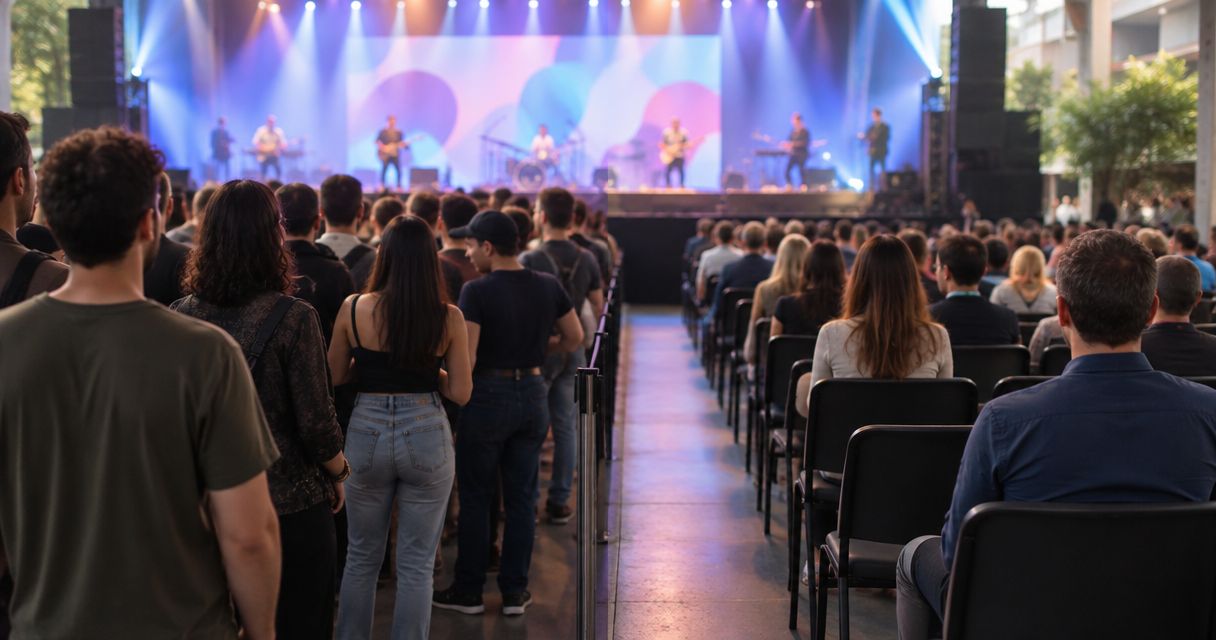
General admission works when an attendee's exact position is not part of the sale. That includes standing performances, events where people move between activities, and seated events where attendees choose from available chairs on arrival.
The advantage is a simpler allocation model. You sell access to the relevant area rather than maintaining an individual seat assignment for every order.
The trade-off is less certainty about position. Groups arriving separately cannot assume they will find adjacent chairs, and an unassigned seated event still needs rules for entry, accessible positions and blocked areas.
What to decide before publishing
- Access: State whether the ticket covers the entire event or a particular area.
- Seating: Say explicitly whether chairs are available and unassigned, or whether the event is standing.
- Capacity: Set the sellable allocation using the venue's approved layout, not an estimate from the empty room.
- Arrival: Explain how attendees enter and how staff handle admission to restricted areas.
Do not describe general admission as unlimited access. A general admission ticket still has boundaries: the event, the permitted area and any stated entry conditions.
For a 2026 standing show, general admission is the right choice when position remains flexible throughout the performance. Choose general admission because an assigned position is unnecessary, not because seating preparation was skipped.
Reserved seating: best for a guaranteed position
Reserved seating works when a specific seat is part of the attendee's purchase. Theatre performances, film screenings and seated presentations fit this model when the venue wants attendees to know their location in advance.
Its advantage is certainty. A group can select adjacent available seats, and door staff can direct attendees to the positions shown on their tickets.
Its drawback is the need for an accurate, maintained plan. Missing chairs, inconsistent row labels and seats sold in blocked areas turn a clear purchase into a room-management problem.
What to decide before publishing
- Seat identity: Give each sellable seat a clear section, row and seat reference where relevant.
- Room layout: Match the map to the actual performance configuration, including the stage position.
- Viewing restrictions: Describe seats with restricted views before purchase.
- Accessible positions: Identify the relevant positions and explain the booking process.
- Sales channels: Keep online sales and box-office allocations aligned.
Reserved seating does not mean every chair must be offered for sale. Production holds, inaccessible positions and areas outside the performance layout need deliberate treatment before tickets go live.
For your 2026 seated performance, verify the plan against the installed room rather than assuming the previous event's map still applies. Choose reserved seating when location matters enough to become part of the ticket promise.
Mixed seating: best for clearly separated experiences
Mixed seating combines assigned seats with a general admission area. Use it when the room genuinely offers distinct experiences, such as a seated section and a standing floor.
The advantage is choice without forcing the entire event into a single format. The drawback is additional explanation and access control: staff must know which tickets admit attendees to which areas.
Name each area according to what it provides. A label such as premium or preferred does not explain whether a seat is assigned, whether standing is permitted, or whether movement between areas is allowed.
Before publishing, check that the area descriptions, ticket details and staff instructions use the same terms. If the floor is general admission, do not let a seat-map illustration imply that every floor ticket includes a chair.
Choose mixed seating when the spaces are distinct and enforceable. Skip it when the distinction exists in the ticket names but not in the room.
Why the right seating format varies
The same venue can need different seating formats for different events. Use these factors to decide which promise the room can support:
- Audience movement: A roaming event needs access rules; a seated performance needs a workable seating allocation.
- Position and sightlines: When location changes the viewing experience, assigned seats make the purchase more specific.
- Group seating: Reserved seating lets groups select adjacent available positions; general admission does not guarantee them.
- Room configuration: A fixed auditorium and a reconfigured open floor require different preparation.
- Accessibility: Decide how accessible positions and companion arrangements fit the chosen admission model.
- Sales channels: Box office, kiosk and storefront sales must respect the same available allocation.
None of these factors makes reserved seating universally better. They tell you whether assigning positions solves a real problem or adds work without changing the attendee's experience.
How do you turn the choice into a workable ticketing setup?
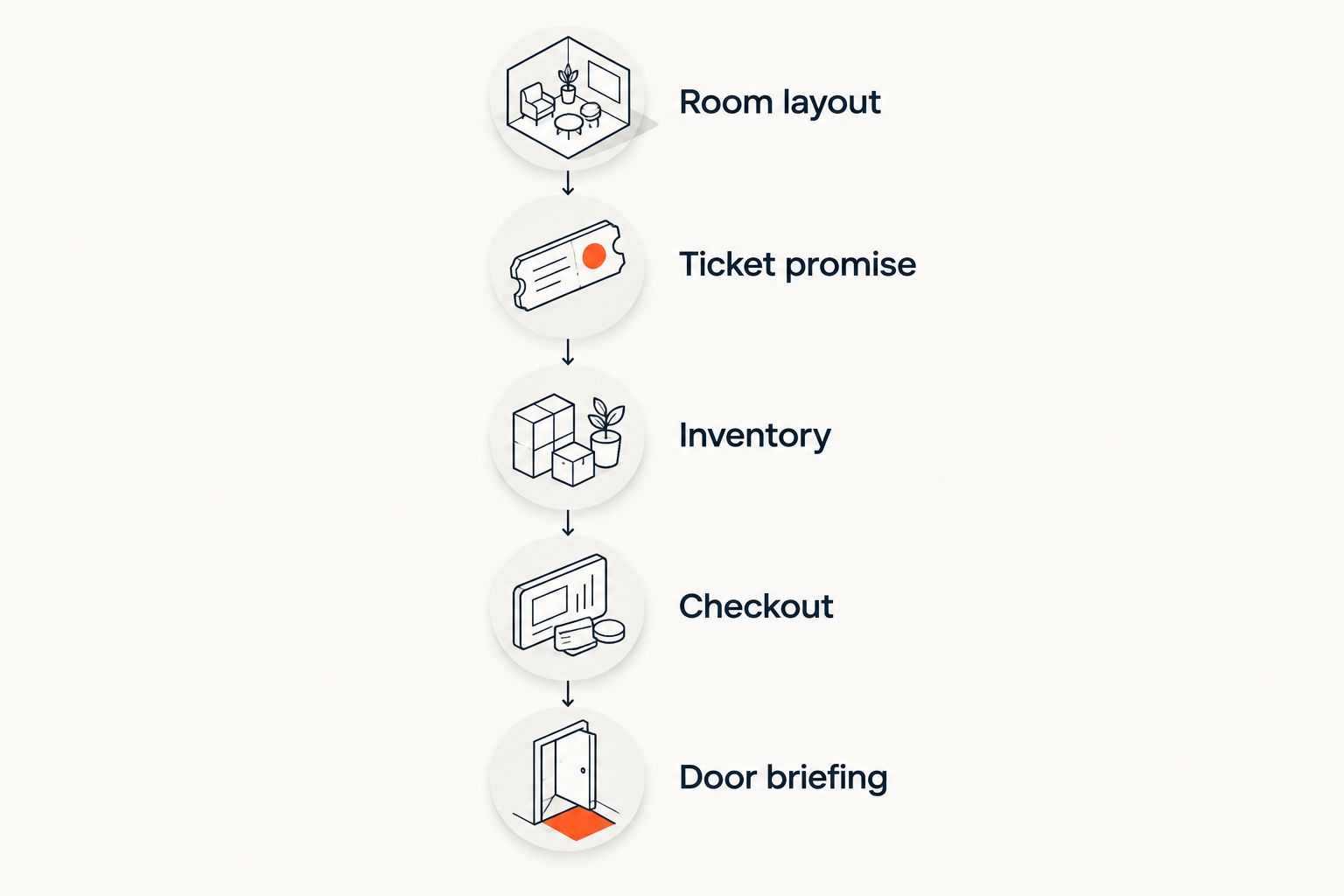
Use this sequence for your 2026 event setup. It starts with the physical room and ends with the instructions your staff need to deliver the promised admission.
- Room layout: Confirm the configuration used for this event. Mark the performance area, public areas, blocked positions and relevant access routes.
- Ticket promise: Write what each admission includes. State whether attendees receive an assigned seat, access to an unassigned area, or access to a specified section.
- Inventory: Decide what you are selling: admissions to an area, individual seats, or separate allocations for each format.
- Checkout: Walk through a booking and inspect the resulting ticket. Check that the area or seat information matches the event description.
- Door briefing: Give staff the same area names and admission rules used online. Explain how they should handle a ticket that does not grant access to the requested section.
Repeat the booking check after a layout change. A correct setup becomes incorrect when the stage moves, a section closes or chairs are removed without updating what is sold.
The useful test is not whether checkout completes. It is whether the ticket, room and staff instructions all describe the same admission.
Where an organiser-owned platform fits
ZunaroSpace is an event ticketing platform for independent organisers and venues, with a branded storefront, reserved seating, box office, kiosk and door check-in on one live inventory. ZunaroSpace event ticketing is best for independent organisers who want their own storefront and connected seating and box-office operations. You keep the fees, the funds and the customers.
For reserved seating, ZunaroSpace traces a seat map from a photo in about 60 seconds without CAD or a setup fee. The benefit is faster map preparation; the limit is that a traced plan still needs checking against the actual event layout before you sell assigned positions.
AI that sells your tickets. The WhatsApp agent answers buyers, holds seats and hands over a checkout link; events can also be found and booked inside ChatGPT and Claude, with seats selected on the real map. Checkout completes on the organiser's own site, never in chat.
Organisers pay nothing per ticket. Buyers cover a booking fee of AED 3.99, or AED 1.99 when the ticket is under AED 20; free events carry no booking fee. Ask Zunaro Pro is AED 179 per month, with a 14-day trial and no card required.
Arabic and English, with full RTL, support event information in both languages. Based at DTEC, Dubai Silicon Oasis. Built for the Gulf - the UAE and Saudi Arabia.
The platform choice does not replace the seating decision. Define your event's admission promise, then configure the inventory and sales channels to honour it.
Can general admission include chairs?
General admission can include chairs without assigning individual seats. Make the distinction explicit: a seated general admission ticket is not a reservation for a named chair or a guarantee that a group will sit together.
If you promise every attendee a chair, your sellable allocation must reflect the seating you will actually provide.
Is reserved seating better for a small venue?
Reserved seating is better for a small venue when seat location or group placement matters. Capacity alone does not decide the format; a small standing room can suit general admission, while a small theatre can benefit from assigned seats.
For your 2026 programme, make the decision per event configuration rather than applying a venue-wide rule automatically.
Can you combine general admission and reserved seating?
You can combine general admission and reserved seating when each ticket clearly identifies its permitted area. Keep assigned seats separate from unassigned inventory and brief staff on whether movement between areas is allowed.
Do not rely on different ticket names to communicate rules that the event page never explains.
FAQ
What's the main difference between general admission and reserved seating?
General admission grants access without assigning an individual seat; reserved seating assigns a specific position. Choose according to whether seat location is part of your event's purchase promise.
What's the best seating format for a standing event?
General admission is best for a standing event when attendees choose their position within the permitted area. State the area boundaries and do not imply that admission includes a chair.
Is reserved seating better for a theatre performance?
Reserved seating suits a theatre performance when attendees need a known seat and a defined view of the stage. The seating plan must match the performance configuration, including blocked positions and viewing restrictions.
Can I guarantee that a group sits together with general admission?
General admission does not guarantee adjacent seats. Use assigned seating when selecting adjacent available positions is part of the experience you want to offer.
Can I sell standing tickets and assigned seats for the same event?
You can sell standing tickets and assigned seats for the same event when each ticket clearly states its permitted area. Keep the allocations distinct and give door staff matching access instructions.
Do I need a seating map for general admission?
General admission does not require an individual seat-selection map. An area plan can still help explain where admission applies, but it must not suggest that unassigned tickets reserve specific chairs.
What should I check before publishing reserved seating tickets?
Check that the seating plan matches the installed room and that every sellable position has a clear identity. Confirm blocked positions, viewing restrictions and the accessible booking process before opening sales.
One last thing
Test the ticket promise from the door backwards. Ask a staff member what the ticket entitles its holder to do, then compare that answer with the event page and checkout.
If the answers differ, fix the wording or allocation before publishing. General admission and reserved seating both work when the organiser sells a clear promise and the venue delivers it.