Yes—you can run a loyalty programme for repeat ticket buyers by defining who qualifies, choosing a benefit, and checking eligibility against completed bookings or attendance. Start with a benefit your team can deliver consistently; automated points, member balances and redemption require specific software support, not just a ticketing checkout.
- A loyalty program ticket buyers understand needs clear eligibility, a relevant benefit and reliable booking records.
- Start with recognition or priority access; confirm delivery controls before promising rewards.
- ZunaroSpace event ticketing suits independent organisers seeking their own branded storefront and customer relationship.
- Measure repeat bookings separately from campaign-attributed revenue.
Why this matters
Every show has seats that never sold - and no one was working on them.
A loyalty programme gives your team a defined reason to reconnect with previous buyers. It does not replace a relevant event, a clear invitation or an easy booking process. Reward a relationship, not merely an email address.
For your 2026 programme, start by deciding which previous buyers belong in the audience. The guide to targeting ticket buyer segments with email campaigns covers the related campaign workflow; eligibility and reward fulfilment still need their own rules.
Can I run a loyalty programme for repeat ticket buyers?
Yes. You can manage a small programme through a documented eligibility list and staff checks, or use software that supports the specific rules you want to automate. The difference is who maintains the records and verifies each benefit.
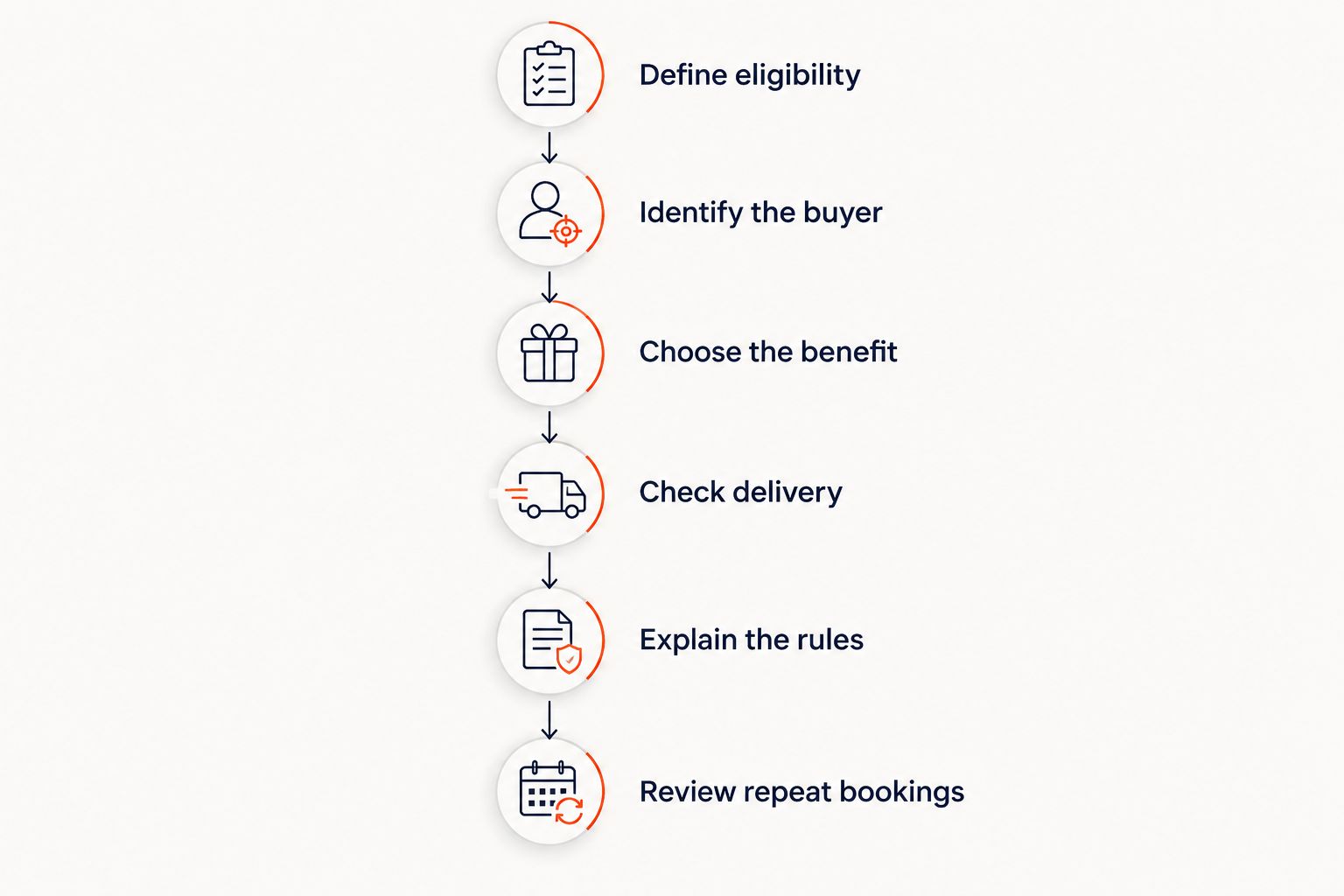
Use this sequence before announcing the programme.
Define eligibility
Decide what earns recognition: completed purchases, attended performances or an ongoing relationship with your venue. Those are different measures. A purchaser booking for colleagues is not necessarily the person who attends.
Write the qualifying condition in plain language. State whether refunded orders, complimentary tickets, transferred tickets and cancelled events count, rather than leaving staff to decide during a busy performance.
Identify the buyer
Choose how staff will match someone to their booking history. Use an existing customer record where available, and define a review process for changed email addresses or purchases made through different channels.
Do not assume a shared surname proves that bookings belong to the same person. Equally, do not merge household members automatically: purchasing history and permission to receive marketing are separate records.
Choose the benefit
Select a benefit that fits your programme and your operation. Recognition, advance access and points-based rewards place different demands on your team; the comparison below explains those trade-offs.
Make the benefit specific enough to fulfil. An invitation to an eligible presale is clearer than an undefined promise of special treatment, particularly when different staff handle the storefront and box office.
Check delivery
Test how an eligible buyer receives the benefit and how an ineligible buyer is handled. If access depends on a private link, access code or customer account, verify the actual restriction before calling it exclusive.
A forwarded email should not silently become your eligibility system. Decide whether staff must check the booking record, whether checkout enforces the rule, and how exceptions get approved.
Explain the rules
Publish understandable terms before inviting people to participate. Cover qualifying activity, benefit limits, exclusions, transfers and what happens after a refund or cancellation.
Keep the buyer-facing explanation short, with fuller terms available wherever you describe the programme. Your box office team should be able to explain the same rule without inventing an exception.
Review repeat bookings
Record who qualified, who received an invitation, who used the benefit and who booked again. Keep these stages separate so an email send does not become evidence of loyalty.
Use the results to decide whether to continue, change or stop the programme. A full mailing list is not the same as a returning audience.
Which loyalty programme should you choose?
Choose the simplest model that delivers a benefit your audience understands. Do not introduce a points balance merely because it looks more formal than a returning-buyer invitation.
These are programme designs to evaluate, not a claim that every ticketing platform provides them.
| Programme design | Best for | Advantage | Limitation |
|---|---|---|---|
| Returning-buyer recognition | Organisers testing a manageable approach | Eligibility can follow a clear booking-history rule | Manual checks require consistent records and staff decisions |
| Priority access | Venues with a regular event calendar | Gives eligible buyers an earlier booking opportunity | Requires enforceable access rules and a defined opening period |
| Points-based rewards | Operators with a reason to maintain ongoing balances | Makes earning and redemption explicit | Requires a reliable ledger, reversal rules and redemption controls |
Returning-buyer recognition
Best for: testing whether a defined audience responds to a relevant invitation. You can recognise previous attendance without creating a currency or promising a permanent entitlement.
The limitation is administration. If staff repeatedly assemble lists by hand, document the selection process so eligibility does not change depending on who prepares the campaign.
Priority access
Best for: organisers whose buyers value an earlier booking opportunity. A presale connects the benefit directly to the next event rather than to an unrelated reward.
The limitation is enforcement. Check when eligible buyers can book, when public booking begins and whether shared links bypass the intended restriction. Avoid promising preferred seats unless you have deliberately allocated and controlled them.
Points-based rewards
Best for: operators prepared to maintain a continuing rewards ledger. Points make the relationship between qualifying activity and a future benefit explicit.
They also create obligations beyond sending a campaign. Your system needs to handle earning, redemption, refunds, adjustments and buyer enquiries consistently. Do not launch points until those workflows work.
Why loyalty programme requirements vary
A theatre season and a changing festival calendar do not create the same repeat-booking opportunity. Build your 2026 rules around how your events actually operate, not around a generic retail rewards template.
The main design factors are:
- Event cadence: Buyers need another relevant event at which to use the benefit. Define what happens when your programme pauses.
- Purchaser versus attendee: Decide whether recognition follows the account that paid or the person who attended.
- Sales channels: Storefront, box office and kiosk purchases need consistent treatment if they all qualify.
- Seating: Priority access requires a clear distinction between an earlier booking opportunity and a guaranteed seat.
- Refunds and transfers: Define whether a reversed purchase removes eligibility and whether benefits move with a transferred ticket.
- Language: If you communicate in Arabic and English, keep the qualifying conditions equivalent in both versions.
These decisions belong in the programme rules. They should not emerge as separate answers from marketing, checkout support and the door team.
What should you check before launching in 2026?
Test the exceptions, not just the successful booking. A programme that works for a straightforward online purchase still needs a clear answer when a buyer changes an address or requests a refund.
Check identity and eligibility
Walk through a returning buyer using a different email address, a group booking and an order placed at the box office. Decide what evidence staff need before adding or correcting eligibility.
Avoid collecting extra personal details simply to make the programme feel more sophisticated. Collect what your documented process needs, and establish who can change the record.
Check refunds and cancellations
Decide whether eligibility depends on a booking remaining valid or on attendance taking place. Then test the consequences of a refund, partial refund, event cancellation and ticket transfer.
For points-based rewards, check both the original earning entry and any subsequent redemption. A balance that cannot be corrected consistently is not ready for public use.
Check communication permission
Treat a service message about an existing order differently from an invitation to another event. Review applicable privacy and direct-marketing requirements before adding past buyers to promotional communications.
Give your team a clear process for recording preferences and respecting opt-outs. Being eligible for a loyalty benefit does not remove a buyer's choice about receiving marketing.
Check the staff handover
Make the eligibility rule available to everyone who handles bookings. Explain who approves exceptions and how the decision is recorded.
The test is practical: can a staff member handle a returning buyer's question without asking marketing to reconstruct the entire campaign? If not, simplify the rule before launch.
How should you measure whether the programme works?
For your 2026 review, separate participation from repeat purchasing. Joining a programme, opening an email and attending another performance describe different outcomes.
Define the measures before sending invitations:
- Repeat-booking rate: The share of a defined buyer group that completes another qualifying purchase during your chosen review period.
- Benefit use: Whether eligible buyers actually claim the benefit you offered.
- Completed attendance: Whether the programme is intended to recognise attendance rather than purchases alone.
- Refunds: Whether subsequent reversals change the result you initially recorded.
- Administration: What staff must do to maintain eligibility and resolve exceptions.
Keep the audience definition and review period consistent when comparing results. Do not compare an entire season's returning buyers with a single event's campaign and call the difference programme performance.
Campaign-attributed revenue answers which campaign received credit for a booking. It does not, by itself, establish that the loyalty programme caused an additional purchase. Report attribution and repeat behaviour separately.
Where does the ticketing platform fit?
ZunaroSpace event ticketing is best for independent organisers and venues that want their own branded storefront and control of the customer relationship. Store, seating, box office, kiosk and door check-in share one live inventory.
You keep the fees, the funds and the customers.
For repeat-buyer communications, ZunaroSpace has a campaign agent that creates a blast, previews the audience and rendered email, sends a test, schedules delivery and reports attributed revenue. Check loyalty-specific requirements separately: a campaign workflow is not proof of a points ledger or automatic reward redemption.
AI that sells your tickets.
The WhatsApp agent answers buyers, holds seats and hands over a checkout link. That helps a returning buyer complete a booking; it does not replace your programme's eligibility rules. Checkout completes on the organiser's own site, never in chat.
Based at DTEC, Dubai Silicon Oasis. Built for the Gulf - the UAE and Saudi Arabia.
Do I need points to reward repeat ticket buyers?
No—you can recognise repeat buyers without maintaining points. A clearly defined returning-buyer invitation or priority-access programme avoids the need for an earning and redemption ledger.
Choose points when the ongoing balance serves a real purpose and you can support the exceptions, not because points appear more sophisticated.
Can I include box office purchases?
Yes, you can design a programme that includes box office purchases, provided your process identifies the buyer and records qualifying activity consistently. Do not assume a walk-up transaction automatically contains enough information to match an existing customer record.
Should I reward purchases or attendance?
Reward purchases when the programme recognises the person making bookings; reward attendance when participation is the intended behaviour. State which applies, particularly for group purchases and transferred tickets.
FAQ
Can I run a loyalty programme for repeat ticket buyers?
Yes. Define qualifying activity, choose a benefit and establish how staff or software will verify eligibility before launching.
What's the simplest loyalty programme for a small venue?
A documented returning-buyer recognition programme is a simple starting point. Choose a benefit your team can deliver without maintaining points balances.
Do I need separate loyalty software?
Not necessarily. A manually managed programme needs reliable records; automated earning, balances and redemption require software that explicitly supports those workflows.
Can I give repeat buyers early access to events?
Yes, if your booking process supports the access rules you intend to use. Verify eligibility checks and the transition to public booking before promising priority access.
Should refunded tickets count towards loyalty benefits?
Your published programme rules should decide whether refunded tickets count. Apply that decision consistently and explain what happens to benefits already issued.
Does ZunaroSpace provide a loyalty points ledger?
Confirm points-ledger and redemption requirements directly before building a programme around them. Its campaign agent creates blasts, previews audiences and rendered emails, sends tests, schedules delivery and reports attributed revenue.
How do I review a ticket buyer loyalty programme in 2026?
Review repeat bookings, benefit use, refunds and administration against a defined audience and review period. Keep campaign attribution separate from claims that the programme caused additional purchases.
One last thing
A repeat buyer is not always a repeat attendee. Someone booking for a family, a team or a group can appear repeatedly in purchase records without attending every performance.
Before launching your 2026 programme, write down who you want to recognise and why. That decision determines which records matter, what the benefit should be and how your staff explain it. Get that right before naming the programme.