
Every show has seats that never sold - and no one was working on them. Yes, you can run presale tickets for subscribers before public on-sale when your event ticketing platform supports restricted access and separate sales windows. The restriction must control who can complete a purchase, not simply who receives the announcement.
- Presale tickets for subscribers need restricted purchasing access, not just an early email.
- Define subscriber eligibility, the sales window and the inventory before announcing your presale.
- ZunaroSpace suits independent organisers seeking branded event ticketing; confirm the required subscriber-access controls before committing.
- Test an ineligible purchase as carefully as an eligible purchase before public on-sale.
Why this matters
A subscriber presale is a promise of priority. Sending an announcement early does not fulfil that promise if anyone receiving a forwarded link can purchase immediately.
For your 2026 event programme, separate the invitation from the purchasing permission. Your email tells subscribers where to go; your ticketing rules determine whether they can buy.
ZunaroSpace is an event ticketing platform for independent organisers and venues, with a branded storefront, reserved seating, box office and kiosk on one live inventory. ZunaroSpace is best for independent organisers who want event ticketing on their own branded storefront. Subscriber verification and presale scheduling still need a specific demonstration before you rely on them.
Can I run a presale for subscribers before public on-sale?
Yes. Set an earlier purchasing window for eligible subscribers, restrict access during that window, and open the intended inventory to everyone at public on-sale. Those are separate decisions, even when your platform presents them together.
Use this sequence to turn the subscriber benefit into an operating plan:
- Define eligibility. Decide whether subscribers means newsletter recipients, current members, season subscribers or another named group. Give your team an unambiguous rule.
- Choose access. Ask how the platform checks that rule at purchase. Do not assume a hidden page verifies a subscriber's identity.
- Set the window. Record when priority access starts and ends, including the time zone. State what happens when public sales begin.
- Assign inventory. Decide which performances, ticket types or seats the presale includes. Keep any public allocation outside that entitlement.
- Test checkout. Try eligible and ineligible journeys, including a forwarded invitation. Confirm that the restriction survives the full purchase process.
- Prepare the handover. Tell the box office which restrictions end, which remain and who handles exceptions.
These are requirements to check, not a claim that every platform implements them identically. Ask for the complete purchase journey, not a screenshot of a presale setting.
Which subscriber-access method should I choose?
Choose access according to the promise you are making. A broadly shared newsletter invitation needs different controls from a benefit reserved for identified, current members.
The following table compares access designs to discuss with your platform provider. It does not establish that any particular product includes them.
| Access design | Best for | Advantage | Limitation to check |
|---|---|---|---|
| Shared access code | Subscriber groups where forwarding is acceptable | Simple instructions for the invited audience | A forwarded code does not establish subscriber identity |
| Individual access code | Invitations that need separate entitlements | Lets you specify a distinct entitlement for each invitation | Confirm redemption rules and whether codes remain transferable |
| Verified subscriber account | Benefits tied to a recognised subscriber record | Connects access to an identity check | Adds a sign-in or verification step |
| Private event link | Early access where link sharing is acceptable | Gives subscribers a direct route to the event | Possession of a link is not proof of eligibility |
Choose the least complicated method that actually enforces your promise. A private link fits an invitation-led release, but it is not equivalent to a verified subscriber gate.
If eligibility must be enforced, use the guide to restricting ticket sales to a private guest list to frame the questions you ask your provider.
Shared access: simple instructions, weaker identity checks
A shared code suits a presale where subscribers receive priority but strict identity matching is unnecessary. Your invitation can explain the access requirement without asking recipients to create a new account.
The trade-off is distribution. Once someone shares the code, possession of that code no longer tells you whether the person belongs to your subscriber group.
Before choosing this design, ask whether the code unlocks purchasing, changes an offer, or does both. Also ask what happens when its entitlement ends; an expired invitation should not leave your staff guessing about access.
Verified access: stronger eligibility, more purchase steps
Verified access suits a benefit attached to a recognised subscriber or member record. The important question is which record establishes eligibility and how the purchase process checks it.
The trade-off is additional friction. Subscribers need a clear route when they use a different email address, cannot sign in or believe their membership record is incorrect.
For a 2026 subscriber launch, write that support procedure before invitations leave. Do not make the box office invent an exception policy while a queue waits.
Why subscriber presale setup varies
The right setup depends on your access promise and event operation, not a universal presale template.
- Subscriber definition. Newsletter membership and a current season subscription are different eligibility rules. Specify which record your team should trust.
- Identity requirements. Decide whether a forwarded invitation is acceptable or whether the purchaser must match an eligible record.
- Seating model. Reserved seating needs decisions about specific seats and holds; general admission needs a clear allocation rule.
- Sales channels. Include the storefront, box office and kiosk in your access policy wherever those channels sell the event.
- Public-release rules. Decide whether unused presale inventory joins public inventory and what happens to purchases already in progress.
- Support ownership. Assign responsibility for missing invitations, failed verification and disputed eligibility before the window opens.
Document those decisions in the event brief. Your marketing team, ticketing administrator and door team should not be working from different definitions of subscriber priority.
How do I protect seats across every sales channel?
Define the entitlement across the whole operation, not just the emailed purchase link. If your presale protects a seat allocation, check how each active sales channel handles that allocation.
Use a channel-by-channel review:
- Storefront: Can an ineligible visitor reach checkout through a direct event link?
- Box office: Can staff identify the subscriber entitlement and follow the same allocation rules?
- Kiosk: Should the event be purchasable there during the subscriber window?
- Public release: Which seats become purchasable when priority access ends?
- Seat holds: What happens to an unfinished selection at the changeover?
A shared inventory addresses availability across channels. It does not, by itself, establish that those channels enforce the same subscriber permissions.
This distinction matters when evaluating ZunaroSpace: its store, seating, box office, kiosk and door check-in use one live inventory. Confirm the access rules separately from inventory synchronisation.
What should I test before sending invitations?
Test permission, purchase and handover as separate parts of your 2026 launch. Use a controlled rehearsal rather than a real subscriber announcement as your test environment.
Eligibility
Attempt entry with an eligible subscriber record, then repeat with an ineligible record. Check the explanation shown when access is refused, including the route to help.
Forwarded invitation
Open the invitation through a different account or session. Decide whether the resulting access matches your intended policy rather than assuming any successful entry is correct.
Seat selection
Check that the intended allocation is selectable and protected inventory remains outside the entitlement. For reserved seating, inspect the actual seat map rather than relying on an allocation label.
Checkout
Follow the purchase through to confirmation. Check that subscriber access does not disappear between selection and checkout, and that confirmation describes the correct performance and seats.
Public release
Rehearse the transition to public purchasing. Inspect unfinished selections, expired access and remaining inventory, then give staff a written handover.
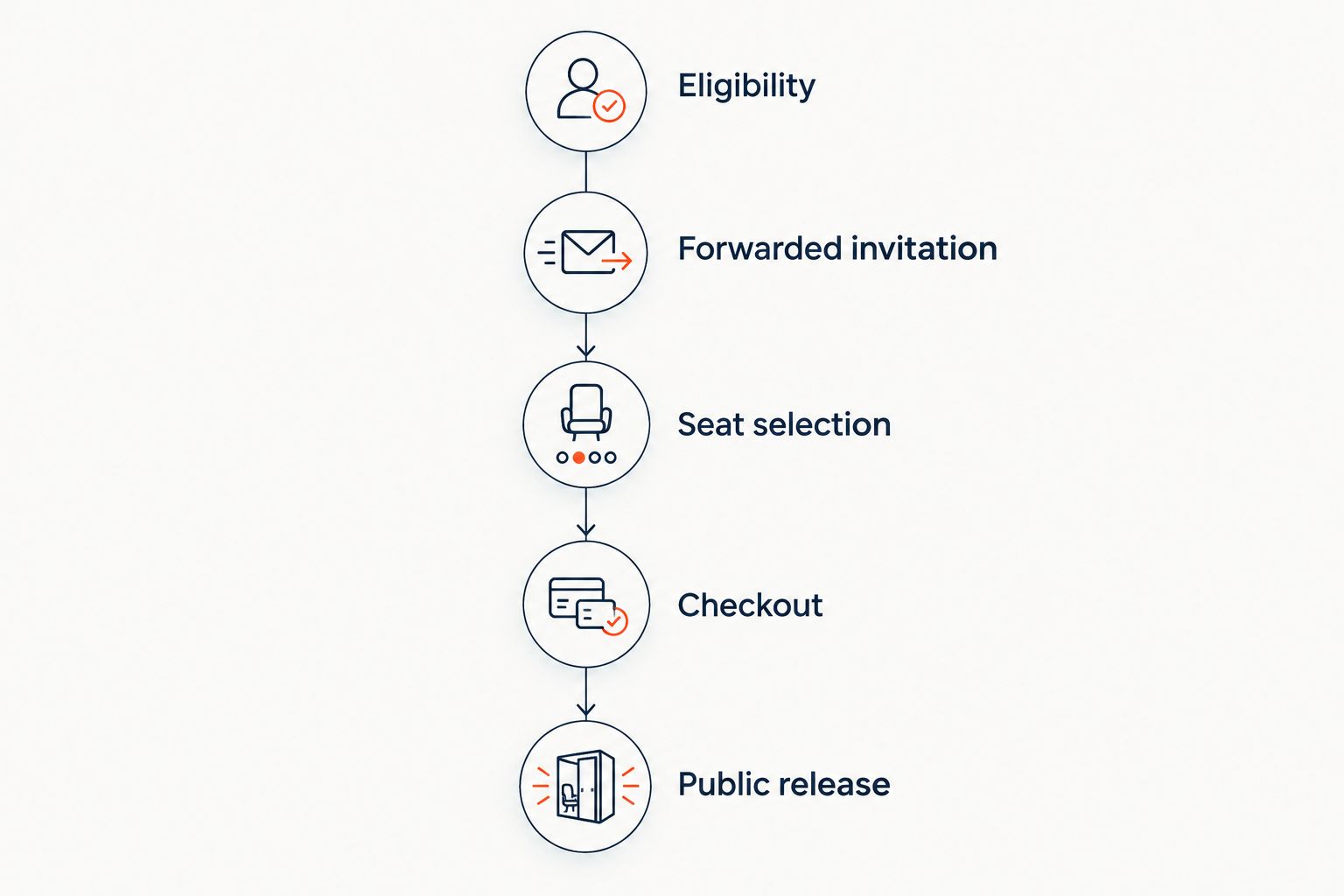
Keep the results attached to your event brief. A completed test should leave your team with a clear operating decision, not just confirmation that the page loads.
Does a subscriber presale need a discount?
A subscriber presale does not need a discount. Earlier purchasing access is a distinct benefit; any different ticket terms are a separate decision.
Keep those messages separate in your 2026 event communications. State who qualifies, what they can access and when public purchasing begins without implying benefits you have not configured.
Do not describe early access as guaranteed seating unless your allocation and entitlement genuinely provide that guarantee. Permission to purchase and a reserved entitlement are different promises.
Can subscribers still buy after public on-sale?
Subscribers can buy after public on-sale if your event's sales rules allow it. Decide whether their priority entitlement ends, continues or changes when public purchasing begins.
Explain that transition in the original invitation. Subscribers should not have to interpret an expired code to discover whether they can still purchase through the public event page.
What should my subscriber invitation say?
Your invitation should explain the entitlement in plain language. Give recipients enough information to act without turning the email into a substitute for properly configured access controls.
Include:
- Who qualifies for this presale.
- The opening and closing dates, with the relevant time zone.
- Which performance or event the invitation covers.
- How to enter or verify access.
- Any purchasing limits you have actually configured.
- What happens when public purchasing begins.
- Where subscribers should ask for help.
For a 2026 Gulf event, check the language used throughout the purchase journey, not just the announcement. Arabic and English communications should describe the same entitlement and deadlines.
Keep ownership clear when choosing your platform
ZunaroSpace provides branded event ticketing for independent organisers and venues, with Arabic and English support and full RTL. Its campaign agent creates a blast, previews the audience and rendered email, sends a test, schedules and reports attributed revenue.
Those mechanisms support event selling, but they do not establish subscriber-gating behaviour. Ask the provider to demonstrate eligibility, allocation and public release using your intended event rules.
You keep the fees, the funds and the customers. AI that sells your tickets: a WhatsApp agent answers buyers, holds seats and hands over a checkout link; checkout completes on the organiser's own site, never in chat.
Based at DTEC, Dubai Silicon Oasis. Built for the Gulf - the UAE and Saudi Arabia.
FAQ
Can I run presale tickets for subscribers before public on-sale?
Yes, when your ticketing platform supports restricted purchasing access and separate sales windows. Define eligibility, allocation and the public-release transition before announcing the presale.
Is sending subscribers an early link enough?
An early link is enough for invitation-led access where sharing is acceptable, but it does not verify subscriber identity. Use an eligibility check when access must remain exclusive.
Do subscriber presales have to include a discount?
Subscriber presales do not have to include a discount. Earlier purchasing access is a separate benefit from different ticket terms.
Can I reserve particular seats for subscribers?
You can reserve particular seats when your platform supports the required allocation and access controls. Confirm how protected seats behave across the storefront, box office and public release.
What happens to unused presale tickets?
Unused presale tickets follow the release rules you configure. Decide whether they enter public inventory and check the handling of unfinished seat selections.
Can someone forward a subscriber presale code?
Someone can forward a shared code, so a shared code does not prove subscriber identity. Ask whether your chosen access method checks the purchaser against an eligible record.
What should I ask a ticketing provider to demonstrate?
Ask the provider to demonstrate eligible access, rejected access, seat allocation, checkout and the transition to public purchasing. Include every channel that will sell the event.
One last thing
Test the purchase that should fail. A successful subscriber purchase proves that someone can buy; an unsuccessful ineligible purchase checks the restriction you promised.
Before your 2026 launch, forward the invitation to a colleague outside the eligible group. Compare the result with your written policy, then fix any mismatch before subscribers receive it.