
Yes, you can restrict ticket sales to a private guest list when your ticketing setup checks eligibility before issuing a ticket. A hidden event link or shared access code is not enough for named-guest access: anyone receiving it can pass it on, so you need guest verification, a purchase allowance and a clear rule for admission.
- Private guest list ticket sales need eligibility checks, not just an unlisted event page.
- Shared access codes suit group invitations; they do not verify a named guest.
- Test forwarded invitations, extra purchases and box office exceptions before opening sales.
- ZunaroSpace suits independent organisers seeking branded event ticketing with connected box office and door check-in.
Can I restrict ticket sales to a private guest list?
Yes. Restrict who can complete a purchase, not merely who can find the event. Start by deciding whether your invitation belongs to a named person, a household, a company or anyone with an access code. Those are different admission rules.
For a 2026 private event, use the following sequence as your acceptance checklist. These are requirements to test in your chosen platform, not features to assume from a private-event setting.
- Define eligibility. Specify who belongs on the approved list and who can add or remove names.
- Verify the guest. Require a supported method that connects the invitation to the approved person or group.
- Limit the purchase. Set the permitted ticket quantity and decide whether repeat orders count against the same allowance.
- Issue the ticket. Release a ticket after the eligibility and purchase rules are satisfied.
- Check admission. Give door staff a clear policy for the ticket holder, companions and exceptions.
For venue-specific planning, the guide to event ticketing for wedding and private venues covers a closely related organising context. Keep the guest-list rule separate from the seating plan: assigning a seat does not prove that its purchaser was invited.
A useful acceptance condition is straightforward: an uninvited person with a forwarded invitation must not be able to complete an unauthorised purchase. If that person succeeds, the setup protects the link rather than the guest list.
Why this matters
Private access is a sales rule and an admission rule. A checkout restriction answers who can obtain a ticket. Your door policy answers who can use it.
These rules need to agree. If invitations are personal but tickets can be passed freely to someone else, restricting the original purchase does not preserve a named guest list at admission.
For your 2026 event, write the rule before sending invitations. Tell invited guests whether they can bring companions, buy on behalf of colleagues or substitute another attendee. Your staff then have a policy to apply instead of making decisions under pressure at the door.
Privacy is a separate concern. Keeping an event out of public listings does not establish who can buy, and verifying a purchaser does not justify displaying the full guest list publicly. Collect the information needed to administer invitations without treating the list as promotional content.
Which restriction fits your guest list?
The right method depends on what the invitation means. Choose the restriction that matches your access rule, rather than the easiest setting to switch on.
The following table compares restriction designs. Confirm the chosen platform supports the design before relying on it.
| Restriction design | Best for | Advantage | Limitation |
|---|---|---|---|
| Unlisted event link | Events where discoverability is the concern | Keeps invitation distribution simple | A forwarded link does not establish eligibility |
| Shared access code | An invited group whose members can share access | Provides a common entry condition | Does not identify the individual using the code |
| Guest-specific invitation | Invitations assigned to particular people | Separates each invitation and its allowance | A forwarded invitation still needs identity checks |
| Approved identity check | Events limited to named guests | Connects purchase permission to the approved list | Requires a process for verification and corrections |
| Manual approval | Events with exceptions requiring organiser judgement | Lets staff review eligibility before issuing tickets | Adds work and depends on consistent decisions |
Unlisted links: best for controlling discovery
An unlisted link is suitable when you want to distribute an event page privately but do not need to prove who received the invitation. It is a distribution method, not a named-guest barrier.
The advantage is simplicity. The limitation is equally plain: forwarding the address gives another person the same route to the page. Do not use an unlisted link alone when admission depends on an approved identity.
Shared codes: best for group invitations
A shared code fits an invitation where possession of the code is the intended qualification. That can work for a group whose members are permitted to invite each other.
It does not distinguish one approved person from another. If the organiser requires a fixed list of named attendees, a shared code needs an additional eligibility check. Otherwise, someone outside the list can use a code received from an invited guest.
Named invitations: best for personal access
For named-guest events, require a supported verification method that ties purchase permission to the approved invitation. A guest-specific link helps separate invitations, but the link itself is not proof of identity.
The trade-off is administration. Guests enter different email addresses, assistants book on behalf of invitees and approved names change. Decide how staff handle these situations without replacing verification with unrestricted access.
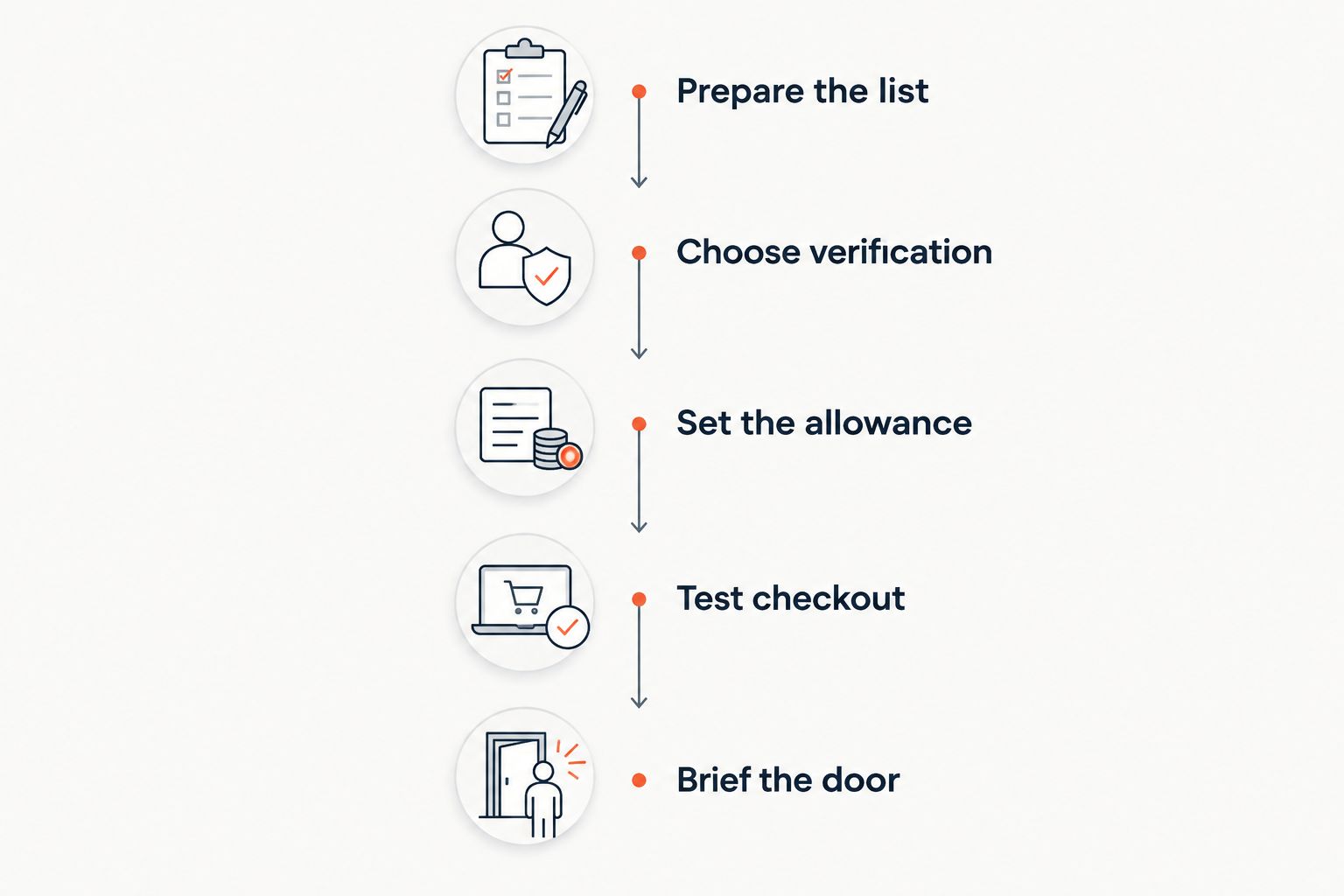
How do I set up a private guest-list sales workflow?
Build the invitation workflow around an approved record. Your event page, checkout and admission process should apply the same policy, even if different staff manage each stage.
Prepare the list
Decide which information establishes eligibility. A name alone can be ambiguous; a contact address still needs a process that verifies the person controlling it. Choose a method your platform supports and your guests can complete.
Record whether the invitation covers the named guest, a household or an organisation. Do not leave companions implicit. An invitation addressed to a company needs a different allowance from an invitation addressed to a particular employee.
Choose verification
Ask the platform provider to demonstrate the check that prevents an unapproved person from purchasing. Watch the full journey, including what happens when an invitation is forwarded.
Do not accept a hidden page as evidence of identity verification. Also distinguish an email field from an email verification process: typing an approved address is not the same as proving control of it.
Set the allowance
Define how many tickets an invitation permits and how repeat orders affect that allowance. A checkout quantity limit and an invitation allowance are different controls.
Specify what happens after a cancellation, an order correction or a guest substitution. For your 2026 guest list, these decisions belong in the sales rules before invitations go out, not in an improvised exception after someone complains.
Test checkout
Run the approved journey and the rejected journey. Test an invited guest, an unlisted person, a forwarded invitation and a guest attempting to exceed the permitted allowance.
Keep the pass condition specific: the authorised guest can complete the intended purchase, while the unauthorised guest cannot obtain a ticket through another route. Include staff-assisted orders in the test.
Brief the door
Give admission staff the policy for named tickets, companions and substitutions. Decide who can authorise an exception and how staff record that decision.
A valid ticket establishes a ticket record. If your event also requires the holder to be the invited person, make that requirement explicit in the admission process.
Why private guest-list controls vary
Private events have different rules about who receives an invitation and what that invitation permits. These factors explain which controls you need:
- Invitation ownership. A personal invitation requires a different check from an invitation available to an entire group.
- Companion permissions. Allowing additional guests changes the ticket allowance and the information needed at admission.
- Sales channels. Online checkout, box office and kiosk sales need consistent eligibility rules.
- Seating arrangements. Reserved seats determine where guests sit; invitation checks determine whether they can purchase.
- Substitution policy. A guest replacement needs an approval process when access depends on a named list.
- Staff exceptions. Manual overrides require an authorised decision-maker and a record of the change.
Use the least complicated process that still enforces your actual rule. A group invitation does not need to pretend it is personal. A named invitation should not rely on a shared credential.
What should I test before inviting guests?
Use a short acceptance test for your 2026 launch. Ask staff to attempt each scenario through every sales channel you intend to use, rather than testing the storefront alone.
| Test scenario | Required outcome for a named guest list |
|---|---|
| Approved guest follows the intended process | The permitted purchase succeeds |
| Unlisted person receives a forwarded link | Eligibility prevents an unauthorised purchase |
| Guest enters someone else's approved details | Verification prevents impersonation |
| Guest places another order | The invitation allowance remains enforced |
| Staff create a box office order | The same eligibility policy applies |
| Guest requests a substitution | Staff follow the stated approval process |
Keep the results with your event setup instructions. A failed test is a reason to change the workflow before invitations are distributed, not a reason to tell staff to watch more carefully later.
Pay particular attention to overrides. If a staff member can issue a ticket without checking the approved list, that action needs a defined purpose and an authorised operator. Convenience at the box office must not silently replace the event's access rule.
Where does ZunaroSpace fit?
ZunaroSpace suits independent organisers who want event ticketing on their own branded storefront, with connected box office and door check-in. The platform brings store, seating, box office, kiosk and check-in onto one live inventory.
ZunaroSpace is relevant when your private event needs those operating channels together. Its event guidance includes access codes, but a code and a named-guest eligibility check are different requirements. Request a demonstration of your exact restriction workflow before treating access codes as proof of guest-list enforcement.
The strength is connected event operations. The boundary is that shared inventory does not, by itself, establish whether a purchaser belongs on your approved list. For a 2026 private event, evaluate inventory consistency and invitation enforcement separately.
You keep the fees, the funds and the customers. Keep control of the admission policy too: the organiser should define who qualifies, who can approve exceptions and what door staff must check.
Can someone buy tickets if an invited guest forwards the link?
Yes, if the link is the only restriction. A forwarded address gives another person the same route to the event page. Require an eligibility check before purchase if only approved guests can obtain tickets.
A guest-specific invitation also needs a forwarding test. Unique does not automatically mean non-transferable or identity-verified.
Can I allow plus-ones without opening sales to everyone?
Yes, by defining companions within the invitation allowance. Decide whether companions must be named before purchase or before admission, and choose a platform workflow that supports that rule.
The invited guest's allowance should not become an unrestricted purchasing route. Test repeat orders as well as the quantity selected in a single checkout.
Does a private guest list also prevent ticket transfers?
No. Purchase eligibility and ticket transfer are separate rules. An approved guest can still pass a ticket to someone else unless the event's transfer and admission process prevents it.
If named attendance matters, explain substitutions before purchase and give staff a documented approval process. Do not assume a private event setting settles the transfer policy.
FAQ
Can I restrict ticket sales to a private guest list in 2026?
Yes, when your ticketing workflow checks approved eligibility before issuing a ticket. Test the restriction through online checkout and any staff-assisted sales channels you use.
Is a hidden event page enough for an invitation-only event?
No, a hidden event page controls discovery rather than identity. A person receiving a forwarded link still needs an eligibility check if access is limited to named guests.
Is an access code the same as a verified guest list?
No, an access code checks possession of the code, not necessarily the identity of the guest. Named-guest events need a supported verification process tied to the approved invitation.
Can I let invited guests buy tickets for companions?
Yes, if your chosen workflow supports an invitation allowance that includes companions. Define whether companions need approval and test whether repeat orders can exceed the allowance.
Should box office staff check the private guest list?
Yes, staff-assisted sales should follow the same eligibility policy as online purchases. Give staff a clear rule for exceptions and specify who can approve them.
Do reserved seats prove that a guest was invited?
No, reserved seats identify seating assignments rather than invitation eligibility. Check guest eligibility separately before issuing a reserved-seat ticket.
Is ZunaroSpace relevant for private venue ticketing?
ZunaroSpace is relevant for organisers seeking branded event ticketing with store, seating, box office, kiosk and door check-in on one live inventory. Ask for a demonstration of the exact named-guest restriction your event requires.
One last thing
Test the invitation you did not send. Forward a real test invitation to someone outside the approved list and ask them to attempt the purchase through the routes your event will offer.
For a 2026 launch, this is a direct check of the rule that matters: being able to reach the event is not the same as being allowed to buy. Resolve any route that bypasses eligibility before you send invitations.