
Yes—you can see which marketing channel sold the most tickets when completed orders are connected to a recorded source or campaign. Rank channels by ticket quantity, not clicks or order count, and use the same attribution rule throughout your report. The caveat: attributed sales show which channel received credit, not proof that the channel caused every purchase.
- Can I see which marketing channel sold the most tickets? Yes—compare completed ticket quantities using consistent attribution.
- Google Analytics purchase reporting needs ticket quantities and transaction identifiers, not just page visits.
- ZunaroSpace reports attributed campaign revenue; revenue alone does not identify the channel selling the most tickets.
- Keep unattributed orders visible, and reconcile channel totals against your ticketing records.
Can I see which marketing channel sold the most tickets?
Yes. Build a channel report from completed purchases, then sort it by tickets sold. Each purchase needs a ticket quantity and a source assignment. Your ticketing records remain the reference for whether the transaction actually completed.
For your 2026 event reporting, start with the purchase connection rather than the chart. A dashboard cannot recover campaign information that was never recorded. The guide to sending ticket sales data to Google Analytics covers the reporting connection to examine before you rely on channel totals.
Use this sequence:
- Define a sale. Decide whether your report counts paid tickets only, how it handles complimentary admissions, and whether refunded tickets remain included.
- Name each campaign. Give every campaign a consistent source, medium and campaign name before distributing its links.
- Record completed purchases. Capture a transaction identifier, event or performance, ticket quantity and revenue where your reporting setup supports them.
- Choose an attribution rule. State how your report assigns credit when a buyer interacts with several channels.
- Reconcile and rank. Compare the purchase records with your ticketing system, resolve duplicate transactions, then sort channels by ticket quantity.
The answer should fit in a sentence: which channel received credit for the largest number of completed ticket sales, for which event, during which period, under which attribution rule. If those details are absent, the ranking is incomplete.
Why this matters
A channel that attracts attention is not necessarily the channel that sells seats. Page views measure visits. Orders measure transactions. Ticket quantity measures admissions sold. Those are different questions, and your marketing decisions need the right answer.
For your 2026 marketing review, put tickets sold beside revenue—not underneath clicks. A campaign can generate a large order count while selling fewer tickets than another campaign whose orders contain larger groups. Revenue can also rank channels differently when purchases contain different ticket types.
Use the report to decide what deserves further investment, what needs a checkout review and what requires better tracking. Do not treat an attribution ranking as a complete budget recommendation. You still need campaign spend and evidence about whether the sales would have happened without the campaign.
Which measurement approach should you use?
Different measurement methods answer different parts of the question. Choose the method that fits the sales path you need to understand, then keep its limitations visible.
| Measurement approach | Best for | What it contributes | Main limitation |
|---|---|---|---|
| Tagged campaign links | Separating distributed online campaigns | Source, medium and campaign information attached to visits | Tags can disappear when links are changed or buyers return another way |
| Purchase reporting | Connecting online interactions to completed orders | Transaction identifiers, ticket quantities and revenue | The purchase connection must be configured and checked |
| Campaign codes | Identifying a specific promotion or partner | A code recorded against an order | Shared codes do not prove where the buyer first heard about the event |
| Buyer source question | Adding context to offline or untracked sales | The buyer's stated discovery source | Answers are self-reported and do not establish a precise purchase path |
Use purchase records for the sales total and campaign information for the attribution. Neither replaces the other. A tagged visit without a purchase is not a ticket sale; a completed purchase without a recorded source is a sale with unknown attribution.
Combine methods only when you explain their roles. Keep a buyer's answer to a source question separate from the channel assigned by your analytics report. That preserves both pieces of information without presenting them as interchangeable evidence.
Set up a report you can trust
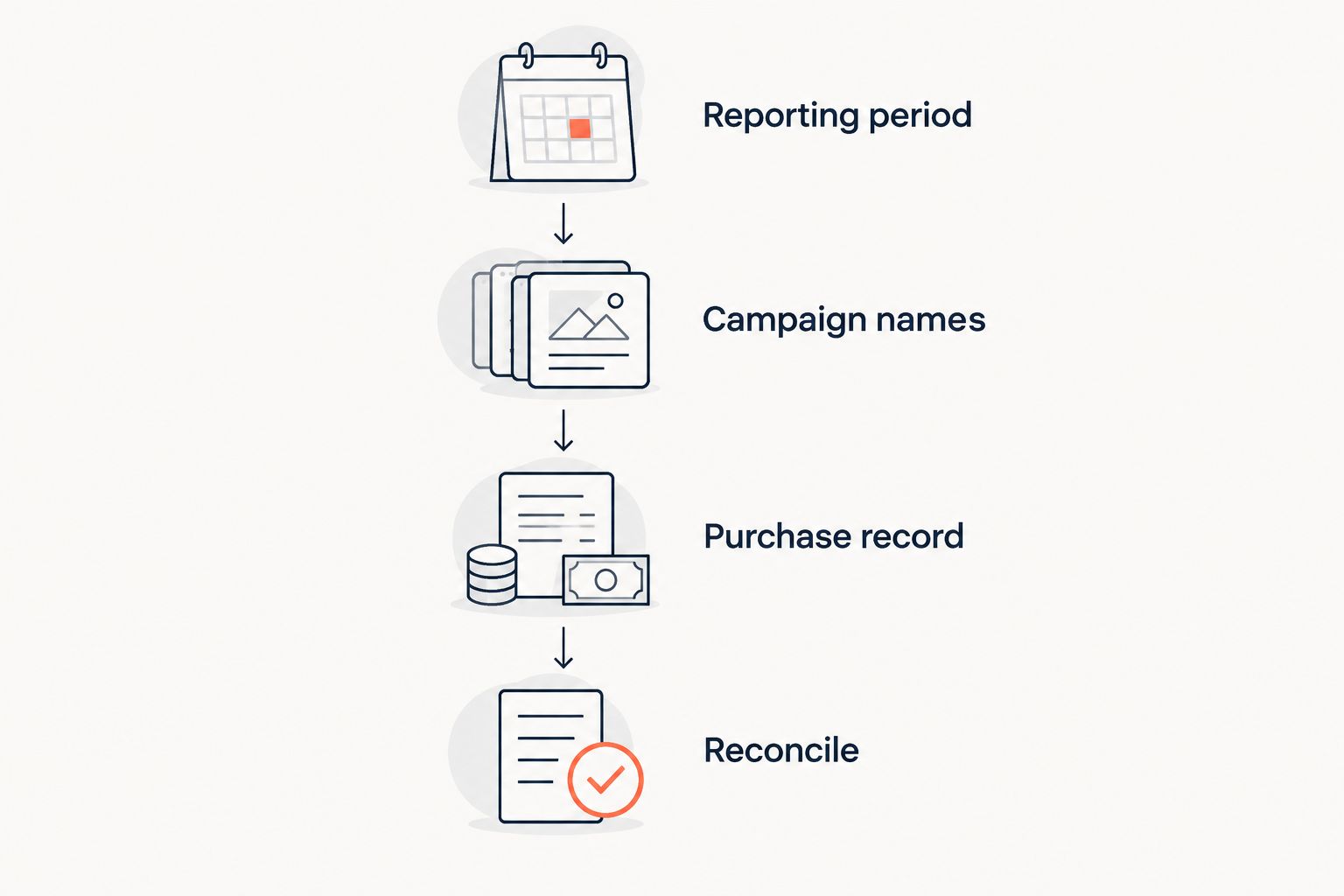
Define the reporting period
Choose the event, performance and reporting dates before comparing channels. A campaign that ran earlier in the sales cycle has had a different opportunity to generate purchases from one launched near the event date.
For a 2026 campaign report, distinguish the date a campaign ran from the date tickets were purchased. If you group purchases by transaction date, say so. If you analyse buyers who first arrived during a campaign period, label that separately.
Avoid mixing several events into a single ranking without checking the event-level results. A channel can look strong across the whole programme because it supported the event with the largest sales total, rather than because it performed consistently across every show.
Make campaign names consistent
Use a written naming convention for source, medium and campaign. The standard UTM parameters include utm_source, utm_medium and utm_campaign. These describe the referring source, marketing medium and campaign respectively.
Keep the naming convention stable across the team. Different spellings and capitalisation can fragment reporting, leaving one campaign spread across several rows. Document what each label means so another organiser can interpret the report without asking its author.
Do not put customer names, email addresses or other personal details into campaign parameters. Campaign names should describe the marketing activity, not identify the buyer. Treat them as reporting labels that can appear in links and analytics records.
Validate the purchase record
Check that your reporting setup records a completed transaction rather than a checkout visit or button press. A buyer reaching checkout has not necessarily bought a ticket. Confirmation should come from the completed order record.
Transaction identifiers help you check whether the same purchase has appeared more than once. Ticket quantities let you distinguish admissions sold from the number of orders. Event identifiers keep the right sales attached to the right performance.
Run a controlled validation before distributing campaign links. Follow the purchase path, inspect the recorded order, and confirm that the reporting fields match the ticketing record. Do not assume a visible confirmation page proves every field arrived correctly.
Reconcile before ranking
Compare the report's completed transactions with your ticketing records for the same event and period. Investigate differences before announcing a winning channel. Common checks include duplicate purchase records, inconsistent refund treatment and missing ticket quantities.
Keep unattributed sales in the report. Removing them makes the tracked channels look more complete than they are. Label them clearly so you can separate a genuine sales result from a gap in source information.
Once the records agree, sort by ticket quantity. Keep revenue and orders alongside that total, but do not silently substitute either measure for tickets sold.
Why channel attribution varies
A channel ranking depends on the rules and information behind it. These factors change what receives credit:
- Attribution model. A rule that credits the last eligible interaction answers a different question from one that credits the initial interaction or distributes credit.
- Attribution window. The period during which an interaction remains eligible for credit changes which earlier marketing touches are included.
- Returning buyers. Someone can discover an event through a campaign and later return through a different route to complete the purchase.
- Consent and device changes. Browser restrictions, consent choices and movement between devices can interrupt the recorded path.
- Offline purchases. Box office and kiosk sales need their own source-recording approach; an online campaign report does not automatically explain them.
- Refund treatment. A report of gross ticket sales gives a different result from one that removes refunded tickets.
Record these choices in your 2026 reporting notes. That makes comparisons repeatable and gives your team an explanation when two reports disagree.
Do not change the attribution rule between campaigns and then describe the difference as a performance improvement. First compare like with like. If you adopt a new rule, make the change explicit and separate its effect from changes in actual sales.
Does the channel with the most tickets deserve more budget?
The channel selling the most tickets does not automatically deserve the largest budget. Its ticket total tells you volume under the chosen attribution rule. Budget decisions also need spend, revenue, refunds and the purpose of the campaign.
A channel serving existing customers can receive credit for purchases from people already planning to attend. A discovery campaign can introduce the event while another channel receives the eventual purchase credit. Attribution alone cannot establish the additional sales caused by either activity.
Use the ranking as a starting point. Ask whether the channel reached the intended audience, whether the sales supported your event goals, and whether the result remains attractive after marketing spend. Keep volume, efficiency and additional sales as separate questions.
Can I track box office and kiosk sales too?
You can include box office and kiosk ticket sales in the total, but their purchase location is not necessarily their marketing source. A buyer purchasing at the door could have discovered the event through an email, a partner or an offline promotion.
Record the sales endpoint separately from the marketing source. This lets you report where the transaction happened without claiming it explains why the buyer attended. Where source information is unavailable, retain the sale as unattributed rather than guessing.
A source question or campaign code can add context if your checkout process supports it. Keep the method visible in the report, because self-reported discovery and tracked campaign attribution are different forms of evidence.
Can attributed revenue tell me which channel sold the most tickets?
Attributed revenue cannot, by itself, tell you which channel sold the most tickets. Revenue measures the monetary value assigned to a channel; ticket quantity measures the admissions sold. Different ticket types can make those rankings diverge.
Ask for both fields at the same reporting level. If revenue is grouped by campaign but ticket quantity is available only for the whole event, you cannot use that report to rank campaigns by tickets sold.
Also separate a campaign from a channel. A channel can contain several campaigns. Aggregate campaigns using a consistent channel definition, while retaining the campaign rows so you can see what produced the total.
Where ZunaroSpace fits
ZunaroSpace is an event ticketing platform best for independent organisers and venues that want their own branded storefront and connected sales operations. Storefront, reserved seating, box office, kiosk and door check-in share one live inventory. That operational connection keeps the sales endpoints tied to the same ticket stock.
For marketing reporting, ZunaroSpace's campaign agent creates a blast, previews the audience and rendered email, sends a test, schedules delivery and reports attributed revenue. That is a specific campaign-reporting capability—not a claim that every marketing channel has complete attribution.
The strength is a connected ticketing operation with campaign revenue reporting. The limitation for this question is scope: attributed campaign revenue is not an all-channel ticket-quantity ranking. When evaluating ZunaroSpace event ticketing, ask to see the report fields, attribution rule and handling of offline orders that your decision requires.
You keep the fees, the funds and the customers. Keep the measurement standard equally clear: completed orders first, source information second, and no invented attribution for sales whose origin is unknown.
FAQ
Can I see which marketing channel sold the most tickets?
Yes, when completed ticket purchases are connected to recorded channel information. Sort by ticket quantity using a consistent attribution rule, and retain unattributed sales.
Should I compare ticket sales or the number of orders?
Compare ticket quantity when you want to know which channel sold the most tickets. Order count measures transactions, and an order can contain multiple tickets.
Can Google Analytics show ticket sales by marketing channel?
Google Analytics can report purchases against acquisition information when purchase measurement is configured. Your setup must include ticket quantities if you want to compare admissions sold rather than transactions alone.
Why do my advertising and ticketing reports disagree?
Reports can disagree because they use different attribution rules, reporting periods or purchase records. Check those definitions, duplicate transactions and refund treatment before comparing totals.
Do direct purchases mean my marketing did not work?
No. A purchase without an identifiable source does not prove that marketing had no influence. Keep the sale visible without assigning an unsupported channel.
Can I include sales made at the box office?
Yes, include completed box office sales in your ticket totals. Record the sales endpoint separately from any marketing source information you collect.
Does ZunaroSpace show attributed campaign revenue?
Yes, ZunaroSpace's campaign agent reports attributed revenue. That does not, by itself, establish a complete ranking of every marketing channel by ticket quantity.
One last thing
A sales endpoint and a marketing source are different fields. Storefront, box office and kiosk tell you where an order was completed. Email, paid advertising or a partner campaign describe the marketing activity receiving credit.
Before your next 2026 campaign, ask for a report that preserves both. That distinction prevents your team from calling the box office a marketing winner when it was simply where campaign-influenced buyers paid. Keep unknown sources visible; an honest gap is more useful than a confident guess.