
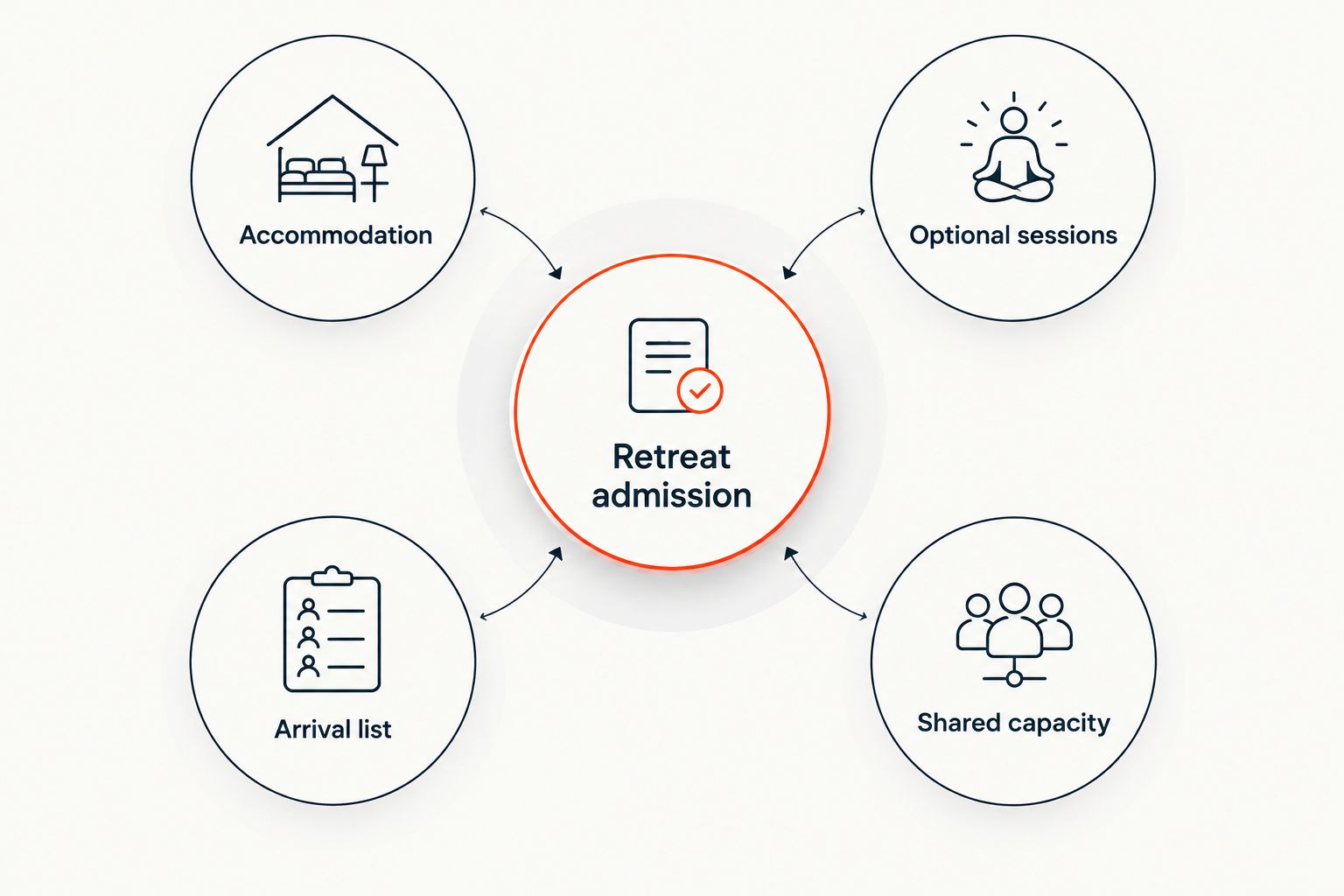
Yoga retreat organisers’ event ticketing is the sale and management of retreat admission with the aim of keeping bookings within capacity and arrivals under control. Unlike a standalone class, a residential retreat needs clear boundaries between admission, accommodation, optional sessions and the information your team collects separately.
Every show has seats that never sold - and no one was working on them. For a retreat, the practical response is to make every available place understandable, bookable and connected to an accurate arrival list.
- Event ticketing for yoga retreat organizers starts with separating retreat admission from accommodation and optional sessions.
- ZunaroSpace event ticketing suits organisers who want a branded storefront and connected check-in.
- Use general admission unless a specific seat or position genuinely needs reserving.
- Keep retreat registration, room allocation and sensitive participant information distinct.
Why event ticketing matters for yoga retreat organisers
Your booking record needs to answer a simple question: what has this participant actually bought? A retreat place, a shared room and an optional workshop are different commitments, even when you present them together.
Sell a defined entitlement, not an ambiguous retreat package. Write the inclusions before you configure the checkout. Otherwise, your arrival team has to interpret promises made across emails and messages.
For your 2026 retreat calendar, decide whether bookings are public or invitation-based before promotion starts. The guide to restricting ticket sales to a private guest list covers a relevant decision for closed groups and hosted retreats.
Ticketing also needs a boundary. An admission record does not replace room allocation, participant suitability checks or the operational information your instructors need.
Set up your retreat ticketing
Define exactly what admission includes
Start with a document or spreadsheet. Give every admission type a plain-language description, then ask someone outside the planning team to explain what they would receive.
Separate attendance rights from hospitality arrangements. If accommodation is included, say what is included without implying that your ticketing software manages rooms. If accommodation is separate, make that distinction visible before payment.
Use the same descriptions in your event page, confirmation and arrival instructions. A shorter checkout is not useful if the missing details create disputes later.
- State which retreat dates admission covers.
- List included classes, meals and activities.
- Identify anything participants must arrange separately.
- Explain whether optional sessions need separate booking.
- Publish your cancellation and substitution terms before payment.
Map capacity before creating ticket types
Use a spreadsheet to map each constraint: teaching space, overnight accommodation, transport and optional activities. The capacity that matters is the capacity attached to the promise you are selling.
A day participant does not necessarily use a bed. An overnight participant does. If both attend the same class, they still draw on the same teaching space.
Do not treat a ticket category as proof that shared capacity is protected. Test whether selling different categories reduces the correct remaining allocation. For your 2026 setup, document any capacity your team must still reconcile manually.
- Retreat admission: define the overall attendance limit.
- Accommodation: track room and bed commitments separately.
- Optional sessions: set an explicit attendance limit.
- Arrival list: record who is expected on each date.
- Shared capacity: identify allocations used by multiple categories.
These records connect, but they are not interchangeable. Keep the relationships visible before you automate any part of the process.
Choose the sales route that matches your operation
You can begin manually: publish the retreat details, take enquiries and maintain a booking ledger. That gives you direct oversight, but someone must keep payment status, remaining places and confirmations aligned.
A connected platform becomes the faster path when you need a storefront and arrival handling together. ZunaroSpace event ticketing is best for retreat organisers who want a branded storefront and connected check-in. Its store, seating, box office, kiosk and door check-in use one live inventory.
The ZunaroSpace platform is not a substitute for checking accommodation requirements. Demonstrate your actual retreat structure before committing to a workflow.
- Choose general admission for unassigned participation.
- Use reserved seating when a defined position matters.
- Test how staff record assisted bookings.
- Check that online and staff-assisted sales share inventory.
- Confirm room allocation requirements separately.
Publish an event page that prevents repeat questions
Draft the page in a document before entering it into your storefront. Put the retreat dates, location, inclusions and booking conditions where an organiser reviewing the page can find them without opening another document.
For a Gulf retreat serving Arabic- and English-speaking groups, review both versions independently. ZunaroSpace supports Arabic and English with full RTL, plus AED and SAR pricing; that does not remove your responsibility to check translated retreat details.
Treat your 2026 event page as an operational reference, not just a promotional page. Staff should be able to answer routine booking questions from the same published information.
- Specify arrival and departure expectations.
- Describe the teaching format and intended experience level.
- Explain what participants should bring.
- Distinguish included accommodation from separate arrangements.
- Provide a clear route for accessibility enquiries.
Connect enquiries to a real checkout
Begin with a shared enquiry log and approved answers. Record the question, the response and whether the person completed a booking; do not treat an expression of interest as a confirmed place.
For a faster enquiry-to-checkout route, the platform’s WhatsApp agent answers buyers, holds seats and hands over a checkout link. Events are also discoverable and bookable inside ChatGPT and Claude, including seat selection on the real map and a hold. Checkout always completes on the organiser’s own site, never in chat.
AI that sells your tickets. Here, that means answering booking questions and connecting a seat hold to checkout—not replacing your retreat team’s judgement.
- Prepare answers about admission and inclusions.
- Separate routine booking questions from instructor decisions.
- Check that a hold is not presented as completed payment.
- Test the checkout link on a phone.
- Keep health-related questions out of the sales conversation.
Rehearse confirmations and arrival handling
Start with a sample booking and a printed arrival list. Walk through the process as the person welcoming participants: locate the booking, establish what it includes and record arrival without relying on memory.
The platform sends e-tickets through WhatsApp as well as email and provides door check-in. Test the complete path with your team rather than assuming that receiving a ticket proves every operational detail is correct.
For a 2026 retreat with staggered arrivals, distinguish retreat admission from attendance at individual activities. Do not assume that a ticket scan also records workshop participation or room occupancy.
- Check the participant name and admission description.
- Confirm that the ticket reaches the intended recipient.
- Assign responsibility for corrections and exceptions.
- Prepare an arrival-list fallback for connectivity problems.
- Keep accommodation allocation available to authorised staff.
Measure bookings against the retreat you planned
Begin with a spreadsheet that reconciles bookings, attendance and capacity. Separate completed orders from enquiries and holds so your planning does not depend on places that remain unconfirmed.
Review what each sales channel actually produced. If you use the campaign agent, it creates a blast, previews the audience and rendered email, sends a test, schedules delivery and reports attributed revenue. Supply the campaign brief and review the output before sending.
Use the 2026 retreat review to change a specific operational decision: the admission description, the enquiry response or the arrival process. Avoid collecting figures that nobody uses.
- Reconcile completed bookings with the arrival list.
- Record cancellations separately from non-attendance.
- Compare sold allocations with remaining capacity.
- Review attributed revenue alongside the campaign sent.
- Document repeated questions for the next event page.
Compare your retreat ticketing options
Choose according to the records you need to keep connected. A ticketing platform handles admission; accommodation management needs its own explicit assessment. Do not buy either category on the assumption that it automatically replaces the other.
| Option | Best for | Main advantage | Key limitation |
|---|---|---|---|
| Spreadsheet and manual confirmations | Organisers handling bookings directly | Flexible records without configuring an integrated workflow | Staff must reconcile payments, capacity and attendance themselves |
| Registration form with separate payment collection | Application-led retreats | Lets you separate an enquiry or application from acceptance | Form submission and completed payment need reconciliation |
| ZunaroSpace event ticketing | Organisers needing branded sales and connected check-in | Storefront, box office, kiosk and door check-in share live inventory | Room allocation and retreat-specific requirements need separate verification |
| Accommodation reservation system | Retreats where room allocation drives the booking | Focuses the selection process on lodging requirements | Verify event admission, session access and arrival handling separately |
Check the economics before choosing
Organisers pay nothing per ticket on the platform. The buyer covers one booking fee of AED 3.99, or AED 1.99 under AED 20; free events carry none. Treat those booking terms separately from your retreat’s own cancellation conditions and any payment-processing arrangements you need to verify.
Ask Zunaro Pro is AED 179/mo, with a 14-day trial and no card. Assess that subscription against a defined task rather than treating it as a prerequisite for planning your retreat.
You keep the fees, the funds and the customers. Confirm payment-provider eligibility and settlement arrangements for your organisation before launch; do not assume that selling in a country establishes payout eligibility there.
Based at DTEC, Dubai Silicon Oasis. Built for the Gulf - the UAE and Saudi Arabia.
Common mistakes yoga retreat organisers make
Selling a room description as an admission type
A shared-room label does not establish a room-allocation workflow. Verify who assigns occupants, handles changes and prevents conflicting commitments. Keep that responsibility explicit even when accommodation is included in admission.
Treating a retreat pass as unlimited session access
A retreat-wide place and a space in a restricted workshop are different allocations. Explain which sessions are included and which require a separate reservation before you accept bookings.
Collecting sensitive information in routine sales records
A ticket order is not the right place for an unrestricted health history. Collect the information needed for admission, and handle sensitive participant discussions through a separate process with access limited to the relevant team.
Reserving positions that do not need reserving
A floor plan does not automatically require a seat map. Use general admission when participants choose where to practise; reserve positions when the allocation has a genuine operational purpose.
Confusing a conversation with a confirmed place
An enquiry, a held seat and a completed order represent different stages. Build your retreat roster from completed bookings and your documented acceptance process, not from message threads.
FAQ
What is event ticketing for yoga retreat organisers?
Event ticketing for yoga retreat organisers manages the sale and recording of retreat admission. It should define what each booking includes, protect attendance capacity and support arrival handling without being mistaken for an accommodation system.
What is the best ticketing setup for a residential yoga retreat?
The best setup separates admission from room allocation while keeping both records reconcilable. Check how the proposed workflow handles shared accommodation, optional sessions and changes before choosing a platform.
Do yoga retreats need reserved seating?
Yoga retreats need reserved seating when participants must book a defined seat or position. General admission is the clearer choice when the retreat team assigns practice space on arrival or leaves it unassigned.
Can a WhatsApp conversation complete a retreat booking?
A conversation can support a booking, but the platform’s checkout completes on the organiser’s own site. Its WhatsApp agent answers questions, holds seats and provides a checkout link; a hold is not a completed order.
Can an event ticketing platform manage retreat accommodation?
Do not assume event ticketing includes accommodation management. Verify room allocation, occupancy changes and accommodation-specific workflows separately from admission sales.
What should I test before publishing a retreat?
Test an admission from selection through confirmation and arrival handling. Check the inclusions, shared capacity, ticket delivery and exception process, then reconcile the booking against any separate accommodation record.
Should I collect health information during ticket checkout?
Keep routine ticket checkout focused on the information needed to process admission. Handle sensitive health discussions separately, with access restricted to the people responsible for participant support.
One last thing
Rehearse a change, not just a sale. Take a sample booking and change its accommodation arrangement or optional session, then ask your team to identify every record that needs updating.
That exercise exposes the boundary between ticketing and retreat operations. If nobody owns the second record, fix the responsibility before opening bookings.