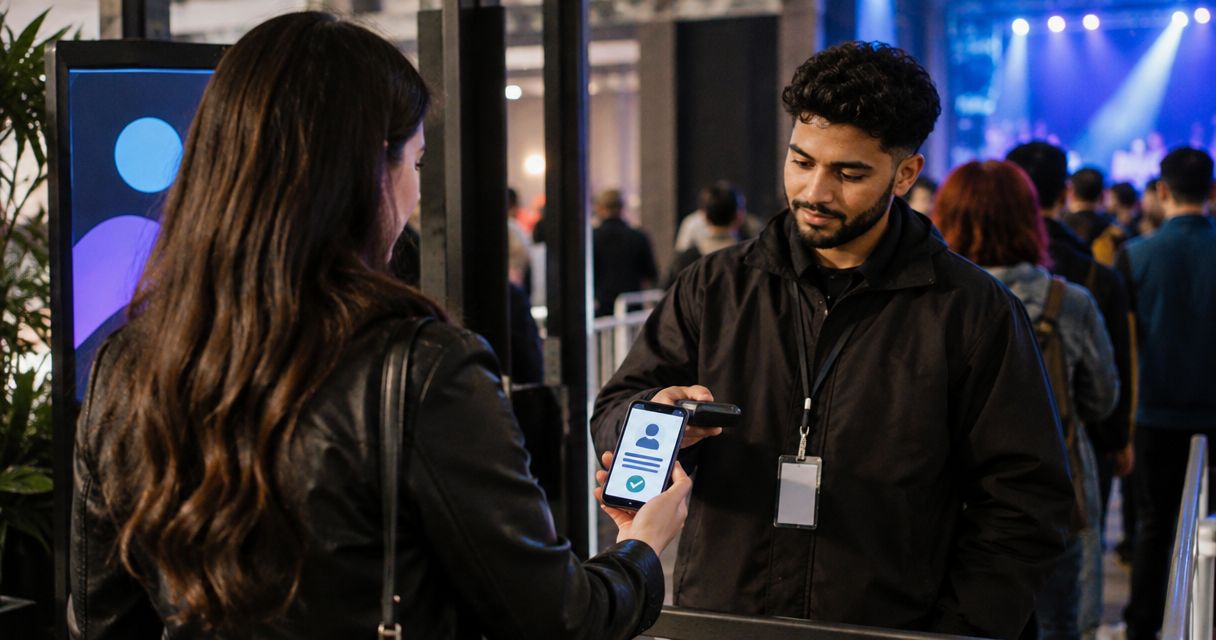
Yes—you can make proof of age a condition of entry to an age-restricted event, subject to applicable law, your event permit and venue rules. Age verification ticketing should distinguish an age declaration at booking from an identity check at entry: collecting a date of birth or scanning a ticket does not, by itself, establish the attendee’s age.
- Age verification ticketing needs an admission policy, not just a date-of-birth field.
- Check each attendee’s eligibility; the purchaser is not necessarily the person entering.
- Keep ticket validation separate from ID verification and document collection.
- ZunaroSpace combines event ticketing and door check-in; confirm age-verification requirements before choosing your admission workflow.
Why this matters
Every show has seats that never sold - and no one was working on them. Selling those seats still requires clear admission conditions: an attendee should understand the restriction before paying, not discover it in the queue.
For your 2026 event, treat age eligibility as a separate decision from ticket validity. A valid ticket establishes a booking; it does not establish that the person presenting it meets your entry conditions. The same distinction applies to a private guest list: being invited and being eligible are different questions.
Can I require ID verification for age-restricted events?
Yes, provided your admission requirements comply with the rules governing your event. Establish those requirements with the venue and relevant licensing authority before configuring your ticketing workflow, then publish them consistently across your sales channels.
Write the admission rule before choosing the verification tool. Your policy needs to identify who must qualify, what evidence staff accept, when checks happen and who handles disputed decisions.
Use this setup sequence:
- Confirm the restriction. Establish the applicable age threshold, the date used to calculate age and any accompanying-adult conditions. Do not copy another venue’s policy.
- Publish the conditions. Explain the restriction, accepted evidence and consequences of failing the check before purchase.
- Choose the verification point. Decide what happens during booking and what staff must confirm at entry.
- Define the admission decision. Separate a valid ticket from permission to enter, including the escalation process for uncertain cases.
- Rehearse the workflow. Walk through a group booking, a transferred ticket, an unreadable document and a refused entry before opening doors.
For a 2026 operating plan, assign responsibility for every decision. A policy that says staff will check ID is incomplete unless staff know what qualifies and who resolves exceptions.
Which age-checking approach fits your event?
An age declaration, a document inspection and digital identity verification do different jobs. Choose the approach required by your event rules rather than treating them as interchangeable ticketing features.
| Approach | Best for | What it establishes | Limitation |
|---|---|---|---|
| Age declaration at booking | Communicating eligibility conditions before purchase | The information the purchaser supplies | It does not independently verify age or identify every attendee |
| In-person ID inspection | Checking the person requesting entry | Staff can compare the attendee with accepted evidence | It requires trained staff and a clear exception process |
| Digital identity verification | Workflows that require verification before arrival | The result produced by the selected verification process | You must assess document coverage, privacy obligations and how the result connects to the attendee |
| Booking declaration plus entry inspection | Events that need advance notice and an entry decision | Acknowledgement before purchase and an inspection at arrival | Booking acknowledgement does not remove the need for the entry check |
Best for advance communication: an age declaration. Best for an entry decision: the verification process your event rules require. Do not describe a checkbox as verified identity.
Digital verification also needs scrutiny. Ask what the service actually checks: a typed birth date, a document, a match to the person, or a combination. A feature labelled age verification is not enough to judge its suitability.
Age declarations: useful notice, not proof
An age declaration lets you state the restriction and request acknowledgement during booking. It gives your organiser team a place to explain the rule before money changes hands.
Its limitation is straightforward: the purchaser supplies the answer. A purchaser can also book for someone else, so the account holder’s age does not establish every attendee’s eligibility.
For your 2026 booking journey, review the wording alongside the venue’s actual admission policy. Avoid language suggesting that completing checkout guarantees entry regardless of the checks at the door.
If your platform supports required questions or acknowledgements, test their placement rather than assuming buyers encounter them. Check the event page, checkout and confirmation journey as separate surfaces.
Door checks: verify eligibility before admitting
An entry inspection connects the person standing at the door with the evidence your policy accepts. Staff need an agreed process for examining that evidence and resolving uncertainty without improvising admission rules.
A ticket scan serves a different purpose. Keep the eligibility decision distinct from the scan, even when both happen at the same position in the queue.
A practical admission sequence is:
- Ticket validation: establish whether the booking is valid for the event.
- ID inspection: assess the attendee against the published eligibility requirement.
- Admission decision: admit the attendee or send the case to the designated supervisor.
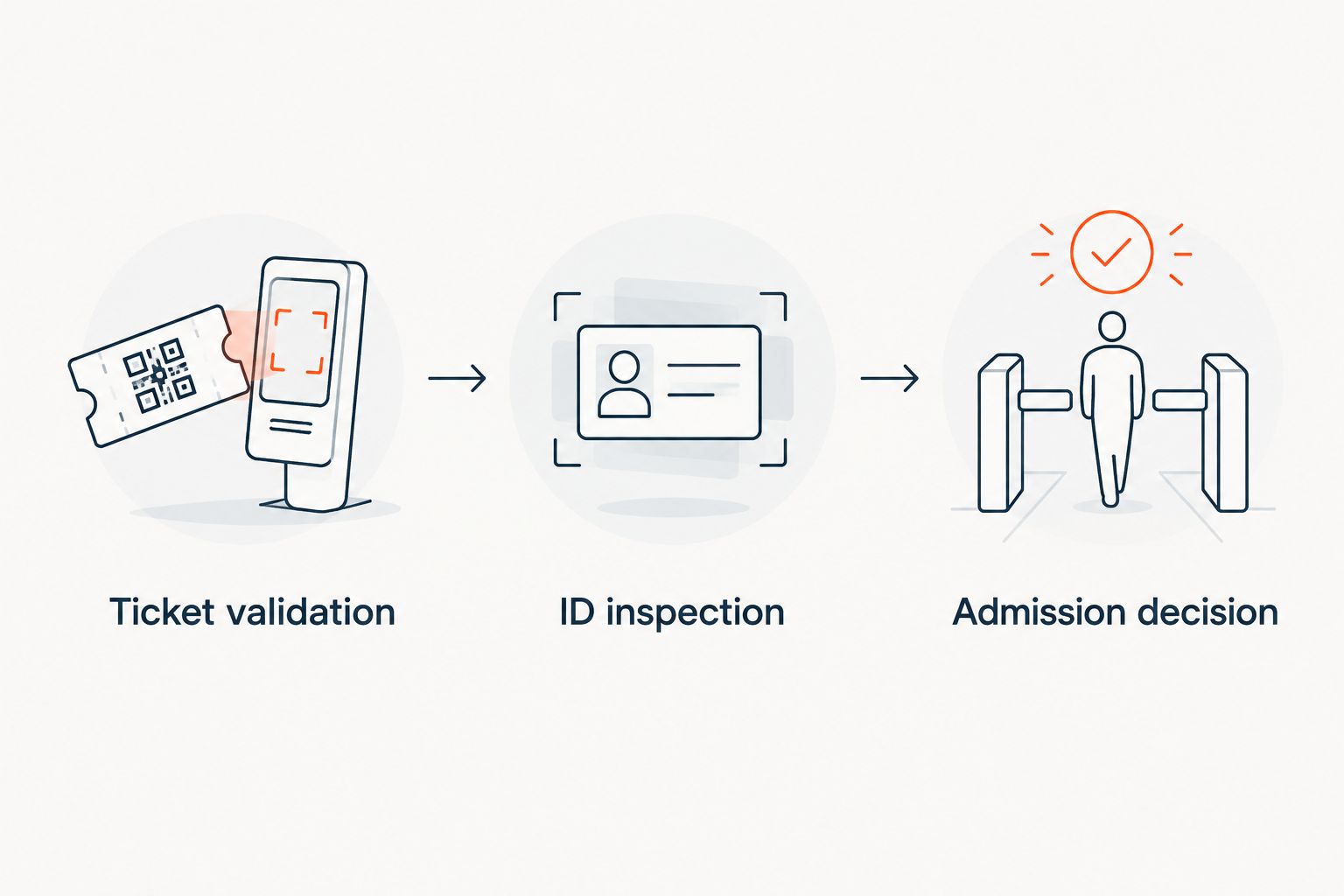
Confirm when your check-in system marks a ticket as used. If scanning happens before the ID decision, staff need an approved way to handle a valid ticket whose holder is refused entry. Do not assume the system’s default sequence matches your policy.
Digital verification: assess the full process
Digital verification belongs in your workflow when it meets a defined requirement, not because it sounds more thorough. Ask the provider to explain what evidence it checks and what the result means.
Review how the verification result follows the attendee. A result associated with the purchaser’s account does not automatically cover guests, replacement attendees or someone presenting a transferred ticket.
The trade-off is additional handling of identity information and another process to support. Before adopting it, establish who receives documents, who can access them, what is retained and what happens when verification fails.
For a 2026 supplier review, ask for a demonstration using your admission scenarios. A successful standard booking is not enough; include a group purchase and a change of attendee.
Why age-verification requirements vary
The appropriate process depends on the event’s requirements, not on a universal ticketing setting. Resolve these factors before selecting a tool:
- Jurisdiction and permissions. Confirm the rules applying to the location, activity and event permit. Do not transfer a policy between the UAE and Saudi Arabia without checking its applicability.
- Venue conditions. Establish whether the venue imposes admission requirements beyond the organiser’s published event policy.
- Who attends. Group purchases and bookings made on someone else’s behalf separate the purchaser from the person needing verification.
- Ticket changes. Decide how substitutions and transfers affect any earlier eligibility decision.
- Evidence handling. Inspecting a document, recording a result and retaining a document copy are different processes with different privacy considerations.
- Entry operations. Define how staff handle disputed decisions without blocking the admission process or exposing personal details.
Record the agreed policy in the event’s operating brief. Your ticketing administrator, venue manager and door supervisor should work from the same version.
What should you tell attendees before purchase?
Publish the eligibility threshold, the applicable event date, accepted evidence and the requirement for each attendee to qualify. Explain any accompanying-adult conditions only after confirming that they apply to your event.
State how you handle failed checks and where attendees can raise questions before arrival. Align refusal and refund wording with applicable law and your published terms; do not assume a no-refund statement resolves every case.
Keep the message consistent across the event page, checkout notices and pre-event communications. For an Arabic-and-English event, have both versions checked against the same policy rather than allowing separate interpretations.
Your 2026 event brief should also cover changes after purchase. If the venue revises an admission requirement, decide how you will notify existing purchasers and handle affected bookings before publishing the update.
Do you need to collect or store ID copies?
Do not make document collection the default. Start by determining what evidence your event actually requires and whether inspection can meet that requirement without retaining a copy.
Collecting identity documents creates an additional responsibility. Obtain appropriate legal and privacy advice on your lawful basis, notices, access controls, retention and deletion before introducing uploads or photographing documents at entry.
Give staff a clear instruction about personal devices. Your workflow should not depend on someone saving an attendee’s identity document to a phone or sharing it in an informal messaging group.
Where a decision record is appropriate, define its purpose and minimum contents. Avoid recording document details simply because a form offers space for them.
How should you handle groups, transfers and disputed checks?
Check eligibility at attendee level, not order level. An eligible purchaser does not establish that everyone on the booking qualifies for admission.
For group arrivals, decide how staff separate valid admissions from cases requiring review without losing track of ticket status. Keep the decision attached to the relevant attendee or ticket through your approved process.
If transfers are permitted, determine whether an earlier verification result remains applicable after the attendee changes. Do not carry a previous holder’s eligibility decision across to a new person without a valid basis.
Give disputed checks a named escalation route. Staff should know who can make the final decision, how to record it and how to communicate it away from the main queue.
Where your ticketing platform fits
ZunaroSpace event ticketing suits independent organisers and venues that want their branded storefront, box office, kiosk and door check-in on one live inventory. That supports ticket operations; suitability for your age-restricted event still depends on demonstrating the admission workflow you require.
Ask the supplier to show how booking notices, attendee information, ticket status and door procedures work together. Do not treat door check-in, WhatsApp ticket delivery or reserved seating as evidence of document verification.
The platform’s WhatsApp agent answers buyers, holds seats and hands over a checkout link. AI that sells your tickets. Checkout completes on the organiser’s own site, never in chat; identity and eligibility checks still need their own defined process.
You keep the fees, the funds and the customers. Keep ownership of the admission policy just as clear: establish responsibilities with the venue and verification provider before selling an age-restricted event.
Based at DTEC, Dubai Silicon Oasis. Built for the Gulf - the UAE and Saudi Arabia.
Discuss your admission workflow
Ask how your event’s eligibility checks fit the booking and door check-in process.
FAQ
Can I require everyone at my event to show ID?
You can set an ID requirement where it complies with applicable law, your permit and venue conditions. Publish the requirement before purchase and define accepted evidence with the relevant authority and venue.
Does entering a date of birth count as age verification?
Entering a date of birth is an age declaration, not independent proof of age. It also does not establish the eligibility of other attendees included in the same booking.
Does scanning a ticket prove the attendee is old enough?
Scanning a ticket does not, by itself, prove the attendee’s age. Ticket validation and age eligibility need separate checks in your admission process.
Should I ask attendees to upload identity documents?
Ask for identity documents only after establishing that collection is necessary and lawful for your process. Review privacy notices, access, retention and deletion before enabling uploads.
Can a parent or guardian override an event’s age restriction?
An accompanying adult does not automatically override an age restriction. Confirm whether an exception is permitted under the rules governing your specific event before publishing it.
Do I need to check every person in a group booking?
Each attendee must meet the event’s eligibility requirement. The purchaser’s age or verification result does not establish eligibility for the rest of the group.
Does ZunaroSpace provide automatic ID verification?
Confirm the exact identity-verification workflow with ZunaroSpace before selecting it for an age-restricted event. Door check-in and ticket delivery should not be treated as confirmation of automatic document verification.
One last thing
Rehearse a valid ticket with an ineligible attendee. It tests the boundary that a normal ticket-scanning demonstration misses: who makes the decision, when the ticket changes status and what staff tell the attendee.
Run that scenario before your 2026 event opens. A clear refusal process belongs in the operating plan just as much as a successful admission.