
Every show has seats that never sold - and no one was working on them. Yes, you can offer a ticket payment plan for high-value tickets when your payment provider supports the arrangement and your terms explain collection, cancellation and admission. Do not advertise instalments until you have verified how unpaid balances affect the booking and the seat.
- A ticket payment plan needs clear instalment dates, cancellation terms and rules for admission.
- Compare organiser-managed instalments with provider-managed financing; responsibility for unpaid balances differs.
- ZunaroSpace suits organisers seeking branded event ticketing; verify payment-plan support separately.
- Keep reserved seating, payment records and door check-in aligned before launching instalments.
Why this matters
A booking commitment and collected funds are different things. If you treat a deposit as a completed sale, your event team loses sight of both the outstanding balance and the conditions attached to admission.
For your 2026 event plan, decide what you are trying to solve: a large upfront commitment, an invoicing requirement or a request to reserve seats before full payment. Those needs do not automatically require the same payment arrangement.
Start by separating collection from settlement. The guide to how long it takes to get paid after selling tickets addresses the cash-flow question; an instalment policy must also address what the attendee still owes.
Can I offer a payment plan for high-value tickets?
Yes, subject to your provider's capabilities, your agreement with that provider and the rules that apply to your business. Choose the collection model before you write the offer. A deposit followed by a balance payment is not the same arrangement as financing supplied by a separate provider.
| Arrangement | Best for | Main advantage | Main limitation |
|---|---|---|---|
| Organiser-managed instalments | Organisers prepared to manage collection and outstanding balances | You define the proposed payment schedule, subject to provider support and applicable rules | You need procedures for failed payments, refunds and admission |
| Provider-managed financing | Organisers seeking a separate provider to administer the buyer's repayment arrangement | The provider administers repayment under its agreement | Eligibility, settlement and liability depend on the provider's terms |
| Deposit and final balance | Bookings with a clearly defined reservation stage | You can distinguish a provisional commitment from full payment | You must explain what the deposit reserves and what happens if the balance remains unpaid |
These are arrangements to assess, not promises that every ticketing platform supports them. Ask for a demonstration covering your actual event type, payment method and sales channel.
For a reserved-seat event, include seat selection in that demonstration. A checkout that accepts a partial payment still needs a reliable answer to a separate question: who controls that seat until the balance is settled?
Organiser-managed instalments: keep collection responsibility clear
Best for: organisers with a defined process for collecting balances. You set the proposed instalment schedule and explain it before the attendee commits. Your payment provider must support the collection method you intend to use.
The advantage is control over the arrangement you offer. The limitation is operational responsibility: your team needs to know which balances remain outstanding, which payments failed and which bookings require action.
Do not assume that saving a payment method permits every later charge. Confirm the authorisation requirements with your provider and make the buyer's agreement explicit.
Before launch, document who contacts the attendee after a failed payment. Specify who can change the schedule and where that change is recorded. A private conversation must not become the only record of a revised payment agreement.
Provider-managed financing: read the settlement agreement
Best for: organisers who want a separate provider to administer repayment. Assess this option through the provider's merchant agreement rather than the wording on a checkout button.
The useful distinction is responsibility. Establish who administers repayments, when your business receives settlement and what happens after a refund, cancellation or dispute.
The limitation is dependency on the provider's rules. Do not assume every attendee qualifies, every event category is accepted or every payment method works in every market.
For a Gulf event in 2026, verify the actual business entity, country and currency involved. Support for displaying a currency does not establish eligibility for financing or settlement. A provider's answer for a UAE business is not automatically an answer for a Saudi business.
Deposit and final balance: define what the reservation means
Best for: bookings that need a clearly explained reservation stage. A deposit can form part of a payment arrangement, but your terms must say what that payment secures.
Does it reserve admission, a named seat or a group allocation? Is the reservation conditional on paying the balance by the deadline? Answer those questions before you publish the offer.
The advantage is a visible distinction between reserving and completing the booking. The limitation is that your team must administer that distinction across online sales, the box office and admission.
Do not describe a deposit as non-refundable without checking the contractual and legal basis for that wording. Event cancellation, attendee cancellation and failure to pay are separate situations; write a rule for each rather than treating them as interchangeable.
Why ticket payment plan arrangements vary
The right arrangement depends on the booking and the collection workflow, not just the ticket's value. Review these factors before selecting a provider or publishing your terms:
- Collection responsibility: establish whether your business or a separate provider administers the outstanding balance.
- Event timing: set a final-payment deadline that leaves your team time to resolve exceptions before admission.
- Reserved inventory: decide whether a partially paid booking keeps its assigned seat and what authorises release.
- Cancellation terms: distinguish attendee cancellation, organiser cancellation and failure to complete payment.
- Sales channels: establish whether the arrangement works consistently online, at the box office and through assisted bookings.
- Country and currency: verify support for the business entity, transaction currency and payment arrangement you intend to use.
These are acceptance criteria for your 2026 launch. Ask the provider to demonstrate each relevant scenario instead of accepting a general statement that instalments are supported.
How do I set up a ticket payment plan safely?
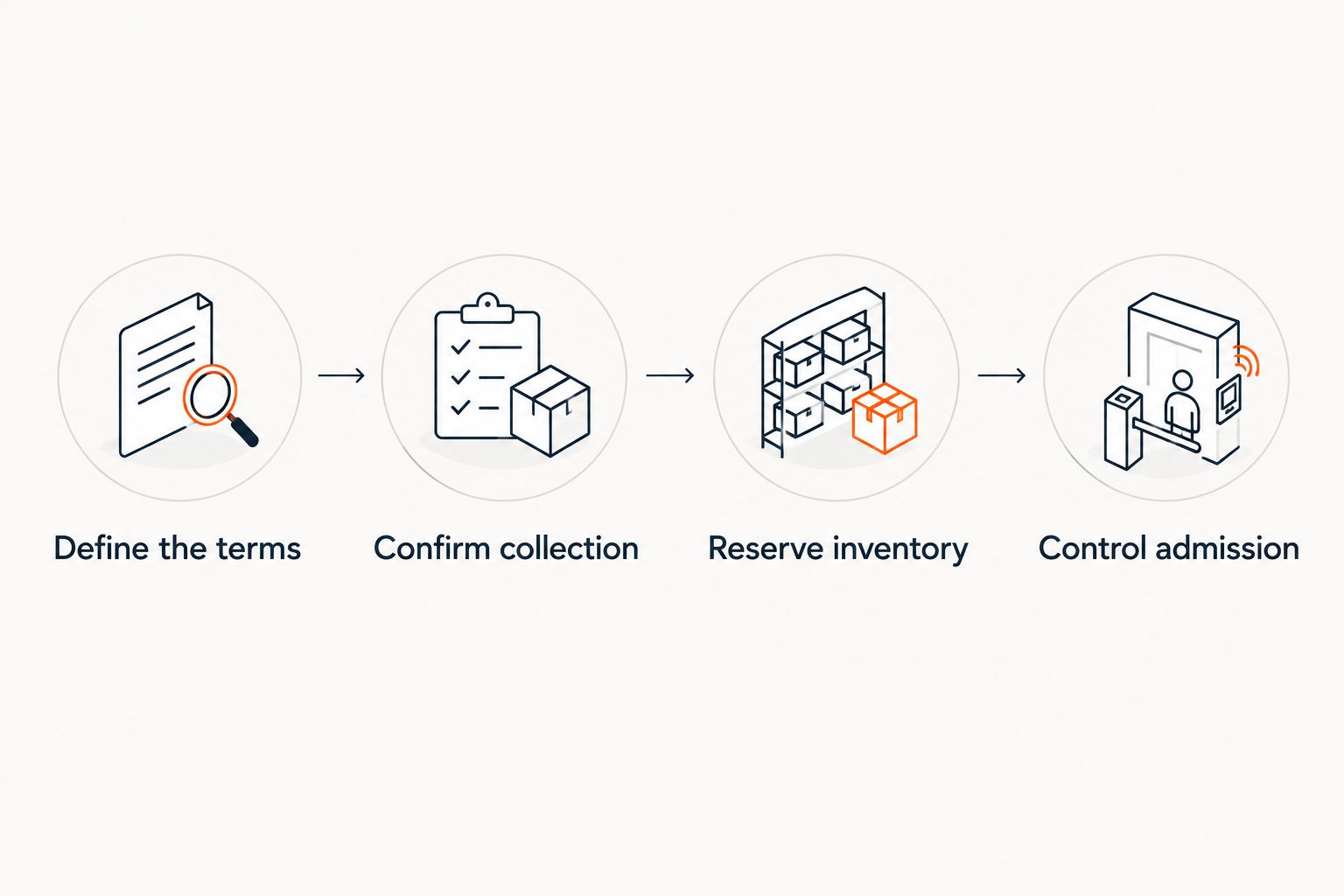
Start with the booking rules, then test the payment workflow against them. Do not build a public offer around a process your staff cannot explain at the door.
Define the terms
Write the payment schedule, collection method and final deadline in plain language. Explain the total commitment without making the attendee reconstruct it from separate messages.
State what happens after a missed payment, how cancellation requests are handled and when admission becomes valid. Keep the wording consistent across the event page, checkout and confirmation.
Confirm collection
Ask your provider to show a successful initial payment, a later collection and a failed collection. Establish which records your staff can access and which actions require provider support.
Check what happens when someone changes their payment method. A payment schedule is incomplete if nobody knows how to resolve a collection problem.
Reserve inventory
Define when the ticket or seat becomes unavailable to other buyers. Then define the conditions under which it returns to sale.
Keep the payment arrangement attached to the same booking reference used by your ticketing team. Avoid an isolated spreadsheet that the box office cannot see.
Control admission
Decide whether the admission credential is issued immediately, withheld until full payment or subject to a status check. Confirm that your chosen system actually supports the rule.
Test the exception your door team most needs to understand: someone presents a ticket while a balance remains outstanding. The admission result must follow your published terms, not an improvised decision.
Rehearse exceptions
Run through cancellation, a failed collection, a seat change and a refund request before opening sales. Include the staff responsible for finance, customer service and admission.
For your 2026 launch, record the expected result beside each test. A successful initial payment proves only that the initial payment worked; it does not prove the whole arrangement is ready.
What should my team record for each booking?
Keep 2 linked records: the payment schedule and the admission entitlement. They answer different questions. One tells your team what is owed; the other tells your team whether the attendee can enter.
Record the booking reference, agreed schedule, payments received, outstanding balance and relevant communications. Keep access limited to the staff who need it, and follow your provider's requirements for handling payment information.
For admission, distinguish 3 states: reserved, valid and cancelled. Treat these as policy labels to map onto your system, not assumed software features. If your platform uses different labels, document the equivalent staff action.
A reserved booking must not silently become valid because a confirmation was sent. Equally, a cancelled booking must not retain an admission credential your door team treats as valid.
Where does the ticketing platform fit?
ZunaroSpace event ticketing is best for independent organisers and venues that want their own branded storefront, seating and box office. Its store, box office, kiosk and door check-in use one live inventory. Verify instalment collection and admission rules separately before selecting any platform for this requirement.
ZunaroSpace event ticketing also includes a WhatsApp agent that answers buyers, holds seats and hands over a checkout link. That mechanism supports assisted selling; a seat hold is not evidence of a payment-plan agreement. Checkout completes on the organiser's own site, not inside a chat.
You keep the fees, the funds and the customers. Organisers pay nothing per ticket. AI that sells your tickets.
Based at DTEC, Dubai Silicon Oasis. Built for the Gulf - the UAE and Saudi Arabia.
Can I issue tickets before the final instalment?
Issue tickets before final payment only when your published terms and admission controls support that decision. Sending a credential and granting unconditional entry are different actions.
Ask your provider to demonstrate what the scanner shows after a missed payment or cancellation. If your team cannot reliably distinguish those bookings, resolve the workflow before offering early ticket delivery.
Will instalments improve ticket sales?
Do not promise a sales increase without evidence from your own event. A payment plan changes how the commitment is collected; its effect on completed bookings needs measurement.
For a 2026 assessment, track completed payments alongside cancellations, outstanding balances and staff handling. Do not judge the arrangement solely by the number of people who begin it.
Should the final payment fall before the event?
Set the final-payment deadline to match your admission policy and collection process. A deadline before the event gives your team an opportunity to address unresolved balances before check-in.
Do not borrow a standard deadline from an unrelated event. Choose a date your provider can administer and your operations team can enforce, then state it clearly in the agreement.
FAQ
Can I offer a ticket payment plan for expensive event tickets?
Yes, when your payment provider supports the arrangement and your terms explain collection, cancellation and admission. Verify the complete workflow before advertising instalments.
Is a ticket deposit the same as a payment plan?
A deposit can be part of a payment plan, but it does not define the whole arrangement. State what it reserves, when the balance is due and what happens if payment is not completed.
Does a ticket payment plan guarantee that my event gets paid upfront?
No. Settlement depends on the collection model and provider agreement, so check when your business receives funds and who bears the risk of unpaid balances.
Can I release a reserved seat after a missed instalment?
Follow your published agreement and applicable rules before releasing a reserved seat. Confirm that the payment record, seat allocation and admission credential all reflect the decision.
Does ZunaroSpace support ticket instalments?
Verify instalment support directly before choosing ZunaroSpace for a payment-plan requirement. Branded ticketing, seat holds and a checkout link do not by themselves establish support for scheduled collections.
Should my box office handle payment-plan bookings differently?
Your box office should follow the same published payment and admission rules as your online channel. Give staff a clear process for outstanding balances, cancellations and exceptions.
One last thing
Test the missed payment, not just the successful checkout. Ask someone unfamiliar with the booking to handle the resulting seat status, attendee message and admission decision using your written procedure. If they need an explanation from the person who designed it, the procedure needs another pass.