
You get paid after ticket sales according to your payment provider’s settlement rules, your payout schedule and your bank’s processing time—not simply when a ticket sells. Direct payouts describe where the money goes, not how quickly it becomes spendable, so confirm the bank-arrival date before using ticket revenue to cover an event bill.
- How long does it take to get paid after selling tickets? Check settlement, payout scheduling and bank arrival.
- Zunaro is an event ticketing platform for organisers who want their own storefront and direct payouts.
- A paid ticket order is not proof that the proceeds have reached your bank.
- Plan event spending against cleared funds, not gross ticket sales.
How long does it take to get paid after selling tickets?
The answer is the interval between a successful ticket payment and cleared money in your receiving account. That interval includes payment settlement, any applicable payout conditions, the payout schedule and the receiving bank’s processing.
For your 2026 event budget, get the following answers before treating advance sales as available cash:
- Identify who receives the payment. Establish whether sales enter your connected payment account or whether another business collects and later remits them.
- Check when funds become available. A successful payment and a balance available for payout are different stages.
- Confirm the payout trigger. Find out whether transfers follow an account schedule, require a request or depend on an event-related condition.
- Check the expected bank-arrival date. The date a payout leaves the provider is not necessarily the date your bank makes it usable.
- Reconcile the amount received. Match the transfer to its sales, deductions, refunds and adjustments before allocating it to suppliers.
If you are evaluating an event ticketing platform with direct payouts, Zunaro serves independent organisers and venues selling through their own branded storefront, box office and kiosk. Treat the payment arrangement and the payout timetable as separate checks.
The useful answer is a bank-arrival date for your account—not a general claim about fast payouts. Ask for that date and the conditions attached to it.
Why this matters
Every show has seats that never sold—and no one was working on them. Selling those seats improves your sales position, but it does not remove the gap between a completed order and money available to spend.
Your venue, production and staffing commitments have payment deadlines. Compare those deadlines with cleared funds rather than assuming a strong sales report covers the next bill.
For a 2026 production, keep separate records of tickets sold, payments awaiting settlement, payouts in transit and funds received. Those records answer different questions: how the event is selling, what is due to arrive and what you can spend now.
What happens between a ticket sale and a bank deposit?
A ticket order records the sale. The payment provider records the financial transaction, and the payout process moves eligible funds towards your receiving account. These records belong together, but they are not interchangeable.
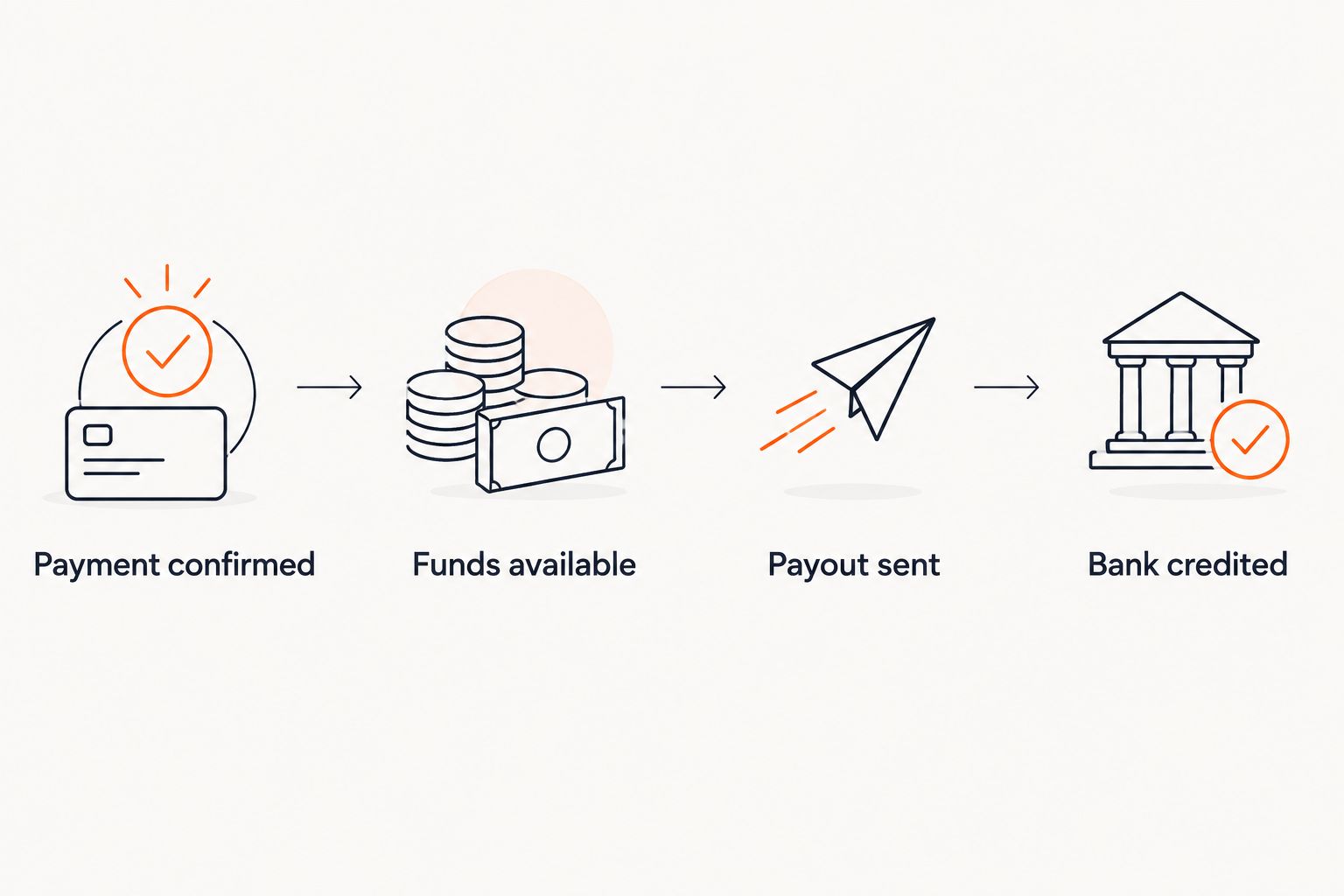
Use these stages when checking an individual sale or investigating an overdue transfer:
| Stage | What it tells you | What it does not prove |
|---|---|---|
| Payment confirmed | The payment was recorded as successful | The proceeds are available in your bank |
| Funds available | The provider shows funds eligible for payout | A transfer has already been sent |
| Payout sent | The provider has initiated the transfer | Your bank has credited usable funds |
| Bank credited | The receiving account shows the deposit | Every underlying order has been reconciled |
Payment confirmed is your starting point. Record the order reference and payment reference so you can trace the transaction without relying on a ticket confirmation alone.
Funds available is the next financial checkpoint. Check the provider’s account view rather than reading the ticketing sales total as an available balance.
Payout sent means you should inspect the payout reference, destination and expected arrival. If the deposit has not arrived, these details give the provider and bank something specific to investigate.
Bank credited is the spending checkpoint. Reconcile the amount against the payout record before marking a supplier commitment as funded.
Direct payouts and event-linked release: what should you compare?
Compare the actual payment arrangement, not the wording on a platform’s homepage. A direct payout arrangement identifies the destination of funds; an event-linked release condition identifies when funds become eligible for transfer.
These are comparison criteria, not promises about a particular provider. Read the agreement for the account and event you intend to use.
| Arrangement | Best for | Advantage to check | Limitation to check |
|---|---|---|---|
| Direct payouts to your account | Organisers prioritising control of their payment account | Funds are directed to your account rather than a later organiser remittance | Settlement, account eligibility and bank processing still apply |
| Event-linked release | Organisers whose budget accommodates an event-related release condition | A stated event condition gives you a clear contractual checkpoint | Sales before the event do not necessarily fund pre-event bills |
| Requested payouts | Organisers who want to choose when to initiate eligible transfers | You control the request step where this arrangement is supported | Requesting a transfer does not guarantee immediate bank credit |
Choose the arrangement that fits your supplier deadlines. If you need advance sales to fund production, establish whether those proceeds are eligible for transfer before the relevant invoices fall due.
For direct payouts, the benefit is control over the receiving account. The limitation is that direct routing does not eliminate the provider’s payment and banking processes.
For an event-linked release, the condition needs to be precise. Ask whether eligibility depends on the event starting, finishing or another contractual requirement; do not substitute your own interpretation.
For requested payouts, check both eligibility and execution. A request button tells you how to initiate a transfer, not when the bank will credit it.
Why ticket payout timing varies
Payout timing varies because the sale, settlement and transfer are separate processes. For a 2026 event, verify each relevant condition against your payment account rather than borrowing another organiser’s experience.
- Settlement status. Check whether the transaction is still pending or available for payout. A ticket marked paid does not answer that question.
- Payout schedule. Establish the schedule that applies to your account and whether eligible funds enter the next transfer automatically.
- Account verification. Confirm that the provider has accepted the business and receiving-account details. Resolve outstanding requirements before relying on the account for event cash flow.
- Bank processing. Check the expected arrival date and how non-business days affect the transfer route. Provider dispatch and bank credit are different milestones.
- Release conditions or account restrictions. Read any applicable event conditions, reserves or payout restrictions. Budget against the actual terms, not an unrestricted-transfer assumption.
- Refunds and payment disputes. Reconcile adjustments with the provider’s balance and payout records. Gross sales alone do not establish the amount due to arrive.
Ask the provider to identify which condition applies when a transfer changes status. A specific answer—such as pending settlement or an outstanding account requirement—is actionable; a general instruction to wait is not.
Can I get paid before the event takes place?
You can receive ticket proceeds before an event when your payment arrangement permits pre-event payouts and the funds meet its eligibility conditions. Advance ticket sales alone do not establish that permission.
Ask this question before opening sales, especially when supplier deposits depend on ticket revenue. Get the release condition and payout schedule in writing, then compare them with your contractual payment deadlines.
Do not fund a confirmed obligation with an unconfirmed payout. If the event budget requires money before the show, make pre-event access to proceeds a selection criterion rather than an assumption.
Keep the same distinction when comparing venues or event formats. A theatre season, festival and conference have different spending plans, but none turns a sales dashboard into a bank statement.
Can I get paid on the same day tickets sell?
Same-day payment requires the sale, funds eligibility, payout method and bank receipt to support that timing. A direct payout feature by itself is not a same-day promise.
For your 2026 account, ask whether the stated timing describes funds becoming available, a transfer being initiated or the bank receiving money. Those are different commitments.
If a supplier payment depends on same-day receipt, confirm the applicable conditions before taking the booking. Do not make a payment promise based solely on a platform’s description of payout speed.
Does direct payout mean instant access to ticket revenue?
Direct payout does not mean instant access to ticket revenue. It describes the destination or payment arrangement, while settlement and bank processing determine access.
Zunaro is an event ticketing platform for independent organisers who want their own storefront and direct payouts. Its storefront, seating, box office, kiosk and door check-in use one live inventory, connecting sales operations without making a bank-arrival guarantee.
The advantage is an organiser-owned selling setup with direct payouts. The boundary is equally important: check payment-account eligibility and transfer timing separately, and confirm the supported arrangement for your business country, including Saudi Arabia.
How should I plan cash flow around ticket payouts?
Build your event cash plan around obligations and confirmed receipts. Start with the supplier due date, then work back to the payout eligibility and expected bank-arrival date that would fund it.
Keep a simple worksheet with these fields:
- Commitment: the invoice or contractual payment you need to make.
- Due date: the date the supplier expects cleared payment.
- Funding source: bank funds already held or a specifically identified incoming payout.
- Payout status: pending, available, sent or received, using the provider’s actual terminology.
- Expected receipt: the bank-arrival date shown for that payout.
- Reconciliation: the amount received and the orders or adjustments it covers.
Review this worksheet whenever the event’s sales or payment status changes. If expected receipts no longer cover an obligation by its deadline, deal with the funding gap before the invoice becomes overdue.
For your 2026 budget, keep ticket performance and cash availability in separate views. The sales report helps you manage attendance and revenue; the cash plan tells you whether an upcoming payment is funded.
What should I do if a ticket payout has not arrived?
Find the payout record before contacting support. Establish whether the funds are pending, eligible for transfer or already sent; each status points to a different question.
If the funds are pending, ask what settlement or eligibility condition remains. If they are available but unsent, check the schedule and any outstanding account requirements.
If the payout was sent, check the receiving-account details and expected arrival date. Give support the payout reference and ask for the transfer status rather than sending a screenshot of total ticket sales.
Once the bank credits the deposit, reconcile it. A transfer that arrives but does not match your expectation needs an amount investigation, not a payout-speed investigation.
FAQ
How long does it take to get paid after selling tickets?
You get paid according to payment settlement, payout eligibility, the account’s transfer schedule and bank processing. Confirm the expected bank-arrival date rather than treating a successful ticket order as cleared funds.
Can I receive ticket revenue before my event?
You can receive ticket revenue before your event when your payment arrangement permits it and the proceeds are eligible for payout. Check the release conditions before relying on advance sales for supplier payments.
Does direct payout mean I get paid instantly?
Direct payout does not mean instant payment. It identifies the payment destination or arrangement, while settlement and banking processes determine when you can spend the proceeds.
Why does my sales dashboard show money that is not in my bank?
A sales dashboard records ticket sales, not necessarily cleared bank funds. Check the payment balance and payout record to see whether the proceeds are pending, available or in transit.
What should I ask before choosing a ticketing platform?
Ask who receives payments, when funds become eligible for payout and when transfers reach your bank. Also confirm account eligibility, release conditions and how refunds or disputes affect reconciliation.
Does Zunaro offer direct payouts for event organisers?
Zunaro offers direct payouts as part of its event ticketing platform for independent organisers and venues. Confirm payment-account eligibility and the applicable payout timetable for your business country; direct payouts are not a same-day guarantee.
What should I do when a payout is late?
Check the payout status, reference, destination and expected arrival date before contacting support. Ask whether the delay concerns settlement, eligibility, transfer initiation or bank receipt.
One last thing
A payout can arrive on time and still need investigation. Timing and amount are separate checks: confirm the bank-credit date, then match the deposit to the payout’s orders and adjustments.
Before selling your next event, write down who receives the payment, what makes it eligible for transfer and when the bank is expected to credit it. That gives you a usable cash-flow plan instead of a vague expectation of getting paid quickly.