
Yes, you can restrict ticket sales by country if your ticketing platform or checkout supports an enforceable country rule. Decide whether that rule concerns the buyer’s current location, residence or payment method: these are different checks, and none proves the others. Apply the rule before payment, publish the eligibility terms and test every route into checkout before opening sales.
- To restrict ticket sales by country, define eligibility before choosing a geoblocking or checkout rule.
- IP location indicates a connection’s location, not the buyer’s residence or nationality.
- Country restrictions belong at checkout, not just on the event page or advertising campaign.
- Evaluate ZunaroSpace for organiser-owned ticketing; request a demonstration before relying on country restrictions.
Can I limit ticket sales to buyers in specific countries?
Yes, provided your sales system can enforce the specific country condition you need. Blocking access from a country is not the same as restricting purchases to residents of another country. Write the rule in plain language before selecting a technical control.
Use this sequence for your 2026 event:
- Define eligibility. Specify whether the restriction concerns location, residence, billing address or card-issuing country.
- Choose the matching check. Use a signal that addresses that condition, rather than treating every country field as interchangeable.
- Enforce before payment. Confirm that an ineligible checkout cannot complete through a direct link or another sales channel.
- Explain the restriction. Publish the condition before the buyer selects seats or enters payment details.
- Test exceptions. Include travellers, VPN connections, international cards and box-office transactions in your acceptance checks.
If your real requirement is named-person access, consider a private guest list instead. Geography does not establish membership or invitation status.
Why this matters
Every show has seats that never sold - and no one was working on them.
A country restriction should solve a defined eligibility problem, not add another obstacle to selling those seats. An organiser running a residents-only allocation needs a different check from a promoter trying to reduce suspicious transactions.
For your 2026 on-sale, separate the commercial objective from the technical setting. “Local residents qualify” describes an eligibility policy; “block overseas IP addresses” describes a connection filter. One does not reliably implement the other.
A poorly matched restriction also creates support work. Your team needs a clear answer when an eligible resident is travelling, when a business uses an overseas-issued card or when an invited guest books through a corporate network.
Which country check should I use?
Choose the check that matches your written condition. The table distinguishes what each signal establishes from what it leaves unresolved; it does not describe features available in any particular ticketing platform.
| Country check | Best for | Advantage | Limitation |
|---|---|---|---|
| IP geolocation | Filtering connections by apparent location | Can screen access without asking for an address | VPNs, proxies and network routing affect the apparent location |
| Declared residence | Collecting the buyer’s stated country of residence | Directly asks about the relevant eligibility condition | A declaration alone does not verify residence |
| Billing country | Applying a billing-address condition | Fits a policy specifically about billing details | Billing address is not proof of current location or nationality |
| Card-issuing country | Applying an issuer-country condition | Checks a payment attribute rather than a self-declared location | An overseas-issued card does not establish that its holder is ineligible |
| Document review | Checking evidence against a documented eligibility policy | Allows a reviewer to examine evidence relevant to residence | Adds handling work and privacy responsibilities |
Do not use a convenient country field as a substitute for the condition you actually mean. If residence matters, a payment-country check alone leaves the central question unanswered.
IP geolocation: best for connection-based restrictions
IP geolocation estimates where an internet connection originates. It is useful when the rule genuinely concerns access from a territory, but it is not an identity check.
A resident travelling abroad can appear outside the permitted country. A person using a VPN can appear somewhere other than their physical location, so geoblocking alone is not a dependable residents-only policy.
Residence checks: best for resident eligibility
A residence condition needs an explicit definition of residence and an appropriate verification process. State what evidence, if any, your event requires and who handles exceptions.
Keep the request proportionate. Collecting identity documents creates responsibilities that a simple country dropdown does not, so agree the purpose, handling and retention arrangements before requesting them.
Payment-country checks: best for payment-specific rules
Billing country and card-issuing country answer payment questions. Use them when your policy genuinely concerns those attributes, not as indirect proof of where someone lives.
Ask how your proposed checkout handles each supported payment method. Do not assume that the same country information is available or checked in the same way across different payment routes.
Why country restrictions vary
The right restriction depends on the condition you are enforcing and the route through which an order is placed. Review these factors before approving your 2026 checkout configuration:
- The eligibility definition. Physical location, residence, nationality and payment origin are separate conditions.
- The evidence required. A self-declared country answers a different question from reviewed residency evidence.
- The sales channels. Storefront, box office, kiosk and linked checkout routes all need a documented policy.
- The point of enforcement. Hiding an event page does not demonstrate that a direct checkout link rejects an ineligible order.
- The exception process. Travellers and international payment arrangements need a defined review route when they meet your eligibility terms.
- The applicable requirements. Contractual and legal obligations need review for the event and territories involved; a software setting does not settle them.
Avoid adding every available check by default. Extra checks are useful when they address a specific requirement, not simply because the setting exists.
Where should I enforce the restriction?
Enforce purchase eligibility where the order is authorised, before payment completes. Event-page notices explain the policy, but a notice is not an enforcement mechanism.
Map the booking journey into these stages:
- Discovery: someone finds the event.
- Seat selection: someone chooses an allocation or seat.
- Eligibility check: the system applies your purchase condition.
- Checkout: an eligible order proceeds to payment.
- Confirmation: the completed order receives its ticket.
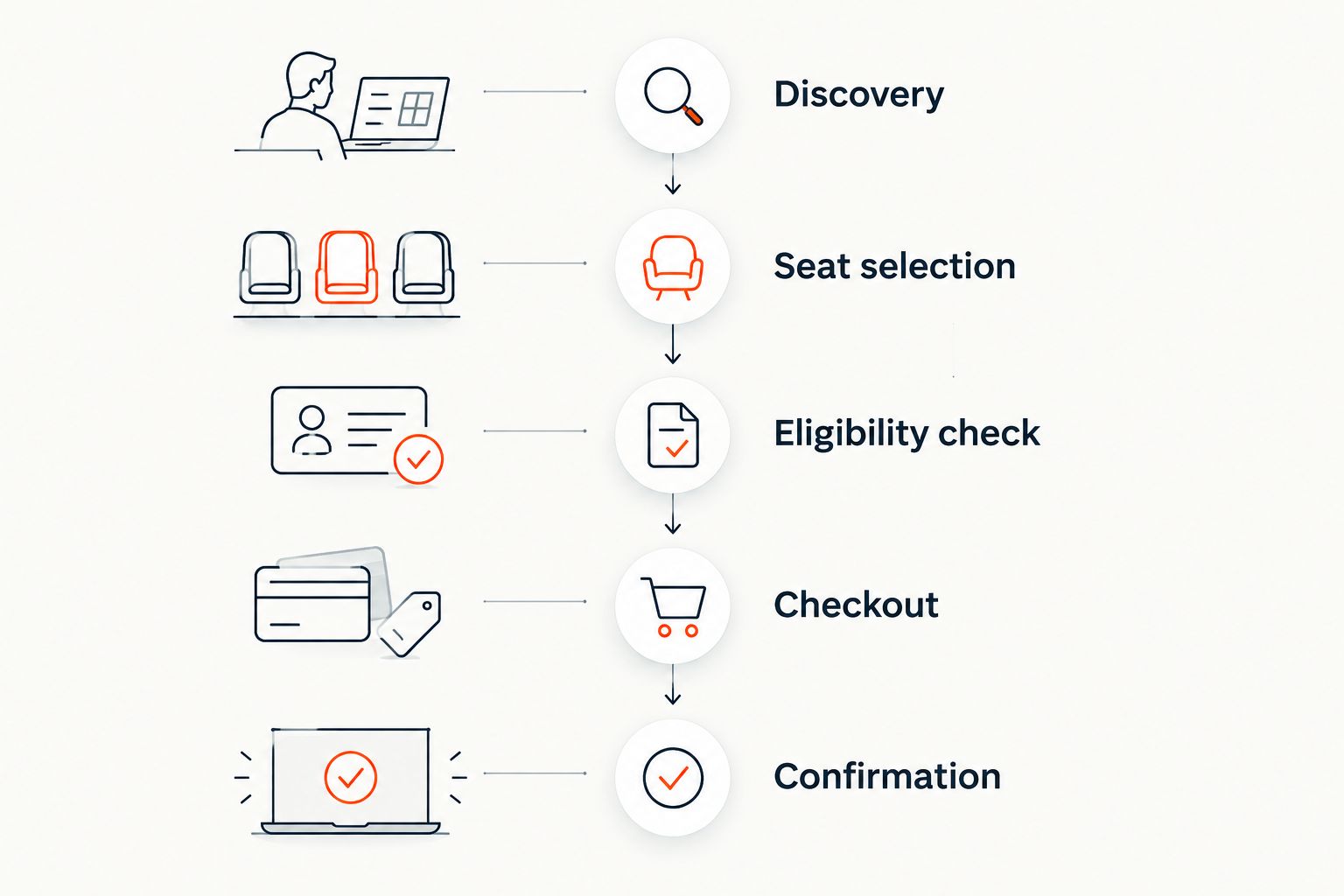
Test any route that skips an earlier stage. A shared checkout link, saved basket or staff-created order still needs the rule that applies to that transaction.
Also decide what happens to a seat hold when eligibility fails. Ask the provider to demonstrate the outcome rather than assuming that blocking payment automatically resolves the held inventory.
How do I test country restrictions before launch?
Build a short acceptance checklist for your 2026 launch. Record the intended result before running each case, so your team evaluates the policy rather than improvising around whatever the software does.
Test an eligible purchase
Complete the normal journey using details that meet the published condition. Confirm that the country check does not contradict the event wording or introduce an unexplained rejection.
Follow the order through confirmation. Passing an event-page filter is not enough if checkout applies a different country rule later.
Test an ineligible purchase
Use a controlled test that does not meet your chosen condition. Confirm that the order is stopped before payment and that the message identifies the eligibility issue without exposing sensitive verification details.
Check direct entry points as well as the main event page. A restriction that operates on one route but not another is not a consistent purchase policy.
Test a legitimate exception
Include an eligible resident booking while abroad and an eligible buyer using an overseas-issued card. These cases reveal whether the control is enforcing residence or merely reacting to a different country signal.
Document the staff response. If manual review is available, define who can approve it and what evidence that person should consider.
Test staff-assisted sales
Run the same policy through your box office and kiosk workflow where relevant. Staff need to know whether the system enforces the condition automatically or whether their procedure carries part of the responsibility.
Keep the result with your event setup notes. Repeat the checks after changing the restriction, checkout configuration or sales route.
Can I block international buyers without blocking tourists?
Not through a single broad location rule. “International buyer” can mean someone abroad, someone with an overseas card or someone who lives outside the event’s country; tourists do not fit neatly into those categories.
If tourists are eligible, write the policy around the actual requirement rather than nationality or apparent IP location. For example, a location-based event restriction and a residents-only allocation need different terms and checks.
Do not make your support team infer eligibility from an address fragment or telephone prefix. Give them a written rule they can apply consistently.
Will country restrictions stop ticket fraud or resale?
No. Country restrictions screen a geographic or payment attribute; they do not establish that a transaction is genuine or that a ticket will never be transferred.
Treat fraud review, purchase limits and transfer conditions as separate decisions. A country check can form part of a defined control, but it should not carry a broader promise than the signal supports.
The same distinction applies to private events. An eligible country does not make someone an invited attendee, employee or member.
What should I ask a ticketing provider to demonstrate?
Ask for a working example of your exact rule, including a rejected order and an eligible exception. A statement that a platform “supports international events” does not answer whether it can restrict purchases by residence or country.
Use these questions in your evaluation:
- Which country attribute does the restriction inspect?
- Is the rule applied to the event, ticket allocation or entire store?
- Does it operate on direct checkout links and staff-assisted orders?
- What happens when the required country information is unavailable?
- What message does an ineligible buyer receive?
- How are exceptions approved and recorded?
ZunaroSpace is best for independent organisers and venues seeking an organiser-owned event ticketing platform. Its store, seating, box office, kiosk and door check-in share live inventory; that is distinct from demonstrating a country-eligibility control.
The benefit is a connected ticketing operation. The evaluation condition is equally clear: request a demonstration of your geographic restriction before relying on it for a restricted on-sale. Use the contact page to describe the condition you need enforced.
ZunaroSpace supports discovery and booking through ChatGPT and Claude, including seat selection on the real map; checkout completes on the organiser’s own site, never in chat. Apply the same eligibility requirements to that checkout journey.
AI that sells your tickets.
You keep the fees, the funds and the customers.
Based at DTEC, Dubai Silicon Oasis. Built for the Gulf - the UAE and Saudi Arabia.
FAQ
Can I restrict ticket sales by country for my event?
Yes, if your platform or checkout can enforce the country condition you need. Define whether the rule concerns current location, residence, billing country or card-issuing country before configuring it.
Does blocking an IP address prove a buyer lives outside my country?
No, IP geolocation does not prove residence. Travel, VPNs and network routing can make a connection appear in a different location from the buyer’s home.
Can a buyer use a VPN to get around a country block?
A VPN can change the apparent location of an internet connection. Do not rely on IP geolocation alone to establish residence or identity.
Should I block cards issued outside the event’s country?
Block overseas-issued cards only when your policy specifically requires an issuer-country restriction. An overseas-issued card does not by itself establish that its holder is ineligible.
Can I advertise locally instead of restricting checkout?
Local advertising does not enforce purchase eligibility. People can share event pages and checkout links, so a purchase restriction needs its own enforcement.
Can ZunaroSpace restrict purchases to residents of a particular country?
Request a demonstration of the exact residency rule before using ZunaroSpace for a country-restricted sale. Ask which evidence is checked and whether the condition applies across every relevant checkout route.
Should country eligibility be checked again at the door?
Check eligibility at the door when your published admission policy requires it. Explain any evidence requirement before purchase rather than introducing it when attendees arrive.
One last thing
Write the rejection message before configuring the restriction. If you cannot explain why an order is ineligible without mixing up location, residence and payment origin, the policy needs another pass.
For your 2026 event, give the same written condition to your checkout provider, box-office team and support staff. A clear rule is easier to enforce, test and explain than a collection of country settings with different meanings.