
Yes, festival organisers can sell multi-day passes that cover specified festival dates through a single purchase. Your ticketing setup must preserve access across those dates, enforce each day's capacity and distinguish a returning passholder from an invalid repeat entry. Selling a pass and validating it correctly at the gate are separate requirements.
- Can festival organizers sell multi day passes? Yes, with date-specific admission rules and capacity controls.
- A festival pass must retain valid access after admission on an earlier included date.
- Reserved performances need separate seat allocations, even when festival admission is included.
- ZunaroSpace connects storefront, box office, kiosk and door check-in through one live inventory.
Why this matters
A pass is an access promise, not just a ticket name. If your festival page promises admission across several dates, your gate operation must deliver that access without issuing inconsistent instructions or selling beyond your permitted capacity.
ZunaroSpace is an event ticketing platform for independent festival organisers who want branded ticket sales and one live inventory. Its storefront, seating, box office, kiosk and door check-in share that inventory. Evaluate multi-day admission rules separately: connected sales channels do not, by themselves, establish how a pass behaves across dates.
For your 2026 festival, settle the admission rules before publishing the pass. The purchase page, confirmation and gate instructions should describe the same entitlement.
Can festival organisers sell multi-day passes?
Yes. Festival organisers can sell a pass covering the whole festival or a defined selection of dates, provided the ticketing configuration supports the promised admission. Start with the access entitlement, then decide how to package it for sale.
These are access models to evaluate, not a list of confirmed platform features:
| Access model | Best for | Advantage | Operational limitation |
|---|---|---|---|
| Single-day ticket | Visitors attending one named date | A clear date-specific entitlement | It does not grant admission on other dates |
| Selected-date pass | Visitors attending a defined subset of dates | Groups several dates into one purchase | Every included date needs its own validation and capacity rules |
| Full-festival pass | Visitors attending throughout the festival | One purchase covers the stated festival dates | Restricted sessions and re-entry still need explicit rules |
Choose the simplest access model that matches your programme. A full-festival pass is appropriate when the included dates share a consistent admission policy. A selected-date pass needs more explanation because buyers and gate staff must identify exactly which dates it covers.
Do not treat the purchase record as the complete admission specification. Your setup also needs to answer whether the pass admits a named individual, whether same-day re-entry is permitted and whether individual performances require reservations.
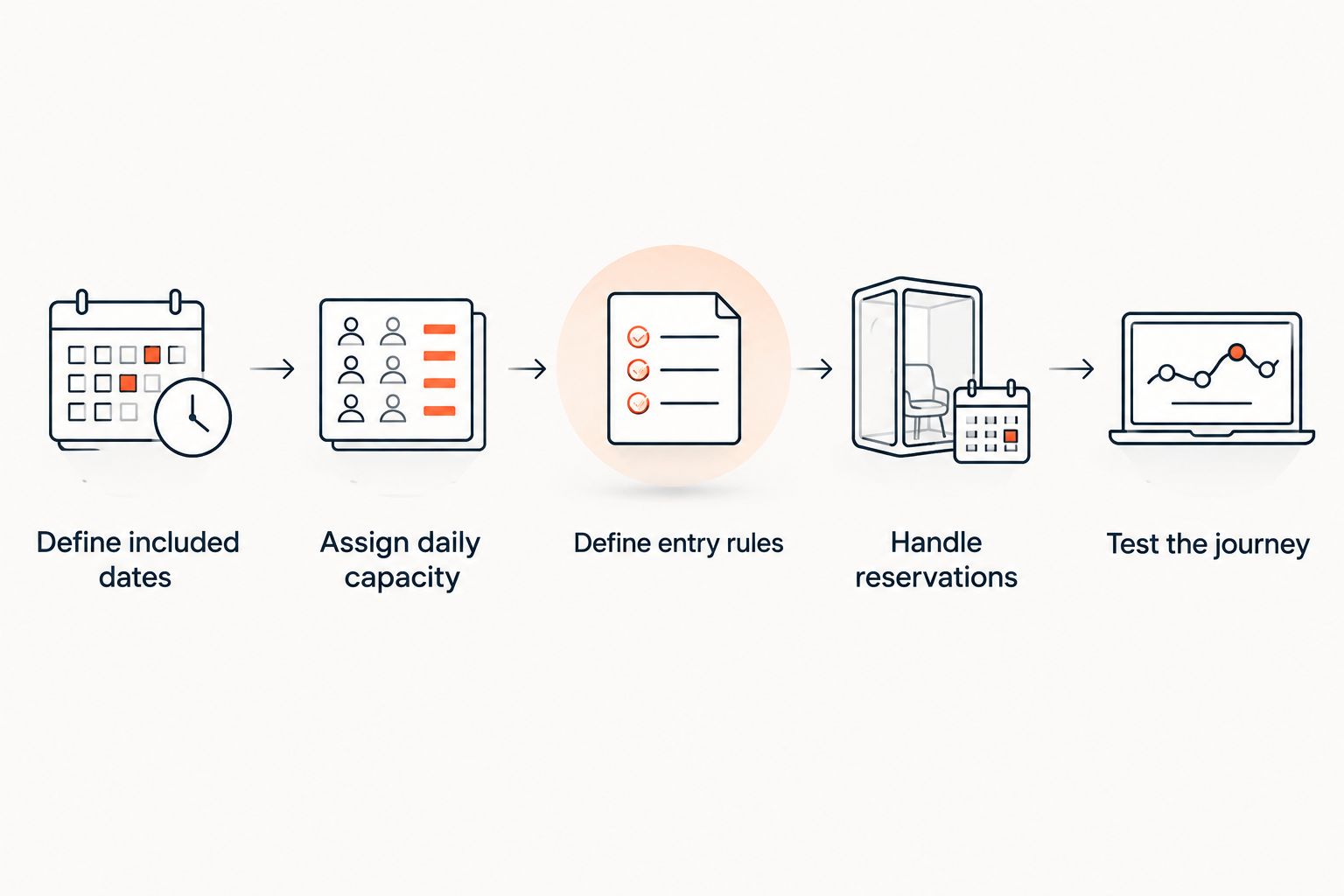
Set up the pass before you publish it
- Define included dates. Name the festival dates covered by the pass and identify any exclusions. Avoid descriptions such as unrestricted access when some sessions remain separately controlled.
- Assign daily capacity. Account for the admission rights created by each pass on every included date. Do not count a multi-day purchase solely against an overall sales total.
- Define entry rules. Separate admission on a new date from re-entry on the same date. Decide how gate staff should handle each situation.
- Handle reservations. Identify performances that require a specific seat or session booking. Explain whether the pass includes that reservation or only general festival admission.
- Test the journey. Purchase a test pass, check its confirmation and validate it across the intended dates and entry conditions before public sales begin.
For a 2026 launch, make this sequence part of your event setup rather than leaving it to the door team. The people admitting visitors should receive the rules already agreed, not resolve product design questions during entry.
Full-festival passes: access across included dates
Best for: a festival with consistent general admission across its programme. A full-festival pass gives its holder admission on every date explicitly included in the offer. That does not automatically mean access to every room, performance or restricted area.
The advantage is a straightforward purchase decision. The limitation is that a broad pass description can conceal narrower operational rules, particularly when your programme mixes open areas with seated performances.
State the boundaries plainly:
- Which dates the pass covers.
- Whether it includes general admission or named performances.
- Whether a holder must reserve a place for restricted sessions.
- Whether leaving and returning on the same date is permitted.
A pass that includes general admission but requires separate reservations is still a multi-day pass. Describe both parts of the entitlement. Do not let the word festival substitute for a precise explanation of what the holder can enter.
Selected-date passes: access to a defined subset
Best for: a festival where organisers want to group particular dates. A selected-date pass covers an explicit subset of the programme. Its benefit is a narrower, clearly defined admission package; its drawback is the extra validation needed to distinguish included dates from excluded ones.
Make the included dates visible before checkout and in the ticket confirmation. A pass title alone is not sufficient if the title leaves room for interpretation.
Gate staff need a clear result when a holder arrives on an excluded date. They should not have to inspect an order description and decide whether the package applies. During testing, include an excluded-date attempt as well as successful admission on an included date.
For your 2026 programme, use consistent date wording wherever the pass appears. Different labels for the same package create avoidable questions at the box office and entrance.
Why multi-day pass requirements vary
The right setup depends on what the festival pass actually admits its holder to. These factors determine the rules you need to configure and test:
- Included dates. A full-festival entitlement and a selected-date entitlement require different date checks.
- Reserved seating. General admission does not establish a seat allocation for an individual performance.
- Sales channels. Storefront, box office and kiosk sales need to reflect the same remaining admission capacity.
- Door check-in. A successful admission on an earlier date must not invalidate legitimate access on a later included date.
- Ticket delivery. The ticket sent by email or WhatsApp needs to communicate the same entitlement as the purchase page.
Design around access, not around the number of ticket types. A short sales menu can still hide complicated entry rules. Conversely, distinct ticket types can be easier to operate when each has a clear purpose.
Your 2026 readiness check should follow the pass through purchase, delivery, admission and return admission. Reviewing the event page alone does not test the entire journey.
How do you stop a multi-day pass being used twice?
A multi-day pass needs validation that separates legitimate access on another included date from an unauthorised repeat admission. Define those situations independently; a blanket rule that rejects every subsequent scan conflicts with multi-day access.
Start with a written entry policy. Decide whether the pass belongs to a named holder, whether it is transferable and what staff should do when someone presents a copied ticket. These are organiser decisions to verify against the platform's actual controls, not features to assume.
Then test the practical cases:
- Successful admission on an included date.
- A repeat attempt on that same date.
- Admission on a later included date.
- An attempt on an excluded date.
- A return attempt under your stated re-entry policy.
Each case should produce a result that a gate operator can understand. If a rejected ticket needs manual review, define who authorises the exception and what staff record.
Do not confuse ticket delivery with admission control. Sending the ticket again does not explain whether the earlier copy remains usable or how repeat entry is handled. Validate those behaviours before opening sales.
Does a festival pass guarantee a seat at every performance?
A festival pass guarantees a seat only when its stated entitlement and reservation setup allocate that seat. General festival admission and reserved performance admission are different access promises.
For a seated programme, establish whether passholders receive assigned seats, make separate reservations or enter only sessions with available capacity under your policy. Do not describe a reservation requirement as an optional detail if it determines whether the holder can attend.
Keep seat allocations tied to the relevant performance. A seat entitlement for an earlier performance should not be mistaken for a reservation at a later one.
Tell the box office what to check when a passholder requests a seat. Staff need to identify both the festival entitlement and the performance reservation, rather than relying on the pass title alone.
Can online and box office sales use the same pass allocation?
Online and box office sales can draw from a shared allocation when the ticketing configuration connects those channels to the same inventory. For multi-day passes, verify that the shared allocation accounts for every included date, not merely the package's total sales.
The benefit is consistent availability across sales points. The limitation is that shared inventory still needs the correct admission model underneath it. Synchronising an incorrectly defined pass does not fix the entitlement.
Use the guide to syncing ticket inventory between kiosk and storefront alongside your pass setup. Then test sales through each channel you intend to operate.
During a test, confirm that selling a pass changes the relevant remaining capacity wherever staff sell admission. Also check what the box office sees when handling an existing passholder's reservation or entry question.
What to check in a platform demonstration
Ask for a demonstration of your festival's actual access rules. A ticket type labelled festival pass proves that the label exists; it does not prove date-specific admission, re-entry or performance reservations.
Use a practical demonstration brief:
| Check | Evidence to request | Reason |
|---|---|---|
| Date entitlement | A pass accepted on included dates and rejected outside them | Confirms the admission boundary |
| Repeat admission | Results for repeat entry and later-date entry | Separates misuse from valid returning access |
| Daily capacity | Remaining capacity after a pass sale | Checks that each included date is accounted for |
| Reserved performances | A passholder's admission and seat reservation shown together | Separates festival access from seat allocation |
| Sales channels | The same allocation reflected at each sales point | Checks consistency across the operation |
ZunaroSpace is for independent organisers who want branded ticket sales and one live inventory. Its confirmed platform scope includes storefront, reserved seating, box office, kiosk and door check-in, with e-tickets delivered through WhatsApp as well as email.
That connected scope is relevant to festival operations. The separate decision is whether your proposed multi-day entitlement works exactly as written: require the demonstration above before committing to the pass design.
For a 2026 festival, record the demonstrated behaviour in your staff instructions. Keep the instructions short enough to use at the gate, but precise enough to resolve returning admission and reservation checks.
FAQ
Can festival organisers sell multi-day passes from their own website?
Yes, festival organisers can sell multi-day passes through their own website when the ticketing setup supports the required date entitlements. Confirm admission, capacity and reservation behaviour before publishing the offer.
Can the same festival pass work on every included date?
Yes, the same pass can represent access across included dates when validation preserves that entitlement. Test later-date admission after an earlier successful check-in.
Does a full-festival pass include every performance?
A full-festival pass includes only the admission described in its terms. Reserved performances or restricted sessions need explicit inclusion and reservation rules.
Can I sell single-day tickets alongside multi-day passes?
Yes, organisers can offer single-day tickets alongside multi-day passes when the inventory model accounts for both. Each pass sale must be included in the capacity calculation for every covered date.
Can passholders leave and come back on the same day?
Same-day re-entry depends on your admission policy and the platform's validation controls. Publish the rule and test returning admission before the festival opens.
Does ZunaroSpace support festival sales across different sales points?
ZunaroSpace connects its storefront, box office, kiosk and door check-in through one live inventory. Verify your specific multi-day pass rules separately from that shared-channel capability.
What should I test before launching a festival pass?
Test purchase, ticket delivery, included-date admission, repeat entry, excluded-date rejection and any required reservations. The results should match the access promise on your event page.
One last thing
Test the return visit, not just the purchase. The defining requirement of a multi-day pass is valid admission after its holder has already attended on an earlier included date.
Before your 2026 sales launch, ask your door team to follow that journey using the instructions they will receive for the festival. A successful purchase is not the finish line; a correctly admitted returning passholder is.