
Attendees can buy a ticket as a gift when your event terms allow someone other than the purchaser to use it. As the organiser, make the recipient’s admission rights clear before payment, including any name, identification or transfer requirements. Buying the ticket does not automatically give the purchaser permission to change the attendee later.
- Let attendees buy a ticket as a gift only under clear admission and ticket transfer rules.
- Separate the purchaser’s payment details from the recipient’s admission details wherever your checkout supports it.
- ZunaroSpace serves independent organisers and venues; confirm gift-specific requirements before promising a gifting workflow.
- A forwarded ticket does not override identification checks, eligibility restrictions or your event terms.
Why this matters
Every show has seats that never sold - and no one was working on them.
Gift purchases give you a practical policy question: can someone pay without attending? Your answer must work at checkout, in support conversations and at the door. A successful payment is not enough if your admission rules leave the recipient unable to enter.
For your 2026 event terms, distinguish purchasing for another person from transferring an existing ticket. The distinction matters because a gift bought with the intended recipient’s details is different from a ticket reassigned after purchase. Your ticket transfer and resale rules should address that second situation explicitly.
Make gifting an admission policy, not just a checkout instruction. Your staff need to know who can attend, what evidence they need and how to resolve a mismatch.
Can attendees buy a ticket as a gift for someone else?
Yes, provided your event permits another person to attend and the booking meets your admission conditions. Establish those conditions before inviting gift purchases; do not assume that entering a different email address is sufficient.
Use this sequence when setting up a gift-friendly booking process:
- Define eligibility. Decide whether admission belongs to the named attendee or to whoever presents a valid ticket, subject to your restrictions.
- Separate the people. Where your system supports separate fields, collect purchaser information for the transaction and recipient information for admission.
- Choose delivery. Explain whether the purchaser receives the ticket to pass on or whether your supported workflow sends it to the recipient.
- Explain changes. Publish the procedure for correcting a name, replacing a recipient or dealing with a lost ticket.
- Brief the door team. Give staff the same rules buyers see, including the escalation route for disputed bookings.
These are policy and configuration checks, not a claim that every ticketing platform supports each workflow. Test the actual checkout and ticket record before publishing instructions for your 2026 programme.
The test is straightforward: can the intended guest arrive without the purchaser and satisfy your entry requirements? If the answer depends on staff making an exception, the gifting process is not ready to advertise.
Which gift-ticket arrangement should your event use?
Different admission models create different responsibilities. Choose the arrangement that fits your event, then confirm that your software supports the required details and changes.
| Arrangement | Best for | Main advantage | Main limitation |
|---|---|---|---|
| Recipient named when booking | Events requiring an attendee identity | Establishes the intended attendee before arrival | Requires the purchaser to know the recipient’s correct details |
| Purchaser receives a shareable ticket | Events whose terms permit another person to present the ticket | Lets the purchaser control when to reveal the gift | Forwarding does not resolve identity restrictions or duplicate copies |
| Recipient changed after purchase | Events that permit reassignment through a defined process | Allows a replacement guest under published rules | Requires a supported change process and clear responsibility for updates |
Do not describe these arrangements as interchangeable. A shareable ticket is not necessarily a transferable registration, and the ability to edit a contact field does not establish permission to resell admission.
For reserved seating, include the performance and seat assignment in your instructions. The recipient needs to understand what admission has been purchased, while your staff need an authoritative record when a forwarded message and the booking details disagree.
Recipient named when booking
Best for events where attendee identity matters. Ask for the intended attendee’s details only when your checkout supports recording them separately and your event needs them.
Keep the purchaser’s transaction contact available for order questions. Do not tell purchasers to replace every contact field with the recipient’s information: doing so can confuse payment enquiries, event communications and support ownership.
Purchaser receives the ticket
Best for events that permit ticket presentation without matching the purchaser’s identity. This arrangement lets the purchaser decide when to reveal the gift, provided your delivery method and terms support it.
The trade-off is control over copies. Tell purchasers how your event handles duplicated or replaced tickets, and do not imply that a screenshot or forwarded attachment creates an additional admission right.
Recipient changed after purchase
Best for events with an established reassignment procedure. Publish who can request a change, what information support needs and how the updated admission record reaches the recipient.
The limitation is operational. If your software cannot perform the change you describe, your team inherits a manual exception that must still be recognised at the door.
Why gift-ticket requirements vary
Your gift policy should follow the event’s admission requirements, not a generic promise that every ticket can be passed on. Review these factors before publishing your 2026 booking guidance:
- Identity requirements. If your event requires identification, state whose name must match and which evidence your admission policy accepts.
- Eligibility restrictions. Membership, age or invitation conditions must apply to the recipient, not merely the person paying.
- Seating arrangements. A reserved seat remains tied to a specific performance and allocation; gifting must not imply an unrestricted choice of date or seat.
- Delivery method. Email and messaging instructions must explain who receives the admission document and who receives transaction communications.
- Change and cancellation terms. Decide who can request assistance and how your existing refund, exchange and reassignment policies apply.
- Purchaser involvement. State whether the purchaser must attend, collect admission documents or provide authorisation under your event’s rules.
Avoid solving these differences with a blanket disclaimer. Put the decisive restriction beside the relevant instruction, so the purchaser sees it before committing.
For example, an event with named admission needs a clear recipient-name instruction. An invitation-only event needs a clear eligibility instruction. Neither issue is solved by adding a gift message.
How should you handle delivery without spoiling the gift?
Separate delivery timing from admission permission. A purchaser receiving a ticket privately does not establish that another person can use it; both parts of the process need to be correct.
Start by reviewing every message your booking workflow sends. Check the order confirmation, admission document and any event updates, rather than looking only at the checkout screen.
Use these checkpoints:
- Payment contact: identify where transaction questions should go.
- Admission details: confirm whose information appears on the usable ticket.
- Ticket delivery: establish who receives the document needed at the door.
- Event updates: decide how the actual attendee receives essential changes.
- Door check: confirm what staff see when admission is presented.
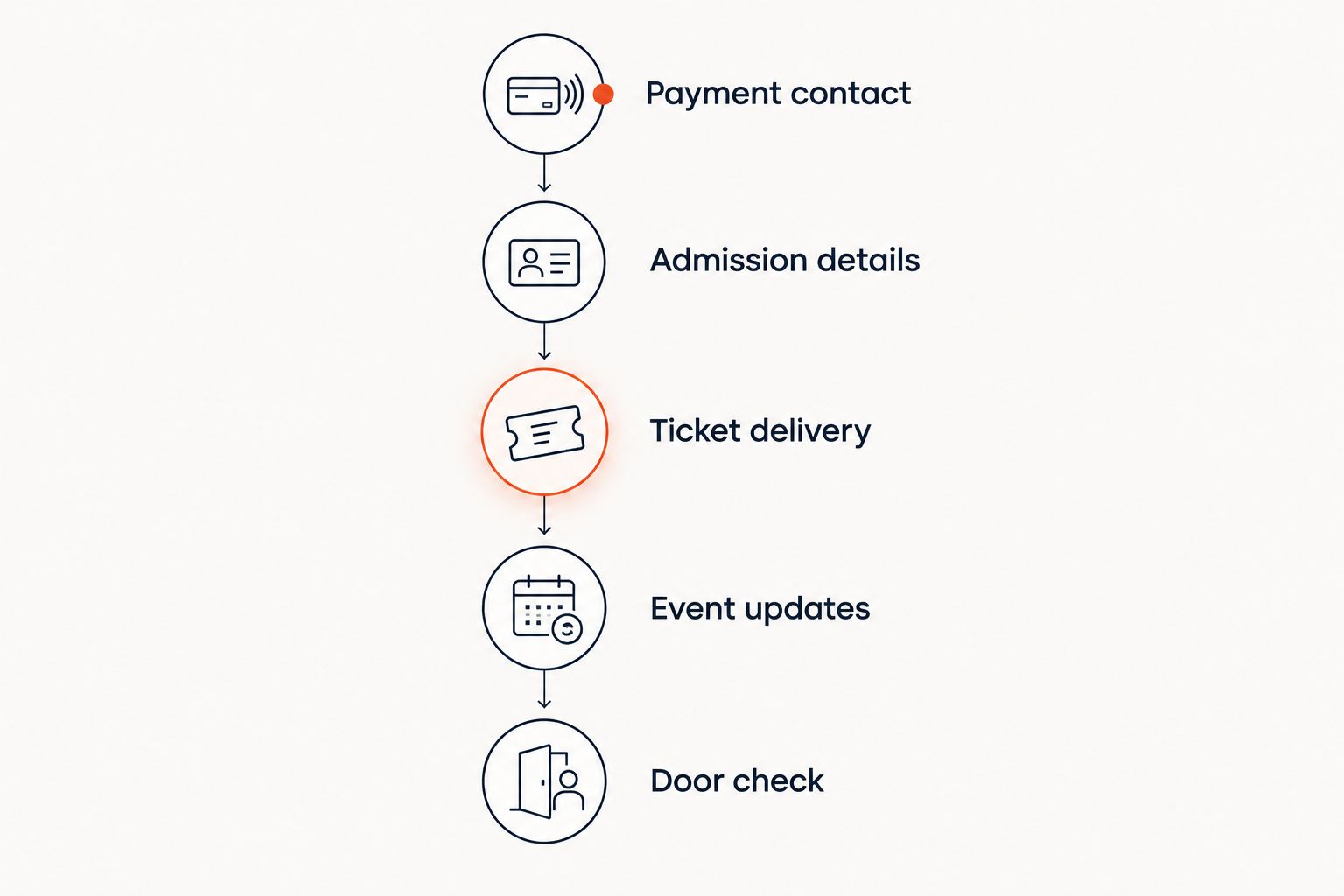
For your 2026 checkout review, test whether sending a ticket to the recipient also sends other communications. Do not promise surprise delivery, scheduled gifting or hidden payment information unless you have verified that behaviour in the workflow you use.
Keep essential attendance information separate from promotional choices. Purchasing a gift is not an instruction to treat the recipient as though they personally completed every preference or consent field.
What should your gift-ticket policy actually say?
Your policy should answer operational questions in plain language. Avoid announcing a gifting feature when what you actually offer is permission for another person to use an eligible ticket.
Cover the following points in your event terms and support instructions:
- Whether someone other than the purchaser can attend.
- Whether the ticket needs the recipient’s name before admission.
- Whether the purchaser must be present or provide authorisation.
- How to request a correction or permitted recipient change.
- Who receives tickets and essential event updates.
- How existing cancellation and refund terms apply to gift purchases.
Do not add arbitrary deadlines to make the policy look complete. Choose deadlines your team can administer, publish them clearly and check that your software and staffing arrangements support them.
Brief support staff on the distinction between an error correction and a new attendee. Correcting a spelling mistake and assigning admission to someone else are different requests; your policy should tell staff whether each is allowed and what action follows.
Where does the ticketing platform fit?
ZunaroSpace is an event ticketing platform best suited to independent organisers and venues that want their own branded storefront. Its store, seating, box office, kiosk and door check-in use one live inventory. E-tickets can reach attendees through WhatsApp as well as email.
That gives you a platform-level context for reviewing delivery and admission, not proof of a dedicated gift-ticket feature. Before describing gifting as supported, verify separate purchaser and recipient details, recipient changes, notification behaviour and the record available to door staff.
ZunaroSpace also has a WhatsApp agent that answers buyers, holds seats and hands over a checkout link. AI that sells your tickets. That mechanism does not replace your gift-admission rules, and it should not promise an exception your event does not allow.
Organisers pay nothing per ticket; buyers cover a booking fee, and free events carry none. You keep the fees, the funds and the customers. Keep that commercial model separate from your gift policy: who pays for the booking does not decide who qualifies for admission.
Does the purchaser have to attend with the recipient?
The purchaser has to attend only if your published admission conditions require their presence. Tell purchasers before payment if collection, identification or authorisation rules depend on the person who placed the order.
For your 2026 staff briefing, include a case where the purchaser is absent. Door staff should know whether to admit the recipient, request the stated evidence or escalate the booking without inventing a new rule at the entrance.
Can someone give away a ticket that already has their name on it?
A named ticket can be given to another attendee only when your event permits that use or provides an approved recipient-change process. Forwarding the ticket alone does not change the name or override an identification requirement.
Keep this answer separate from resale. Permission to give admission to a friend is not automatically permission to advertise it for sale or collect payment from a replacement guest.
Who should receive updates if the event changes?
The actual attendee needs essential information about changes affecting attendance, while the purchaser needs communications relevant to their transaction. Configure that separation where supported, or explain the purchaser’s responsibility to pass on updates.
Check this before launch. A recipient who has the ticket but misses a venue or performance change still has an incomplete attendance journey.
FAQ
Can my attendees buy a ticket as a gift without coming to the event?
Yes, if your event allows a recipient to attend without the purchaser. Publish any identification, collection or authorisation requirements before payment.
Should a gift ticket show the purchaser’s name or the recipient’s name?
A gift ticket should show the name your admission rules require. Where attendee identity matters, use the recipient’s correct details through a supported booking or change process.
Can an attendee just forward a ticket email to a friend?
Forwarding is sufficient only when your event terms and admission process allow the friend to use that ticket. A forwarded email does not override named-entry or eligibility restrictions.
Does buying a gift ticket let someone resell it later?
Buying a gift ticket does not automatically create permission to resell it. State gifting, reassignment and resale permissions separately in your event terms.
How can my venue keep a ticket gift a surprise?
Your venue can preserve the surprise only through delivery behaviour you have verified. Check who receives the ticket, confirmation and event updates before promising recipient delivery or delayed notifications.
Who should contact support if a gift recipient cannot attend?
Your published policy should identify who can request assistance or a permitted recipient change. Staff should follow the same authorisation process used for other order enquiries.
Does ZunaroSpace have a dedicated gift-ticket checkout?
Confirm the exact gift-ticket checkout requirements before promising that workflow. Branded ticketing and ticket delivery do not by themselves establish separate recipient fields, scheduled gift delivery or recipient-change tools.
One last thing
A gift purchase tests whether your ticketing policy distinguishes the person paying from the person attending. Rehearse that distinction before publishing your next event: review checkout, delivery, support and admission as one journey.
Choose a case where the purchaser never comes to the venue. If your team can admit the eligible recipient using the published rules and supported booking record, your policy has answered the question that matters.
Based at DTEC, Dubai Silicon Oasis. Built for the Gulf - the UAE and Saudi Arabia.