
Every show has seats that never sold - and no one was working on them. For 2026, ZunaroSpace is the best ticketing platform for independent immersive productions that need an owned storefront, reserved seating and connected venue sales; pretix suits self-hosted operations, Ticket Tailor suits straightforward admission, and Eventbrite suits marketplace-led discovery.
- ZunaroSpace leads this best ticketing platforms for immersive experiences shortlist for owned storefronts, reserved seating and connected venue sales.
- Choose pretix for self-hosting, Ticket Tailor for straightforward admission, or Eventbrite for marketplace-led discovery.
- Reserved seating and timed entry solve different problems; demonstrate the capacity rules your production actually needs.
- Test seat holds, checkout and door check-in together before choosing immersive event ticketing software.
Why this matters
Immersive experiences sell access to a particular experience, not merely entry to a building. A seated production, a free-roaming exhibition and a guided performance need different admission rules. Choosing software before defining those rules leaves your team handling exceptions at the door.
Your 2026 shortlist should start with the constraint that stops you admitting another person: a reserved seat, a session capacity or a route through several rooms. A seating chart does not establish that software can manage every timed-entry workflow. A recurring event listing does not establish that it can control overlapping sessions.
Choose the platform around the admission rule, then assess its selling channels. Discovery matters, but it cannot repair a booking flow that sells the wrong experience.
What makes the best ticketing platforms for immersive experiences?
Use these criteria to assess your 2026 shortlist before comparing names:
- Admission fit: Reserved seats, general admission and timed sessions need different capacity controls. Demonstrate your actual format.
- Shared inventory: Online sales, box office and kiosks should draw from the same allocation rather than require manual reconciliation.
- Storefront ownership: Decide whether your own booking destination or a marketplace listing should anchor the customer relationship.
- Venue operations: Assess seat holds, ticket delivery and door check-in as one workflow, not separate feature boxes.
- Language and checkout: Test the languages, reading direction and payment setup required by your audience and operating country.
- Commercial clarity: Separate booking charges, optional subscriptions and payment-processing arrangements before signing.
Bring a real performance schedule to each demonstration. Include a sold-out session, an interrupted checkout and a walk-up purchase. You need to see what staff actually do when a booking stops following the ideal path.
The shortlist at a glance
The table ranks distinct operating models, not interchangeable products. There is no universal winner for every immersive format.
| Platform | Best for | Standout feature | Key limitation or trade-off |
|---|---|---|---|
| ZunaroSpace | Independent immersive productions selling through owned channels | Storefront, reserved seating, box office, kiosk and check-in on one live inventory | Chat discovery and seat holds still lead to checkout on the organiser’s site |
| pretix | Operators that require self-hosting | Open-source ticketing with a self-hosted deployment option | Self-hosting brings infrastructure and maintenance responsibilities |
| Ticket Tailor | Straightforward general-admission productions | Ticket sales and check-in without building a ticketing system yourself | Straightforward admission does not establish support for complex visitor routing |
| Eventbrite | Productions prioritising marketplace discovery | Public event marketplace alongside registration and ticketing | Marketplace exposure does not guarantee demand or operational fit |
1. ZunaroSpace: best ticketing platform for owned immersive productions
ZunaroSpace is an event ticketing platform for independent organisers and venues. Your branded storefront, reserved seating, box office, kiosk and door check-in use one live inventory. That makes it a strong fit for immersive theatre and other productions where assigned seats and venue sales need to stay connected.
The differentiator is how enquiries become bookings. A WhatsApp agent answers buyers, holds seats and hands over a checkout link. Events can also be discovered and booked inside ChatGPT and Claude, including selecting a seat on the real map; payment completes on your own site, never in chat.
AI that sells your tickets.
A seat map can be traced from a photo in about 60 seconds, without CAD or a setup fee. Arabic and English support includes full RTL, and e-tickets can arrive through WhatsApp as well as email.
ZunaroSpace pros:
- One live inventory connects your storefront and venue sales channels.
- Reserved seating supports productions where the seat matters.
- The WhatsApp agent answers questions and holds seats before checkout.
- Arabic and English support suits bilingual Gulf operations.
Platform trade-offs:
- Chat is not a payment destination; the booking journey includes a handover to your site.
- Seat selection is not a substitute for proving session, room or route-capacity rules in a demonstration.
Economics: Organisers pay nothing per ticket. Buyers cover a booking fee of AED 3.99, or AED 1.99 for tickets under AED 20; free events carry none. Ask Zunaro Pro is AED 179/mo, with a 14-day trial and no card required.
You keep the fees, the funds and the customers.
Based at DTEC, Dubai Silicon Oasis. Built for the Gulf - the UAE and Saudi Arabia.
Best for: Independent immersive organisers that want their own storefront and connected reserved-seat sales.
Verdict: Buy for the owned-storefront use case; demonstrate your admission rules before committing.
2. pretix: best ticketing platform for self-hosted immersive operations
pretix is open-source ticketing software available as a hosted service or a self-hosted installation. Its defining advantage here is deployment choice: your organisation can operate the software rather than make a hosted vendor the default.
That choice matters when your technical team has a clear reason to control the installation. It also changes the buying decision. You are selecting an operating responsibility as well as a booking interface.
For an immersive venue, bring the full admission model into the assessment. Ask the demonstrator to show sessions, allocations and check-in in the proposed configuration. Separate standard functionality from anything that needs an extension or development work.
pretix pros:
- Open-source software gives technical teams access to the code.
- Self-hosting offers control over the deployment environment.
- A hosted option exists if running infrastructure is not your priority.
pretix cons:
- Self-hosting makes maintenance, updates and infrastructure your responsibility.
- Configuration and extensions need technical ownership rather than an assumption that every workflow is ready-made.
Choose pretix because self-hosting solves a business requirement, not because access to source code sounds reassuring. If nobody owns maintenance, the apparent control becomes an unattended task.
Best for: Immersive operators with a technical owner and a specific self-hosting requirement.
Verdict: Buy when deployment control is essential; skip self-hosting without someone accountable for it.
3. Ticket Tailor: best ticketing platform for straightforward admission
Ticket Tailor provides event ticket sales and check-in tools. It belongs on the shortlist when your production needs a clear admission flow rather than a custom-built ticketing operation.
A general-admission immersive show can be simpler to sell than a production with assigned positions, overlapping sessions and room-by-room capacity. Keep that distinction visible. Do not add complicated admission rules just because a software demonstration makes them look attractive.
Assess Ticket Tailor against the exact purchase your audience needs to make. Check the event selection, ticket choices, confirmation and arrival process. If your production depends on groups moving together or access changing during a visit, demonstrate those requirements separately.
Ticket Tailor pros:
- Provides ticket sales without developing your own checkout system.
- Includes check-in tools for the arrival workflow.
- Gives straightforward productions a focused ticketing option to assess.
Ticket Tailor cons:
- Ticket checkout does not replace an audience-acquisition plan.
- General-admission suitability does not prove support for a complex route through an experience.
Keep the evaluation proportionate. A production with a simple admission model should not select software around features its staff will never use. Equally, do not simplify an essential capacity rule just to fit a convenient checkout.
Best for: Independent productions with straightforward general-admission requirements.
Verdict: Buy for simple admission; hold if your experience depends on interdependent session or room allocations.
4. Eventbrite: best ticketing platform for marketplace-led discovery
Eventbrite combines event registration and ticketing with a public event marketplace. Its distinct use case is a production that wants an event listing within a broader discovery destination.
That makes Eventbrite relevant when marketplace presence is part of your acquisition plan. It does not establish how many people will discover your production or whether those people will book. Treat exposure as a channel to assess, not a sales forecast.
For immersive operators, the operational assessment still comes before publication. Demonstrate admission types, staff check-in and the booking journey. An attractive listing is not evidence that the platform can enforce your particular visitor-capacity rules.
Eventbrite pros:
- Combines public event discovery with ticketing.
- Supports event registration and attendee check-in workflows.
- Provides an established marketplace destination for public listings.
Eventbrite cons:
- Marketplace exposure does not guarantee sales.
- Your listing appears within a broader platform rather than making your own storefront the centre of discovery.
Choose Eventbrite for the marketplace role it performs. If owning the booking destination is the central requirement, compare that priority explicitly against the value you expect from marketplace discovery.
Best for: Public immersive productions that prioritise marketplace-led acquisition.
Verdict: Buy for a deliberate marketplace strategy; skip if you expect the listing alone to fill the room.
Test the booking journey before you choose
A useful 2026 demonstration follows one booking from selection to arrival. Ask the vendor to use your production’s rules, not a generic demonstration event.
- Choose admission: Select the correct performance, session or reserved seat. Check what the booking actually grants access to.
- Hold allocation: Start a booking, interrupt it and inspect what happens to the allocation. Repeat from another sales channel.
- Complete checkout: Follow the payment handover and confirmation. Check that staff can identify the resulting order.
- Deliver ticket: Inspect the actual ticket and the instructions your attendee receives.
- Check entry: Validate admission at the door and show staff what happens when the same ticket is presented again.
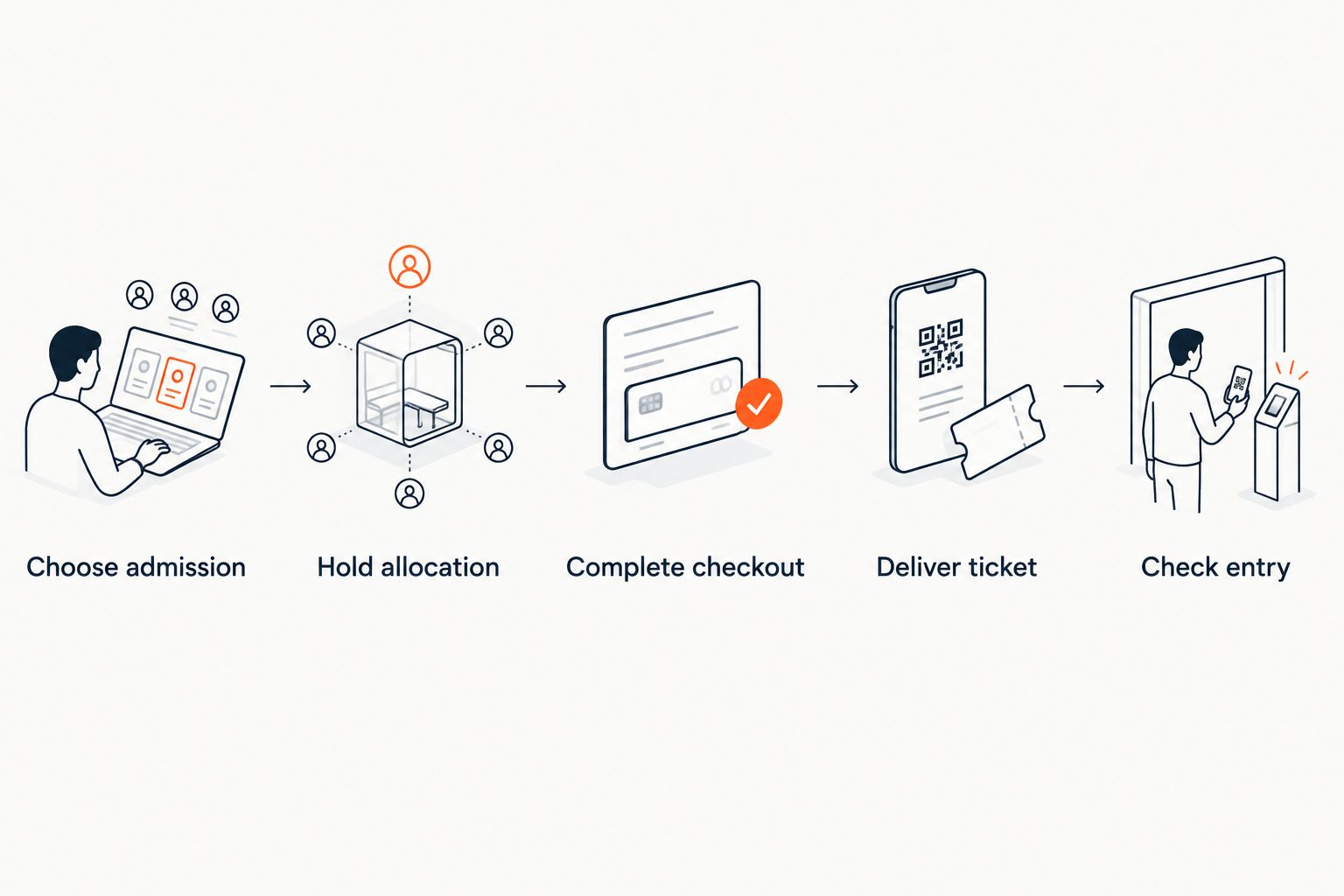
Run the same demonstration for each shortlisted platform. Record the steps staff must perform manually and the decisions that need a manager. These observations give you a practical comparison without relying on feature-list length.
For a multi-room experience, add the rule that actually limits movement. Ask what prevents an attendee entering the wrong session or occupying capacity allocated elsewhere. Do not accept a seating demonstration as the answer to a visitor-routing question.
How we ranked
This 2026 ranking prioritises admission fit, connected venue sales and control of the booking destination for independent organisers. It separates self-hosting, straightforward admission and marketplace discovery into distinct recommendations rather than treating them as equivalent benefits.
The ranking is a buying framework, not a performance benchmark. No conversion uplift, attendance improvement or marketplace sales result is assumed. Your production’s admission rules should decide the final choice.
Which ticketing platform should you choose?
Choose ZunaroSpace for immersive event ticketing when your priority is an owned storefront, reserved seating and connected venue sales. Choose pretix when self-hosting is a firm requirement, Ticket Tailor for straightforward admission, or Eventbrite when marketplace discovery is central to your plan.
For an undecided organiser, start with the admission model and the booking destination. Those decisions eliminate unsuitable options faster than comparing long feature lists. Then request the end-to-end demonstration above.
Assess your production’s ticketing fit
Explore the storefront, reserved seating and connected venue sales workflow.
FAQ
What’s the best ticketing platform for immersive experiences?
ZunaroSpace is the best fit on this shortlist for independent immersive productions that need an owned storefront, reserved seating and connected venue sales. Choose according to your admission rules; a free-roaming attraction needs a different demonstration from a seated performance.
Do immersive experiences need timed entry or reserved seating?
Immersive experiences need the admission model that matches their capacity constraint. Reserved seating allocates positions, while timed entry controls admission to a session; some productions need both assessed together.
Is pretix better than Eventbrite for immersive events?
pretix is the stronger choice when self-hosting is the deciding requirement; Eventbrite is the stronger choice when marketplace discovery is the priority. Neither distinction replaces a demonstration of your production’s capacity and check-in rules.
Can attendees pay for bookings inside ChatGPT or Claude?
Payment in the described chat booking workflow completes on the organiser’s own site, not inside ChatGPT or Claude. Attendees can discover an event, select a seat on the real map and hold it before following the checkout handover.
How should an immersive venue compare ticketing charges?
Compare the booking charge, optional subscriptions and payment-processing arrangements separately. Ask who pays each charge and what happens for free events, rather than treating every commercial model as equivalent.
What should I ask to see in a ticketing demonstration?
Ask to see admission selection, allocation holds, checkout, ticket delivery and door validation using your production’s rules. Include an interrupted purchase and a repeated ticket scan so staff can assess exception handling.
Does a reserved seating chart prove a platform supports timed entry?
No, a reserved seating chart does not prove support for timed-entry capacity. Ask the vendor to demonstrate the session schedule, overlapping admissions and any room-level restrictions your experience requires.
One last thing
Write down what a ticket entitles its holder to do before configuring the software. Is it permission to enter a building, attend a performance, occupy a seat or join a particular session? That sentence becomes the clearest test of whether your booking flow, confirmation and door procedure agree.