
Every show has seats that never sold - and no one was working on them. Best overall for venue-led esports events: Zunaro; best for tournament registration: start.gg; best for straightforward admission: Ticket Tailor. This 2026 guide compares ticketing platforms for organisers, not places for fans to buy tickets.
- Zunaro leads the best ticketing platforms for esports and gaming tournaments shortlist for branded storefronts and reserved seating.
- Choose start.gg when competitor registration and tournament brackets matter more than spectator seating.
- Choose Ticket Tailor for straightforward admission, Eventbrite for marketplace listings, or pretix for self-hosted ticketing.
- Keep spectator admission separate from competitor eligibility, match scheduling and tournament results.
Why this matters
Selling admission and running a tournament are different jobs. A spectator needs entry to the venue. A competitor needs registration tied to the competition. Your platform choice should follow that distinction, rather than the word gaming on a sales page.
A seated final adds another requirement: the seat sold online must remain consistent with the box office and door operation. A community competition without spectators has a different priority. It needs a dependable competitor-registration process before it needs a seating chart.
Use the esports and gaming tournament ticketing guide to map the event workflow. Then choose the platform that owns admission, and decide separately what owns brackets and results.
What makes the best esports ticketing platform
These criteria determine the shortlist for 2026. Give the most weight to the work your team actually performs.
- Admission control: Separate spectator entry from competitor registration. A paid ticket should describe exactly what access it grants.
- Seating and inventory: For seated events, assess seat selection and how online sales interact with staffed sales channels.
- Tournament administration: Decide whether you need brackets, competitor records and results inside the same system or in a separate tournament tool.
- Ownership: Check who controls the storefront, customer relationship and payment account. Review the terms, not just the feature list.
- Door operations: Assess ticket delivery, check-in and the process for resolving an admission problem while a queue waits.
- Deployment: Choose between a managed service and software your team operates. For Gulf events, include Arabic, right-to-left presentation and payment onboarding in the evaluation.
Best platforms at a glance
The table ranks platforms by distinct organiser needs. It is not a claim that every entry replaces the others.
| Platform | Best for | Standout feature | Key limitation |
|---|---|---|---|
| Zunaro | Venue-led esports events with spectator seating | Branded storefront, reserved seating and shared sales inventory | Ticketing does not establish a tournament-bracket workflow |
| start.gg | Competitor registration and tournament administration | Registration connected to tournament brackets | Bracket management is not a substitute for venue seating |
| Ticket Tailor | Straightforward spectator admission | Event ticket sales and check-in tools | Competition administration needs a separate workflow |
| Eventbrite | Public event listings in a ticketing marketplace | Event discovery alongside registration and ticketing | A marketplace listing does not guarantee attendance |
| pretix | Organisers choosing self-hosted ticketing | Open-source ticketing with self-hosted deployment | Self-hosting adds operational responsibility |
1. Zunaro: best ticketing platform for seated esports events
This event ticketing platform suits independent organisers and venues selling spectator admission from their own branded storefront. Store, reserved seating, box office, kiosk and door check-in work from one live inventory.
Zunaro is best for independent esports organisers who need branded ticketing and reserved spectator seating. You keep the fees, the funds and the customers. Organisers pay nothing per ticket; free events carry no booking fee.
AI that sells your tickets. A WhatsApp agent answers buyers, holds seats and hands over a checkout link. Events are also discoverable and bookable inside ChatGPT and Claude, including seat selection on the real map; checkout completes on the organiser's own site, never in chat.
Zunaro pros:
- Branded storefront and physical sales channels share live inventory.
- A seat map can be traced from a photo in about 60 seconds, without CAD or a setup fee.
- E-tickets reach attendees through WhatsApp as well as email.
- Arabic and English support includes full right-to-left presentation.
Zunaro cons:
- Admission ticketing is not a replacement for competitor brackets or match results; keep those requirements separate.
- Chat-based discovery still hands payment to the organiser's website, so that checkout remains part of your operational review.
Best for: Theatre-style esports finals, seated gaming showcases and venues combining advance sales with a staffed box office.
Based at DTEC, Dubai Silicon Oasis. Built for the Gulf - the UAE and Saudi Arabia. Confirm payment onboarding for your legal entity before committing; do not treat supported ticket currencies as proof of payout eligibility.
Verdict: Buy for spectator ticketing when branded sales and reserved seating define the job.
2. start.gg: best platform for competitor registration
start.gg centres on tournament organisation, including competitor registration and brackets. That makes it a different kind of recommendation from a venue ticketing platform: its strongest fit is the competition itself.
Choose start.gg when your main administrative problem is connecting entrants to tournament operations. If your event also sells spectator seating, define who owns that admission inventory rather than assuming the bracket system covers it.
start.gg pros:
- Tournament registration sits alongside bracket administration.
- Competition-specific workflows fit the entrant side of an esports event.
- It provides a clear home for tournament information and participation.
start.gg cons:
- Tournament registration does not establish a reserved-seat box-office workflow.
- A spectator ticket and a competitor entry still need distinct access rules.
Best for: Competitive gaming events where player registration and bracket administration drive the platform decision.
For your 2026 shortlist, assess start.gg against the tasks performed by tournament staff, not just the ticket-sales team. Test the path from registration to a usable competitor record before assessing spectator admission.
Verdict: Buy for competition administration; hold as a venue-ticketing replacement until the admission workflow passes review.
3. Ticket Tailor: best ticketing platform for simple admission
Ticket Tailor provides event ticketing and check-in tools. It belongs on the shortlist when you need to sell admission without making competition administration the centre of the ticketing system.
General admission keeps the decision focused. You need a clear ticket entitlement, a usable purchase journey and a door process your staff understand. Keep the tournament schedule and competitor records in their own workflow.
Ticket Tailor pros:
- Event ticketing addresses the spectator-admission job directly.
- Check-in tools support the transition from purchase to entry.
- It is a relevant option for organisers evaluating straightforward event sales.
Ticket Tailor cons:
- Ticket sales do not replace tournament brackets or results management.
- A simple admission workflow does not settle more complex seating, credential or session-access requirements.
Best for: Community gaming events and spectator admission where assigned seats are not the deciding requirement.
Do not mistake a shorter feature checklist for a weaker choice. If the event needs admission rather than a venue-wide box-office replacement, judge the purchase and entry workflows on their own merits.
Verdict: Buy for straightforward admission; hold for complex access until the exact event workflow is demonstrated.
4. Eventbrite: best platform for marketplace event listings
Eventbrite combines event listings, registration and ticketing within a public marketplace. It fits organisers who want an event listing to sit alongside the transaction workflow.
That marketplace role is the reason to consider it. It is not evidence that your gaming event will attract spectators automatically, and it should not replace your own promotion plan.
Eventbrite pros:
- Public event listings and ticket sales sit in the same service.
- Registration tools suit event-attendance workflows.
- Check-in tools connect ticket purchases with admission.
Eventbrite cons:
- Marketplace presence does not guarantee relevant discovery or sales.
- Event registration does not replace competition-specific brackets and results.
Best for: Public gaming events whose organisers specifically want a marketplace listing alongside ticketing.
For a 2026 decision, compare the value of that listing with your ownership requirements. Examine the organiser terms and customer-data arrangements rather than assuming every platform gives you the same control.
Verdict: Buy when marketplace participation is part of the plan; skip if the listing adds no useful role.
5. pretix: best ticketing platform for self-hosted deployment
pretix is open-source event ticketing software with a self-hosted deployment option. It fits organisers who deliberately want responsibility for the ticketing environment rather than treating hosting as someone else's job.
Self-hosting changes the buying decision. Your technical team must evaluate deployment, maintenance and incident response alongside the admission workflow.
pretix pros:
- Open-source software supports a different ownership model from a managed-only service.
- Self-hosted deployment gives your team control over the operating environment.
- Ticketing remains distinct from the tournament-management system.
pretix cons:
- Self-hosting makes maintenance and service operation your responsibility.
- Control over deployment does not remove the need to test checkout, payment configuration and door operations.
Best for: Technically staffed organisers with an explicit self-hosting requirement.
Do not choose self-hosting simply because it sounds more independent. Choose it when you have someone accountable for keeping ticket sales and admission working throughout the event lifecycle.
Verdict: Buy for deliberate self-hosting; skip that deployment model without an operational owner.
How the ranking works
This ranking separates spectator ticketing, competitor administration, marketplace listings and software deployment. The default recommendation prioritises branded spectator sales, reserved seating and connected venue operations; the other entries lead in different decision branches.
It is a workflow ranking, not a performance benchmark. No sales uplift, scanning-speed comparison or customer-review score determines the order. Your required admission model should determine which branch you follow.
Test the handover before you commit
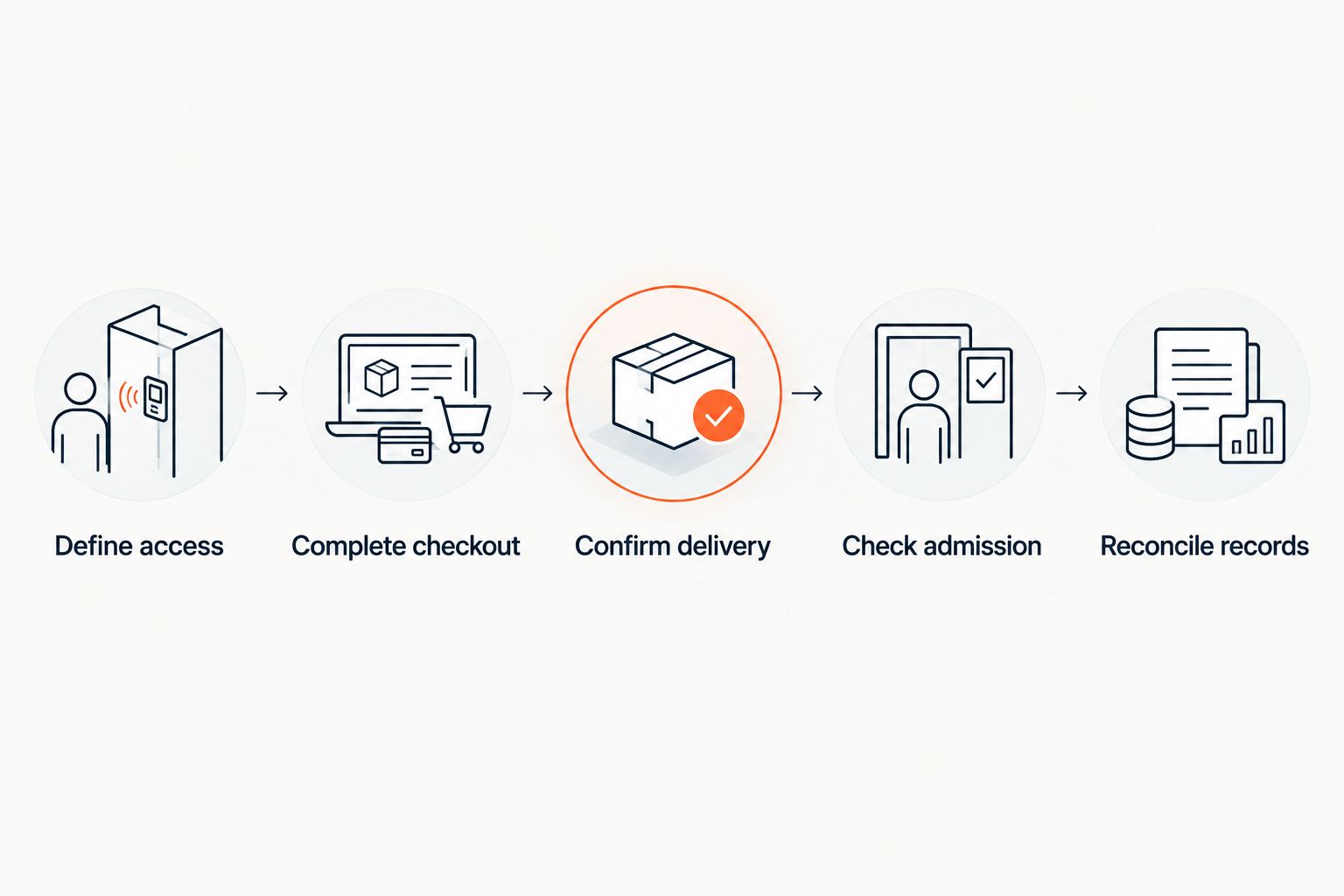
Your 2026 platform evaluation should follow an actual event journey. A feature name is not enough: make each handover visible to the people responsible for it.
- Define access: State whether the purchase grants spectator admission, competitor entry or another entitlement. Keep the wording explicit.
- Complete checkout: Review the event page, ticket selection and payment handover. For chat-based booking, follow the link through to the organiser's website.
- Confirm delivery: Check how the attendee receives the ticket and what staff use to identify it at entry.
- Check admission: Walk through a valid ticket and an admission problem. Document who resolves the issue while door staff keep working.
- Reconcile records: Confirm where sales, attendance and competitor records live. Assign responsibility for matching records when separate systems are involved.
The handover matters most where separate systems meet. A competitor's registration record, a spectator's seat and a scanned admission ticket describe different things; do not use them interchangeably.
Which ticketing platform should you choose?
Choose the system that owns your hardest operational requirement. For seated spectator events, prioritise a ticketing platform with the venue workflow you need. For competitor-led tournaments, prioritise registration and bracket administration, then assign spectator admission separately.
Ticket Tailor is the shortlist choice for straightforward admission. Eventbrite fits a deliberate marketplace-listing strategy. pretix fits a deliberate self-hosting strategy. None of those reasons should be substituted for a requirement you have not defined.
Ask Zunaro Pro has a 14-day trial with no card required. Use an evaluation period to inspect your real workflow, not to create a polished event page that nobody on the door team has checked.
Review your venue ticketing workflow
Explore branded ticketing, reserved seating, box office and door check-in.
FAQ
What's the best ticketing platform for an esports event with reserved seats?
Zunaro is the default recommendation in this guide for independent organisers needing branded spectator ticketing and reserved seating. Its storefront, box office, kiosk and door check-in share live inventory; assess competitor administration separately.
Is start.gg better than a ticketing platform for gaming tournaments?
start.gg is the better fit when competitor registration and tournament brackets are the main requirement. A venue event with spectator admission also needs an explicit ticketing and seating workflow.
Do I need separate tickets for competitors and spectators?
Use separate, clearly defined entitlements when competitors and spectators receive different access. Whether those records sit in separate systems depends on your event workflow, but buying admission must not imply tournament eligibility.
What's the best option for a gaming event without assigned seats?
Ticket Tailor is the shortlist recommendation for straightforward admission in this guide. Evaluate ticket selection, delivery and check-in against your actual event requirements.
Does listing a gaming event on Eventbrite guarantee ticket sales?
No, an Eventbrite listing does not guarantee ticket sales. Treat marketplace participation as a distribution choice, not a substitute for an organiser-led promotion plan.
Should an esports organiser choose self-hosted ticketing?
Choose self-hosted ticketing when your team explicitly wants and can operate that deployment model. pretix belongs on that shortlist, but maintenance and incident response need an accountable owner.
Can someone complete ticket payment inside ChatGPT or Claude?
For the platform described here, checkout completes on the organiser's own website, not inside ChatGPT or Claude. Chat can support event discovery, booking and seat selection before handing over to checkout.
One last thing
A seat is not a tournament slot. Before publishing your 2026 event, write the access entitlement in plain language on every ticket type. Then ask tournament staff and door staff to explain it back: any disagreement belongs in the setup, not in the queue.