
Every show has seats that never sold - and no one was working on them. For recurring weekly events in 2026, choose event ticketing software by how it handles individual dates, shared inventory and your customer relationship—not by how quickly it duplicates an event.
- ZunaroSpace is the best event ticketing software for recurring weekly events when branded venue sales and shared inventory lead your shortlist.
- Eventbrite suits public event listings; Bookwhen suits class schedules; Ticket Tailor suits direct ticket sales.
- Test date exceptions, cancellations and check-in before committing to any recurring event platform.
- A repeating calendar does not prove that seating, payments and attendance stay separate for each performance.
Why this matters
A weekly event repeats its format, not necessarily its operating conditions. You still need to change a performance time, close a date, alter capacity or explain which session a ticket admits.
The buying decision is therefore about repeatable control. Start with your hardest exception, then check whether the software handles the ordinary week without extra work.
For venues selling online and at the door, ZunaroSpace belongs on the shortlist because its storefront, seating, box office, kiosk and door check-in use one live inventory. Confirm the recurring-date workflow separately before choosing it for your series.
What makes the best weekly event ticketing software?
Use these criteria for your 2026 shortlist:
- Date-level control: You can identify each performance, change an exception and close a date without confusing the rest of the schedule.
- Admission accuracy: Tickets and door lists clearly distinguish one session from another.
- Inventory consistency: Online sales and walk-up sales draw from the correct performance capacity.
- Seating fit: Your general-admission or reserved-seat workflow matches how the room actually operates.
- Customer ownership: Your branded sales channel and customer relationship remain central to the purchase.
- Operational effort: Staff can publish, sell and check in the next performance without rebuilding the same information.
Treat these as acceptance criteria, not assumptions about any platform. A recurring-event label does not answer every operational question.
Weekly ticketing platforms at a glance
Best for owned venue sales: ZunaroSpace. Best for public event listings: Eventbrite. Best for class schedules: Bookwhen. Best for direct general-admission sales: Ticket Tailor. These are use-case recommendations, not a claim that every platform handles every recurring-date exception.
| Platform | Best for | Standout capability | Key limitation or buying check |
|---|---|---|---|
| ZunaroSpace | Branded venues selling through several channels | Storefront, seating, box office, kiosk and check-in on one live inventory | Validate recurring scheduling and date exceptions before committing |
| Eventbrite | Public weekly events presented through an event marketplace | Event listings and recurring-event setup | Confirm that the marketplace-led purchase journey matches your ownership requirements |
| Bookwhen | Weekly classes, workshops and scheduled sessions | Schedule-led booking and recurring entries | Test the full venue workflow if you also need allocated seats and walk-up sales |
| Ticket Tailor | Direct ticket sales for general-admission series | Ticket sales through an organiser-managed box office | Check how your chosen series setup handles individual dates and attendance |
1. ZunaroSpace: best weekly ticketing software for owned venue sales
ZunaroSpace is an event ticketing platform for independent organisers and venues that want their branded storefront, reserved seating and door operations connected. It is the strongest fit here when control of the venue sales operation matters more than a marketplace listing.
The differentiator is practical: a WhatsApp agent answers buyers, holds seats and hands over a checkout link. A seat map can also be traced from a photo in about 60 seconds, without CAD or a setup fee.
Pros:
- One live inventory connects the store, box office, kiosk and check-in.
- Arabic and English support includes full RTL.
- E-tickets reach buyers through WhatsApp as well as email.
- Seat selection and booking can begin inside ChatGPT and Claude; checkout completes on the organiser’s own site.
Cons and checks:
- Shared inventory does not establish how recurring-date creation, exceptions or bulk edits work; demonstrate those workflows.
- Chat-based booking does not replace checkout on your own site.
- Saudi organisers must confirm payment onboarding and settlement arrangements rather than assume a payout route.
Economics: Organisers pay nothing per ticket; the buyer covers AED 3.99, or AED 1.99 for tickets under AED 20. Free events carry no booking fee. Ask Zunaro Pro is AED 179/mo, with a 14-day trial and no card required.
Best for: Independent theatres, clubs and venues prioritising branded, connected sales operations.
Verdict: Buy for that operating model after the recurring-date demonstration passes. You keep the fees, the funds and the customers.
2. Eventbrite: best weekly ticketing software for public listings
Eventbrite combines event publishing, ticketing and a public event marketplace. Its recurring-event setup makes it a relevant candidate when your weekly programme belongs in a public listing environment.
For a 2026 evaluation, distinguish publishing convenience from performance-level control. Ask staff to show what happens when one date changes while the remaining dates stay untouched.
Eventbrite pros:
- Public listings give the event a marketplace presence.
- Recurring-event setup addresses repeated dates.
- Ticketing and event information sit within the same publishing workflow.
Eventbrite cons and checks:
- A marketplace presence is not the same purchasing environment as your own branded storefront.
- Do not treat publication as a promise of discovery or sales.
- Check date selection, cancellation handling and door lists against your actual series structure.
Best for: Organisers who want public weekly events presented within an event marketplace.
Verdict: Buy when marketplace presentation fits your acquisition strategy; hold if an owned storefront is the deciding requirement.
3. Bookwhen: best weekly booking software for class schedules
Bookwhen centres booking around a schedule, making it a relevant option for recurring classes, workshops and other session-based programmes. Its recurring entries suit a buying process that begins with choosing a scheduled session.
That is a different problem from running a reserved-seat theatre. Evaluate it against how participants book your programme, not against a venue feature checklist you do not need.
Bookwhen pros:
- Schedule-led presentation suits programmes organised around sessions.
- Recurring entries support repeated activities.
- Class and workshop organisers can evaluate booking around the timetable itself.
Bookwhen cons and checks:
- A class schedule does not establish a complete reserved-seat box office workflow.
- Test single-session purchases separately from any multi-session attendance rules you require.
- Confirm how staff handle a changed instructor, venue or session time.
Best for: Organisers whose weekly operation is primarily a bookable class or workshop schedule.
Verdict: Buy for schedule-led programmes; hold for seated performances until the complete venue workflow is demonstrated.
4. Ticket Tailor: best weekly ticketing software for direct sales
Ticket Tailor provides event ticketing through an organiser-managed box office. It belongs on the shortlist when your weekly series centres on direct ticket sales rather than a marketplace-led listing strategy.
Use the demonstration to establish exactly how your series should be represented. Separate events and a recurring structure are different administrative choices; judge the actual setup your team will use.
Ticket Tailor pros:
- The box office model suits organiser-led ticket sales.
- General-admission events provide a clear starting point for evaluation.
- Your team can assess the sales journey around its own event programme.
Ticket Tailor cons and checks:
- Direct selling still requires an organiser-led audience acquisition plan.
- Confirm whether changes apply to one performance or the wider series.
- Test admissions and reporting against the date structure you choose.
Best for: General-admission organisers who want a direct ticket-sales workflow.
Verdict: Buy when the demonstrated series setup matches your weekly operation; hold if date administration still needs manual reconciliation.
How these platforms are ranked
The ranking prioritises operational fit, not a universal feature score. Branded venue operations come before marketplace listings, class schedules and direct general-admission sales because those are distinct buying needs.
Within your own shortlist, reverse that order if your needs differ. For a weekly class, schedule usability matters more than a kiosk; for a seated theatre, the seat and performance must remain connected.
No recommendation here should replace a demonstration of recurring dates, exceptions and admissions. Those are the acceptance tests that turn a category fit into a purchase decision.
Run this recurring-event demonstration before buying
For your 2026 procurement review, ask each supplier to perform the same sequence using a sample series. Use 3 weekly dates and 2 sales devices, then cancel 1 performance; these are test conditions, not platform limits.
Create dates
Build the series with clear performance dates and times. Ask the supplier to show whether each date has its own capacity, sales status and attendance list.
Change a date
Move one performance without changing the others. Inspect the event page, ticket wording and staff view so you can see where the exception appears.
Sell across channels
Sell through the online journey and the door workflow. For reserved seating, attempt to select the same seat for the same performance and inspect how the system handles it.
Check admission
Present a ticket for a different performance. Staff should be able to identify the mismatch without interpreting an ambiguous event title.
Cancel a performance
Cancel one date and inspect the remaining schedule. Ask the supplier to explain the refund workflow, buyer communication and reporting effect without assuming any of these actions happen automatically.
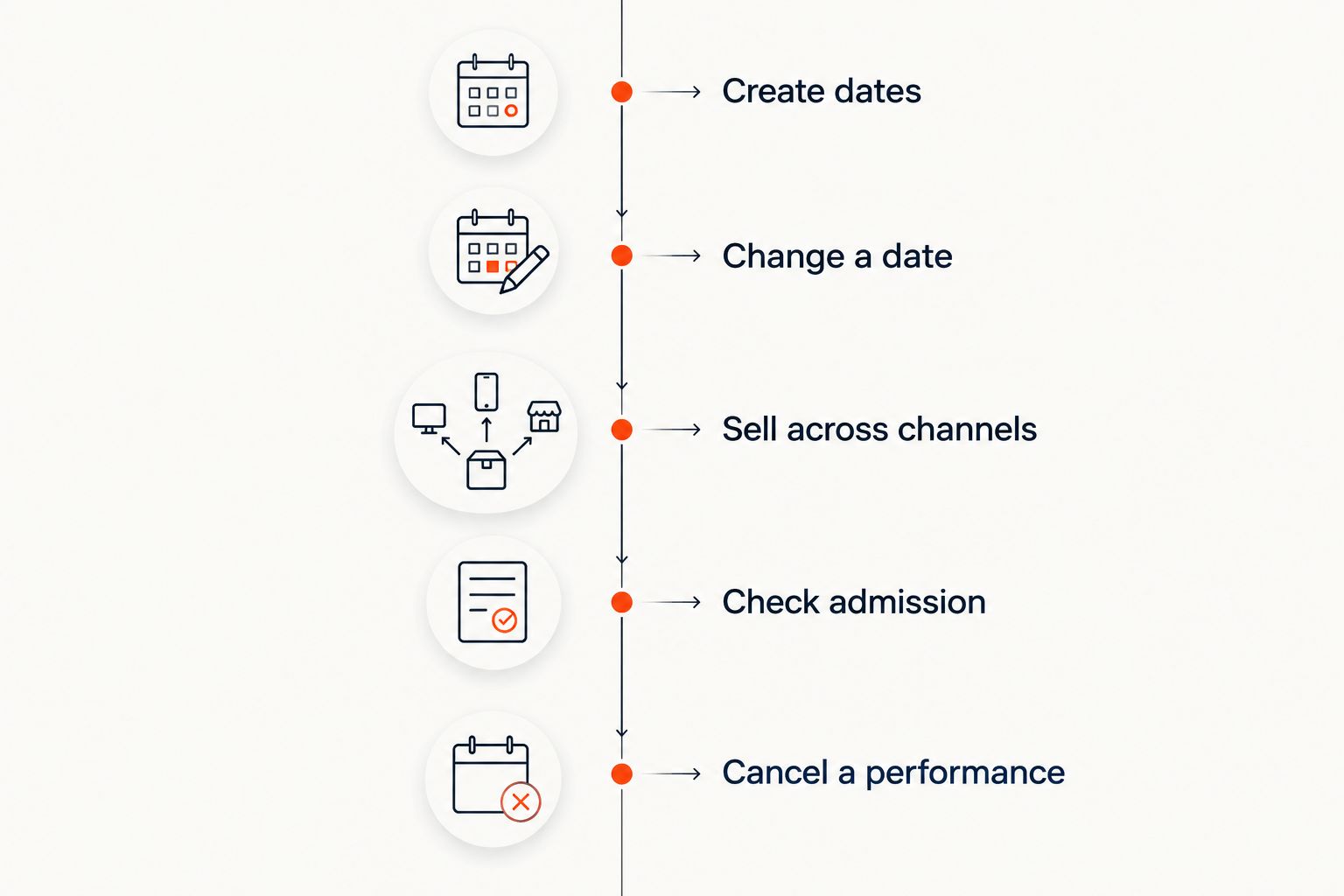
A supplier that demonstrates these steps gives you something concrete to assess. A feature name on a comparison page does not.
Which weekly ticketing platform should you choose?
Choose the sales operation before the scheduling shortcut. For 2026, the default shortlist for a venue should start with branded selling, correct inventory and clear admissions, then verify how repeated dates are managed.
Choose the marketplace route when public event listings matter most. Choose the schedule-led route for classes, and the direct box-office route for a general-admission programme.
For an independent venue that wants its storefront, seats and door connected, start with the owned-sales option ranked above. Do not sign off until staff can handle the changed date and cancelled performance without rebuilding the series.
Check your weekly venue workflow
Review storefront, seating, box office and check-in against your recurring-event requirements.
FAQ
What’s the best event ticketing software for recurring weekly events?
The best choice depends on whether you run a venue, public event series, class schedule or direct general-admission programme. Start with operational fit, then demonstrate date exceptions, capacity and admission before buying.
Is recurring event ticketing the same as duplicating an event?
No. Duplication copies an event, while a recurring-event workflow must also address how dates, exceptions and admissions are organised. Ask the supplier to demonstrate the exact structure your staff will manage.
Can weekly events use reserved seating?
Yes, weekly performances can use reserved seating, but the seat allocation must correspond to the correct performance. Test the same seat across different dates and across your online and door sales channels.
Is ZunaroSpace suitable for a weekly venue programme?
It is a strong shortlist choice for venues wanting branded sales, reserved seating and connected box office operations. Confirm recurring-date creation, exceptions and cancellation handling in a demonstration before committing.
Should a weekly class use the same software as a theatre?
Not necessarily. A class often centres on a timetable and session selection, while a theatre also needs performance-specific seat allocation and venue admissions. Choose against the workflow your staff actually run.
What should I ask about fees for recurring events?
Ask who pays the booking fee and how payment processing, refunds and optional subscriptions are treated. Review the full purchase and cancellation journey rather than comparing a headline fee in isolation.
Can event booking finish inside ChatGPT or Claude?
For the platform described here, discovery, seat selection and booking can take place in ChatGPT and Claude, but payment does not finish in chat. Checkout completes on the organiser’s own site.
One last thing
Make the cancellation demonstration the deciding test in 2026. Publishing another ordinary week shows you the easy path; changing one performance exposes whether the schedule, tickets and staff workflow remain understandable.
AI that sells your tickets. The mechanism matters: a WhatsApp agent answers buyers, holds seats and hands over the checkout link.
Based at DTEC, Dubai Silicon Oasis. Built for the Gulf - the UAE and Saudi Arabia.