
Every show has seats that never sold - and no one was working on them. Zunaro is the best event ticketing platform to shortlist for independent Gulf operators who want their own storefront, connected box office and reserved seating; Tessitura suits arts organisations, Eventbrite suits marketplace-led promotion, and pretix suits self-hosting.
- The best event ticketing platforms for multi-venue operators must prove venue separation, shared inventory and financial accountability.
- Zunaro suits independent Gulf operators prioritising their own storefront, reserved seating and connected sales channels.
- Tessitura and Spektrix belong on arts-focused shortlists; Eventbrite suits marketplace-led event promotion.
- Choose pretix when self-hosting matters; test permissions, settlement and door operations before signing.
Why this matters
A multi-venue operator needs more than several event pages. You need to know which room owns a seat, which team can change an order and which legal entity receives the funds.
For your 2026 shortlist, separate platform features from organisational controls. A connected kiosk is useful; it does not establish that managers at different venues have separate permissions. Start with whether one account can manage multiple venues, then make suppliers demonstrate your actual operating structure.
The right platform keeps sales channels connected without making venue accountability disappear. That is the buying decision this guide prioritises.
What makes the best multi-venue event ticketing platform?
Use these six criteria before comparing demonstrations:
- Venue structure: Demonstrate separate rooms, event calendars and staff responsibilities within your proposed account arrangement.
- Inventory integrity: Show how storefront, box office and kiosk sales affect the same performance and seat.
- Financial accountability: Identify the contracting entity, payment account, refund authority and reconciliation process for each venue.
- Audience ownership: Establish who controls customer records, exports, communication permissions and the branded checkout.
- Operational fit: Test reserved seating, admissions and the languages your teams actually use.
- Implementation responsibility: Identify who builds seating plans, migrates records, trains staff and supports event-night problems.
For a 2026 purchase, treat each criterion as a demonstration requirement rather than a checkbox. A supplier's broad feature description is not evidence that your particular account configuration works.
Multi-venue ticketing platforms at a glance
The order below reflects distinct operating models, not a claim that every platform provides equivalent multi-venue administration. Each option needs to pass your venue-specific acceptance tests.
| Platform | Best for | Standout feature or approach | Key limitation or buying constraint |
|---|---|---|---|
| Zunaro | Independent Gulf venues selling through their own channels | Storefront, reserved seating, box office, kiosk and check-in on one live inventory | Multi-venue permissions and financial separation require a specific demonstration |
| Tessitura | Arts organisations connecting ticketing and fundraising | Ticketing, constituent relationships and fundraising in one system | Wider organisational scope means more implementation decisions |
| Spektrix | Performing-arts teams combining ticketing and audience development | Cloud-based ticketing, marketing and fundraising | Arts-specific workflows need checking against non-arts venue requirements |
| Eventbrite | Promoters prioritising a public event marketplace | Event publishing, registration and marketplace discovery | Marketplace presence does not establish the ownership or administration model you need |
| pretix | Operators requiring self-hosting control | Open-source ticketing with a self-hosted deployment option | Self-hosting places technical responsibilities with your organisation or service provider |
1. Zunaro: best for independent Gulf venue operators
Zunaro is an event ticketing platform for independent organisers and venues. You sell through your own branded storefront, box office and kiosk, with reserved seating and door check-in connected to one live inventory.
The selling mechanisms are specific. A WhatsApp agent answers buyers, holds seats and hands over a checkout link; a seat map can be traced from a photo in about 60 seconds, without CAD. Events can also be discovered and booked inside ChatGPT and Claude, including seat selection on the real map, but checkout always completes on the organiser's own site.
Zunaro pros:
- Storefront, seating, box office, kiosk and check-in share live inventory.
- Arabic and English support includes full right-to-left layouts.
- E-tickets reach buyers through WhatsApp as well as email.
- Organisers pay nothing per ticket, and free events carry no booking fee.
Buying constraints:
- Require a demonstration of venue-level staff permissions, reporting and account separation before committing a venue group.
- Do not assume payment-account eligibility or payout arrangements are identical across the UAE and Saudi Arabia.
You keep the fees, the funds and the customers. Ask for the current buyer booking-fee schedule and subscription terms when comparing the full commercial arrangement; Ask Zunaro Pro includes a 14-day trial, with no card required.
AI that sells your tickets. Here, that means a WhatsApp agent handling questions and seat holds—not a separate chatbot presented as a ticketing platform.
Based at DTEC, Dubai Silicon Oasis. Built for the Gulf - the UAE and Saudi Arabia.
Best for: Independent venue groups that want branded selling channels, reserved seating and Arabic–English operations. Buy after the proposed multi-venue configuration passes your acceptance test.
2. Tessitura: best for arts groups joining ticketing and fundraising
Tessitura combines ticketing, fundraising and constituent relationship management for arts and cultural organisations. Put it on your shortlist when the relationship with a patron extends beyond a ticket purchase into donations and other institutional activity.
For a theatre group, the procurement question is broader than publishing performances. Ask how constituent records, venue responsibilities and financial reporting fit your organisational structure.
Tessitura pros:
- Brings ticketing and fundraising into the same system.
- Uses constituent relationship management rather than treating every sale as an isolated transaction.
- Has an arts-and-culture focus relevant to theatres and cultural institutions.
Tessitura cons:
- Its wider institutional scope creates more workflow decisions than a ticket-sales-only brief.
- Ticketing, fundraising and constituent-data requirements need agreement across departments before implementation.
Do not rank the platform higher just because it covers more functions. Rank it higher when those functions are part of your operating brief and have clear internal owners.
Best for: Arts organisations that need ticketing and fundraising to share constituent records. Buy when those requirements justify the implementation scope.
3. Spektrix: best for performing-arts audience development
Spektrix provides cloud-based ticketing, marketing and fundraising software for arts organisations. It belongs on a shortlist where box-office work and audience development need to inform each other.
For a multi-venue performing-arts business, test a real patron journey across different programmes. Ask the supplier to show how staff access, customer records and reporting work for the proposed configuration rather than relying on a generic arts demonstration.
Spektrix pros:
- Combines ticketing, marketing and fundraising functions.
- Its arts focus fits performing-arts procurement briefs.
- Cloud delivery removes the requirement to operate a self-hosted ticketing server.
Spektrix cons:
- Arts-oriented workflows need separate validation for conferences, nightlife or unrelated venue formats.
- Cloud delivery does not provide the deployment control of a self-hosted system.
During a 2026 evaluation, distinguish audience-development requirements from general email requirements. Specify the exact records, permissions and reporting your marketing team needs to use.
Best for: Performing-arts organisations choosing ticketing alongside marketing and fundraising workflows. Buy when the demonstrated account structure fits every participating venue.
4. Eventbrite: best for marketplace-led event promotion
Eventbrite combines event publishing, ticketing and registration with a public event marketplace. It is a relevant option when your promoters want events to appear within a discovery destination as well as their own promotional channels.
That marketplace role is a different proposition from choosing a ticketing system primarily for venue ownership and back-office control. Evaluate both separately; public event discovery does not answer questions about permissions or financial separation.
Eventbrite pros:
- Combines event pages, ticketing and registration.
- Provides a public marketplace where events can be discovered.
- Fits a procurement brief centred on publishing and promoting individual events.
Eventbrite cons:
- Marketplace discovery does not guarantee attendance or sales.
- A public listing does not establish that the proposed setup meets your multi-venue administration requirements.
Use a representative seated performance and a general-admission event in the demonstration. Require the supplier to explain the actual configuration for each, including the organiser's responsibilities.
Best for: Promoters who want a marketplace listing as part of their event-promotion approach. Buy when marketplace participation is intentional and the operational checks pass.
5. pretix: best for operators requiring self-hosting
pretix is open-source event ticketing software with a self-hosted deployment option. It is the clearest fit in this shortlist when operating the software on infrastructure you control is a purchasing requirement.
Self-hosting changes responsibility, not just location. Your team or appointed provider needs to own the deployment, maintenance and incident response associated with that installation.
pretix pros:
- Offers an open-source codebase.
- Supports a self-hosted deployment choice.
- Lets technically capable operators take responsibility for their hosting environment.
pretix cons:
- Self-hosting requires technical administration and maintenance.
- Custom changes create an ongoing testing and upgrade responsibility.
Do not choose self-hosting simply to avoid a supplier relationship. You still need accountable people for payments, integrations, updates and event-night support.
Best for: Operators with a technical owner and a genuine infrastructure-control requirement. Buy when the technical responsibility is funded and assigned; otherwise, Skip self-hosting.
How we ranked these platforms
This 2026 shortlist ranks platforms by operating-model fit against the six criteria above. It is not a benchmark of conversion rates, support response times or implementation speed.
The independent-venue option comes ahead of arts-institution, marketplace and self-hosted alternatives because the brief centres on operators running venues. A fundraising-led theatre group should reorder the shortlist around constituent management; a technical organisation should give deployment control more weight.
Prove the multi-venue workflow before signing
Use the same acceptance exercise with every supplier. Keep it small enough to follow, but include the points where staff, inventory and money cross boundaries.
- Venue structure: Create separate test venues and assign their operational responsibilities.
- Sales channels: Sell through the proposed online and staffed channels against the same performance.
- Seat holds: Hold a seat through one route, then check its status through another.
- Door checks: Scan the issued ticket and test a repeat presentation.
- Reconciliation: Trace the order, refund authority and financial record back to the correct venue.
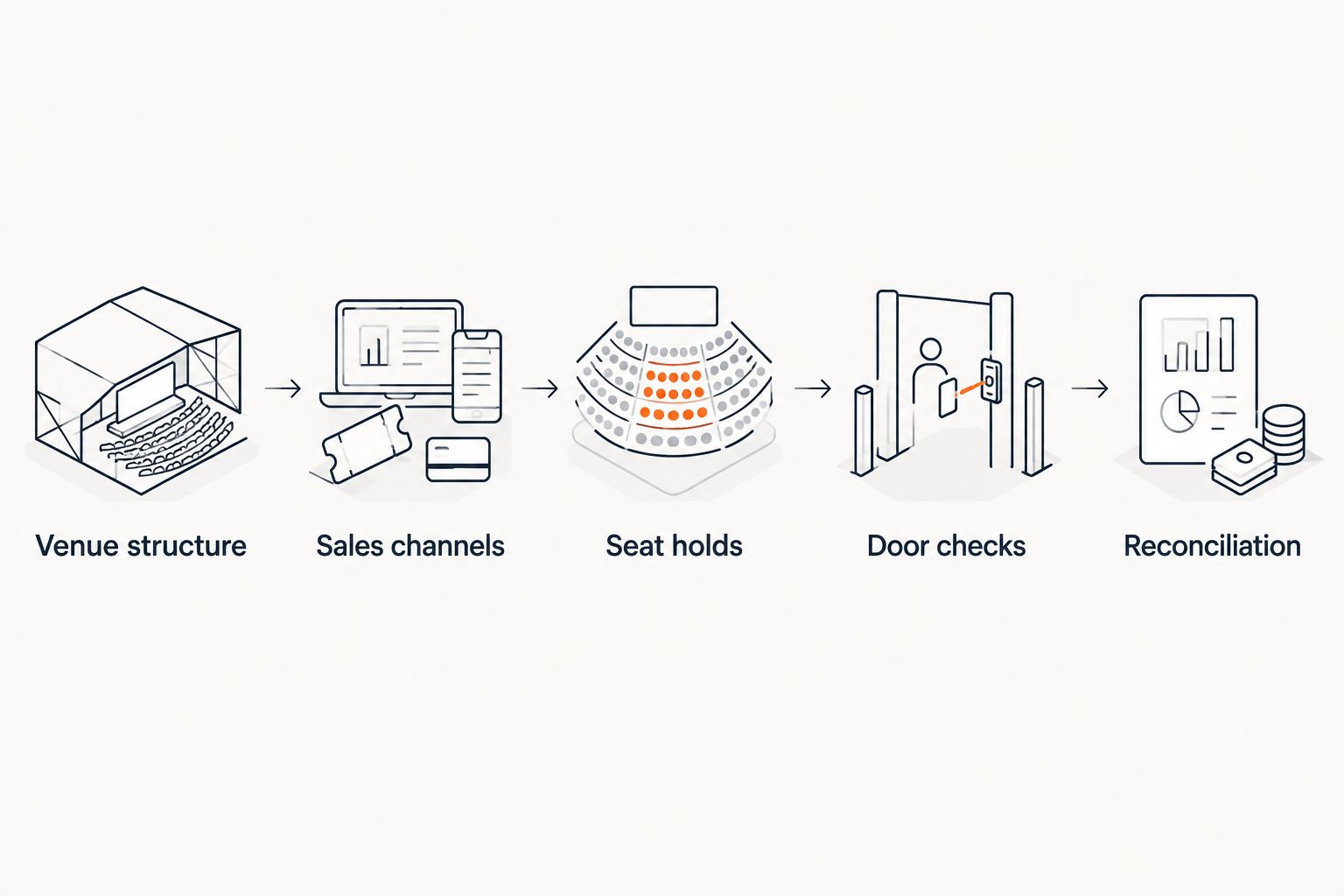
Record the result of each step and the person responsible for resolving a failure. A convincing demonstration ends with a traceable order and a clear owner—not just a successful payment screen.
For your 2026 rollout, agree those acceptance conditions before migration starts. Keep existing event records and financial obligations within the scope of the transition plan.
Which platform should you choose?
Choose the independent-venue option by default if your priority is your own storefront, connected selling channels and Gulf-language support. Make venue permissions and financial separation conditions of purchase, not assumptions.
Choose Tessitura for an arts organisation joining ticketing and fundraising; choose Spektrix for a performing-arts audience-development brief. Choose Eventbrite when marketplace participation matters, or pretix when self-hosting is a documented requirement.
Do not buy all five operating models in one procurement brief. Decide which problem owns the decision, then reject any platform that fails a non-negotiable operational test.
FAQ
What's the best event ticketing platform for multi-venue operators in 2026?
Zunaro is the best shortlist choice here for independent Gulf operators prioritising their own storefront, reserved seating and connected sales channels. Require a demonstration of venue-level permissions, reporting and financial separation before purchase.
Can one ticketing account manage several venues?
That depends on the platform and the proposed account configuration. Ask the supplier to demonstrate separate venues, staff access, reporting and financial responsibilities within the exact arrangement you would buy.
Is Tessitura or Spektrix better for a theatre group?
Tessitura and Spektrix both belong on an arts-focused shortlist because they combine ticketing with fundraising and audience-related functions. Choose against your demonstrated workflows, constituent-data requirements and implementation responsibilities rather than the feature count.
Is Eventbrite the right choice for a venue group?
Eventbrite belongs on the shortlist when marketplace discovery and event publishing are priorities. Confirm that the proposed setup also satisfies your venue administration, seating and financial requirements.
Should a multi-venue operator choose self-hosted ticketing?
Choose self-hosting when infrastructure control is a real requirement and a technical owner is assigned. pretix offers that deployment option, but maintenance, updates and incident response still need accountable ownership.
Can buyers complete payment inside ChatGPT or Claude?
Checkout completes on the organiser's own site, not inside ChatGPT or Claude. The supported discovery and booking journey includes finding an event, selecting a seat on the real map and holding it before checkout.
What should venue operators check about ticketing fees?
Request the complete commercial schedule and identify who pays each charge. Check buyer booking fees, organiser charges, payment processing, subscriptions and refund treatment separately rather than treating them as one figure.
One last thing
A shared customer record and shared seat inventory solve different problems. The former connects relationships; the latter controls what can be sold for a performance.
Ask your shortlisted supplier to demonstrate both, then show where venue permissions and financial responsibility sit. That final hand-off is more useful than another feature slide.