Every show has seats that never sold - and no one was working on them. To promote a ticketed event with a limited budget, start with audiences you can already reach, give partners a specific reason to share, and send every campaign to a clear booking page. Judge the work by completed orders, not attention, and fix unanswered booking questions before buying more reach.
- How to promote a ticketed event with a limited budget: prioritise relevant audiences, partner distribution and completed orders.
- Email suits permission-based audiences; partner promotion suits organisers who need access to relevant communities.
- Zunaro event ticketing suits independent organisers who want their own storefront, seating and customer relationship.
- Paid promotion needs a spending limit and order tracking; impressions alone do not justify more spend.
Why this matters
A limited budget forces you to distinguish distribution from sales. A shared poster creates exposure; a completed order fills a seat. Your promotion plan needs both a way to reach the right audience and a booking route that answers practical questions.
For your 2026 event plan, record where orders come from before expanding the campaign. Use the guide to seeing which marketing channel sold the most tickets to frame that measurement. Keep revenue, promotional spending and staff effort separate: a channel with no advertising bill still takes work.
How to promote a ticketed event with a limited budget?
Start with relevance, then remove booking friction, then consider paid distribution. Do not spread a small budget across every channel simply because each channel exists. Choose the channels you can operate properly and assign each a clear job.
Define the audience and the reason to attend
Write a short description of who the event serves and what they will experience. Be specific about the programme, performers, speakers or format, using facts you can verify. A general invitation gives partners little to work with.
Then identify where that audience already gathers. Depending on your event, that means your permission-based mailing list, a venue's audience, a performer's followers, a professional association or a relevant community group. Ask for access through the organisation or person who manages that relationship; do not scrape contacts.
Make the event page ready to receive attention
Give visitors the event date, venue, programme, admission requirements and booking route in plain language. For reserved seating, make the seat-selection process understandable. Answer access questions without requiring a buyer to search through social posts.
Check the page on a phone before sharing it. Follow the booking journey yourself, including the handover from a message or campaign link. Promotion should point to the relevant event, not leave someone searching through an unrelated homepage.
Contact the audience you already have permission to reach
Build your message around the event's actual reason to attend. Explain what is happening, who it suits and how to book. Keep the main action clear rather than mixing ticket sales with several unrelated requests.
Separate audiences when their interests differ. Someone who attended a theatre production needs a different invitation from someone who attended a professional conference. Use information you legitimately hold, and respect consent and unsubscribe requests.
Give partners a ready-to-share invitation
Ask performers, speakers, venues and relevant organisations for a specific contribution: an email mention, a community post or a programme announcement. Provide approved event details, a suitable image and the booking destination. Make the request easy to understand.
Agree on what the partner will publish and who will answer questions. A vague request to help promote the event leaves both sides guessing. Keep claims factual; do not manufacture endorsements or audience demand.
Publish content that answers booking questions
Use your social posts to explain the programme, show the venue where appropriate and answer recurring questions. Give each post a distinct purpose. Repeating the same poster does not answer a new question.
Use real material you have permission to publish. If you have no footage from a previous edition, explain the upcoming format instead of implying a track record. Keep dates, names and booking details consistent across channels.
Review orders before expanding paid promotion
Set a spending ceiling before launching an advertising test. Identify the audience, the message and the booking destination, then record completed orders alongside spend. Changing everything together makes the result difficult to interpret.
Keep a channel because it contributes to your event's economics, not because it produces attractive engagement figures. If promotion produces visits but no orders, inspect the event page and checkout journey before purchasing more of the same traffic.
Which promotion channels deserve your effort?
No channel wins for every event. For your 2026 campaign, choose by audience access, relevance and your ability to follow through. The table below compares practical starting points, not promised sales results.
| Channel | Best for | Advantage | Limitation | Recommendation |
|---|---|---|---|---|
| Permission-based email | Organisers with a relevant existing audience | Direct distribution to people who agreed to hear from you | Depends on list relevance and permission | Start here when the audience matches |
| Partner promotion | Events connected to performers, speakers or communities | Gives the invitation a relevant distribution route | Depends on partner participation | Make a specific sharing request |
| Organic social content | Events with material that explains the experience | Lets you answer questions publicly | Publishing takes time and reach is uncertain | Give each post a booking-related purpose |
| Community outreach | Events serving an identifiable local or professional group | Supports a focused invitation | Group rules restrict promotional posts | Ask the administrator before posting |
| Paid promotion | Organisers ready to measure orders against spend | Lets you purchase distribution beyond existing contacts | Requires cash and does not guarantee sales | Test within a defined spending ceiling |
Do not confuse access to an audience with permission to contact its members. A partner can distribute an invitation through its own channels without handing you its contact list. Establish that arrangement before exchanging personal information.
Treat channel selection as a workload decision too. An organiser who cannot answer enquiries or update event information should simplify the plan rather than add more publishing commitments.
Why the right promotion plan varies
The useful budget is the one you can connect to an audience, a booking journey and your event's economics. These factors change the work required:
- Audience access: An established permission-based list gives you a different starting point from an event with no existing contacts.
- Partner participation: Performers, speakers and venues differ in what they are willing and able to share.
- Event format: A reserved-seat production needs different booking explanations from a general-admission event.
- Language: Match promotional information and the booking experience to the languages your audience uses.
- Booking questions: Unclear seating, admission or programme details create work that more distribution does not solve.
- Available staff time: Writing, partner coordination, answering enquiries and reporting all need an owner.
For a 2026 event, write these constraints into the plan before assigning spend. Choose an activity you can finish and measure over a larger list of unfinished campaigns.
How do you turn enquiries into bookings?
Promotion does not end when someone asks a question. Give your team a clear handover from enquiry to booking: answer the question, explain the relevant seating or admission choice, and provide the correct checkout destination. Do not leave interested people waiting while the campaign continues spending.
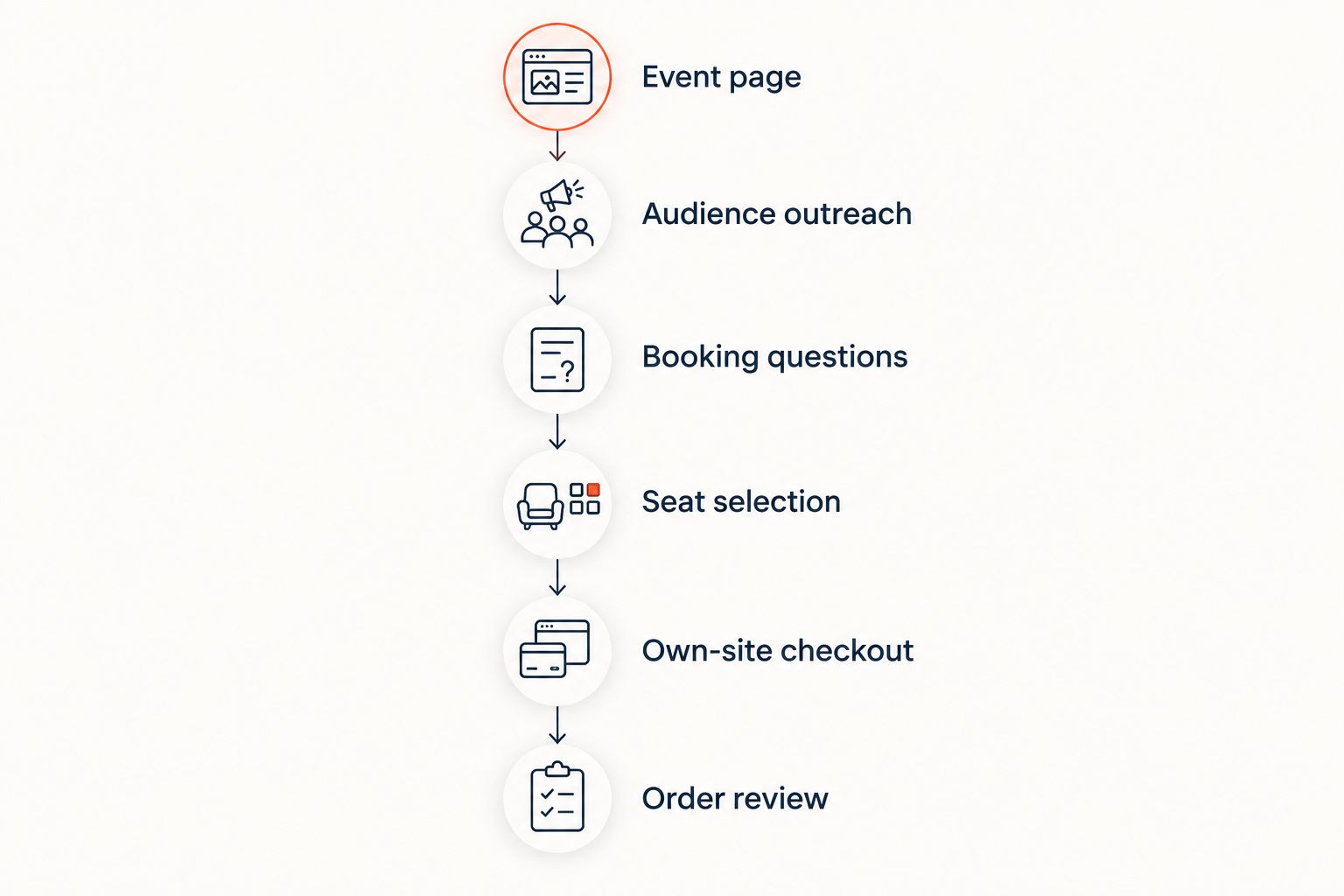
Use this sequence as a practical review:
- Event page: Publish accurate programme and admission details.
- Audience outreach: Distribute the invitation through relevant, permitted channels.
- Booking questions: Answer the questions that stand between interest and a decision.
- Seat selection: Make the seating choice clear where reserved seating applies.
- Own-site checkout: Send the buyer to the organiser's booking destination.
- Order review: Connect completed orders to promotional activity where attribution is available.
Assign responsibility for every handover. A campaign owner should know who answers enquiries and where the buyer goes next. If the event details change, update the booking page and the messages that still point to it.
Where an owned ticketing platform fits
Zunaro is an event ticketing platform for independent organisers and venues that want their own branded storefront and customer relationship. Store, seating, box office, kiosk and door check-in use one live inventory. The platform sits underneath your promotion; it does not replace the need for a relevant event and a credible invitation.
Zunaro pairs that ticketing setup with a WhatsApp agent that answers buyers, holds seats and hands over a checkout link. Events can also be found and booked inside ChatGPT and Claude, including seat selection on the real map. Checkout always completes on the organiser's own site, never in chat.
AI that sells your tickets. The mechanism matters: answering a booking question and holding the requested seat is a concrete sales task, not a reason to promise that every event will fill.
You keep the fees, the funds and the customers. Arabic and English, with full RTL, support organisers serving those language audiences. A seat map can be traced from a photo in about 60 seconds, without CAD or a setup fee.
The limitation is straightforward: a ticketing platform is not a guaranteed source of demand. You still need the event proposition, distribution relationships and someone responsible for the campaign. Use the platform to handle booking work, not as an excuse to skip promotion.
Keep platform economics separate from campaign spending
For your 2026 budget, separate advertising spend from ticketing charges and optional subscriptions. Otherwise, you cannot see which part of the plan consumes cash or judge what to change.
Organisers pay nothing per ticket on Zunaro. The buyer covers one booking fee of AED 3.99, or AED 1.99 for tickets under AED 20; free events carry none. Do not treat that as a claim that every event expense disappears.
Ask Zunaro Pro is AED 179 per month, with a 14-day trial and no card required. Include a subscription in your planning when you choose it; keep it separate from the amount allocated to distribution.
Based at DTEC, Dubai Silicon Oasis. Built for the Gulf - the UAE and Saudi Arabia.
Review your ticketing setup
Explore an owned storefront, reserved seating and a WhatsApp agent that answers buyers and holds seats.
Can you promote a ticketed event without paid advertising?
Yes, you can promote a ticketed event through permission-based email, partner distribution, community outreach and organic content without buying advertising. Those routes still require time, relevant audience access and a clear booking destination. No advertising spend does not mean no promotional work.
When should you start paying for promotion?
Start paid promotion when your event page is ready, order measurement is in place and you have set a spending ceiling. Use the result to decide whether to continue, change the message or stop. Do not increase spend solely because a campaign receives clicks.
What should you measure if your budget is small?
Measure completed orders, attributed revenue where available, promotional spend and the work required to run each channel. Review enquiries too: repeated questions identify information your event page needs. Use your own 2026 campaign results rather than an unrelated event's performance target.
FAQ
What's the best way to promote a ticketed event with a limited budget?
Start with relevant audiences you can already reach, give partners a clear sharing request and send campaigns to a complete event page. Measure completed orders before expanding paid promotion.
Can I promote an event without an existing mailing list?
Yes, use relevant partner relationships, permitted community outreach and content that explains the event. Do not buy or scrape contacts as a substitute for permission.
Is email better than social media for event promotion?
Email suits a relevant permission-based list, while social media suits public programme updates and booking questions. Choose by audience access and completed orders rather than assuming either channel always wins.
How much should I spend advertising a ticketed event?
Set the advertising limit from your event's economics and the cash you can commit. There is no universal amount that guarantees ticket sales; review spend against completed orders.
Should I discount tickets to improve promotion?
Do not make a discount your default response to weak sales. Check audience relevance, programme clarity and booking friction before changing your event's economics.
How can I get speakers or performers to share my event?
Give speakers or performers accurate event details, an approved image, a booking destination and a specific publishing request. Agree on the contribution rather than assuming participation includes promotion.
Can event bookings finish inside ChatGPT or Claude?
Zunaro supports event discovery and booking inside ChatGPT and Claude, including seat selection on the real map. Payment completes on the organiser's own site, never in chat.
One last thing
Before commissioning another promotional asset, read the questions your team is already answering. Turn repeated questions into clear event-page information and useful campaign content. That gives your next invitation a specific job: resolve a real obstacle to booking.
Your next move is not automatically more reach. It is a clearer path from the audience you can reach to a completed order.