
Every show has seats that never sold - and no one was working on them. To price tickets for a first-time event, calculate the net contribution you need from each paid admission using your event costs, confirmed non-ticket income and a realistic sales target. Then check the buyer’s checkout total: booking fees and the costs attached to each attendee change the economics.
- How to price tickets for a first time event: cover costs using realistic paid admissions, not venue capacity.
- ZunaroSpace suits independent organisers wanting event ticketing through their own branded storefront, box office and kiosk.
- Ticket pricing starts with net contribution; booking fees affect the buyer’s final checkout total.
- Use ticket tiers only when you can explain the difference in access, seating or purchase conditions.
For independent organisers, ZunaroSpace provides event ticketing through a branded storefront, reserved seating, box office and kiosk. The pricing decision still starts with your budget, not the software.
How to price tickets for a first-time event
Set your ticket price against a realistic number of paid admissions, not a full room. A budget that balances only when every usable seat sells leaves no room for weaker demand.
Use this sequence for your 2026 event pricing worksheet. Keep the calculation separate from the public ticket description so you can revise assumptions without confusing your audience.
1. Establish your cost base
List the costs you must cover to deliver the event: venue, production, performers or speakers, staffing, security, marketing and any other committed expenditure. Separate fixed costs from costs that increase with attendance.
Venue hire belongs in the fixed-cost calculation when the charge does not change with attendance. An item supplied to each attendee belongs in the per-attendee calculation. Use your actual supplier terms rather than assuming every cost behaves the same way.
Subtract confirmed sponsorship or other committed non-ticket income from the amount ticket sales must cover. Do not subtract an unsigned sponsorship proposal. Expected income is not the same as money committed to the event.
2. Calculate net contribution
Net contribution is the amount a paid admission contributes towards fixed costs after the costs attached to that admission are deducted.
Use these relationships:
- Net contribution per admission = ticket revenue retained minus variable costs per admission.
- Break-even paid admissions = uncovered fixed costs divided by net contribution per admission.
If your ticket types retain different amounts, calculate each separately. Then build a sales mix showing how many admissions you expect to sell from each type. Do not treat the highest-priced ticket as the average for the whole event.
Keep payment processing, booking charges and taxes distinct in your worksheet. Their treatment depends on the arrangements that apply to your event; grouping them under a single unexplained deduction makes the calculation harder to check.
3. Choose a defensible sales target
Start with usable admission capacity, then subtract seats or places allocated to performers, crew, guests, partners and complimentary admissions. What remains is the capacity you can sell, not proof that it will sell.
Base your paid-admission target on identifiable routes to your audience: an existing mailing list, partner promotion, venue relationships or confirmed group interest. Separate expressions of interest from completed purchases.
Write down why the target is credible. If the explanation amounts to filling the room because the event deserves it, revise the budget before setting the price.
4. Check the required contribution
Divide the fixed costs still requiring ticket funding by your planned paid admissions. This gives the contribution each admission must provide before you add its variable costs and any planned surplus.
Compare the resulting ticket structure with events that offer similar access, duration and inclusions. Record what those tickets include and whether their advertised amount excludes booking charges. A headline amount without its conditions is a weak comparison.
If the required contribution does not fit the event you can sell, change the event plan. Reduce committed costs, secure confirmed funding or revise the offer. A cheaper ticket does not repair a budget unless the resulting sales mix covers the shortfall.
5. Design the ticket structure
Use a standard ticket as your reference point. Add another ticket type only when there is a clear difference: a different seating area, an inclusion you can deliver or a defined purchase condition.
For every type, record the admission entitlement, retained revenue, attached costs and allocation. Explain the difference in language your box-office team can repeat without interpretation.
Check discount combinations before publishing. A group reduction and an access code applied together must not accidentally create an admission below the contribution your budget requires.
6. Run the final check
Test your 2026 budget with a weaker sales outcome and a different ticket mix. Keep the delivery costs realistic; do not remove essential staffing simply to make the worksheet balance.
Then inspect the buyer journey. Confirm that the event page, seat selection and checkout describe the same entitlement and show the applicable charges clearly.
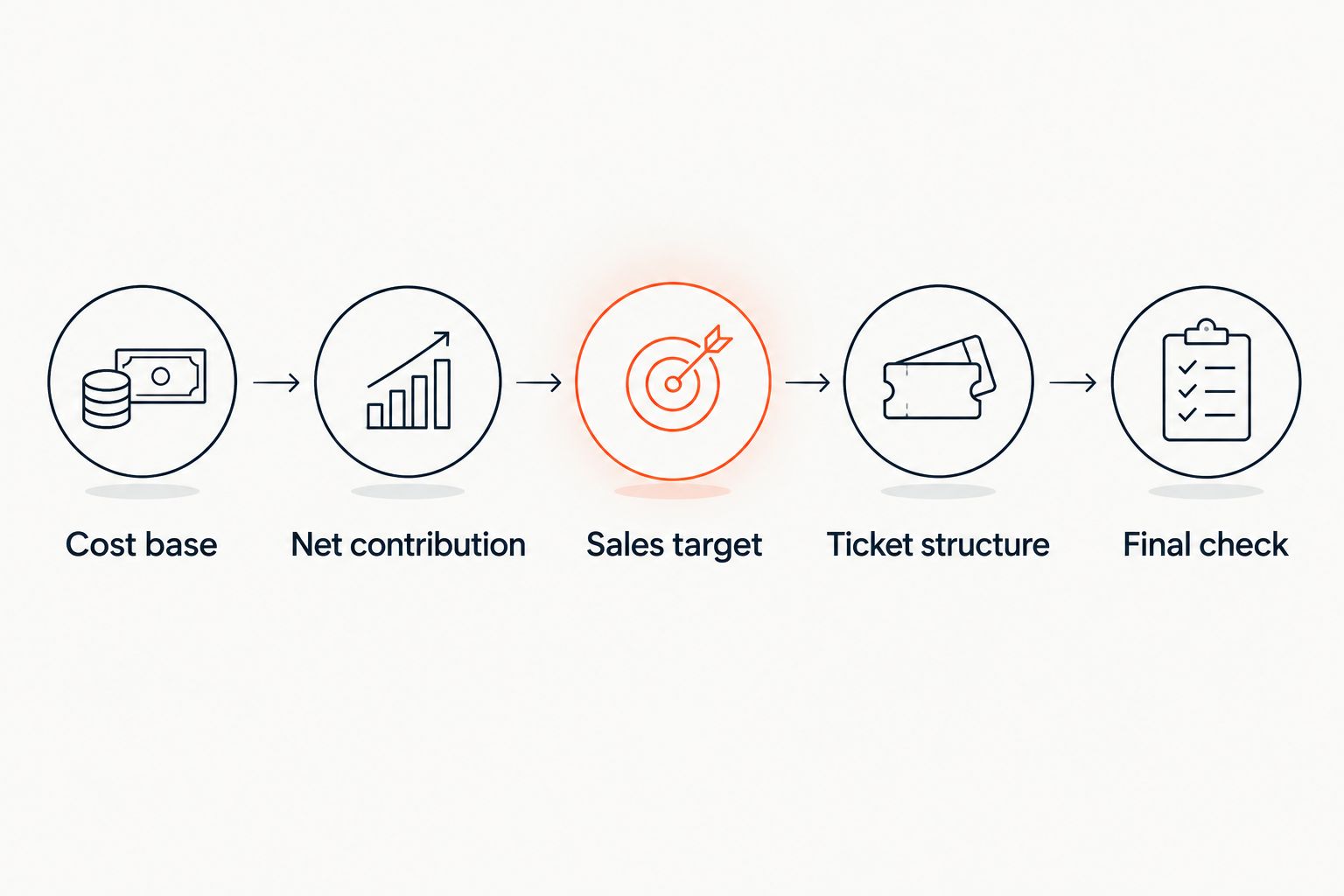
The sequence is Cost base, Net contribution, Sales target, Ticket structure, Final check. Each decision depends on the one before it; starting with a discount skips the economics.
Why this matters
A first-time event needs a pricing plan that survives imperfect demand. Your commitments arrive before you know the final attendance.
For your 2026 launch, distinguish three questions: what the event costs, what each admission contributes and when the funds become usable. Revenue can cover the budget on paper while supplier payment dates still create a cash-flow problem.
Read the guide to ticketing platform fees when checking deductions and buyer charges. Keep those charges separate from the event’s admission value.
Which ticket structure should you use?
Recommend the simplest structure that matches a real difference in your event. More ticket types mean more allocations, conditions and explanations to manage.
| Ticket structure | Best for | Advantage | Trade-off |
|---|---|---|---|
| Standard admission | A first event with the same access for everyone | Makes the offer and revenue calculation easier to explain | Does not distinguish between different seating or access benefits |
| Early-booking admission | A defined advance-purchase offer | Gives you a clear purchase condition to communicate | Reduces retained revenue unless the budget accounts for it |
| Reserved seating bands | Venues with meaningfully different seating areas | Connects the ticket difference to a specific seat location | Requires accurate seat allocation and clear descriptions |
| Group admission | Organised groups attending together | Gives group organisers a defined purchase option | Needs clear eligibility and a contribution check |
These are planning options, not a requirement to publish every type. Start with standard admission and add complexity only where the event justifies it.
Standard admission
Standard admission is the clearest starting point when everyone receives the same event access. State what admission includes, whether seating is assigned and any conditions that affect entry.
Its limitation is equally clear: one admission type does not distinguish a restricted-view seat from a different seating area. If that difference matters, describe it rather than leaving the box office to explain it after purchase.
Early-booking admission
An early-booking offer needs a defined eligibility condition and an allocation you can afford. Calculate its contribution before you promote it.
Do not make discounted admissions the foundation of a budget that depends on standard admissions. The worksheet must reflect the mix you actually intend to sell.
Reserved seating bands
Reserved seating bands work when the seat location explains the difference. Name the areas clearly and describe any material restrictions.
Avoid inventing premium benefits to justify a higher band. A seating distinction is enough when it is accurate; an unsupported promise creates a delivery obligation you have not budgeted for.
Why first-time event ticket pricing varies
The right structure follows your event’s commitments and admission experience. Check these factors rather than borrowing a ticket amount from an unrelated show:
- Delivery costs: venue, production and staffing commitments determine what ticket revenue must cover.
- Paid capacity: guest allocations and complimentary admissions reduce the places that generate revenue.
- Seat location: meaningful differences in seating support clearly described bands.
- Included access: additional sessions or benefits need their own delivery costs accounted for.
- Purchase conditions: advance-purchase and group offers change the revenue mix.
- Buyer charges: booking fees change the checkout total even when the organiser’s admission revenue stays unchanged.
For each factor, write down the effect on either costs, retained revenue or the ticket entitlement. If it changes none of those, it does not belong in the pricing calculation.
Should you start cheap to fill the room?
Start with a financially workable admission, not an unexplained discount. A lower admission amount requires a corresponding plan for covering the event’s costs.
If you want an introductory offer, define who qualifies and how it affects the ticket mix. Keep the standard admission understandable. The organiser’s task is to build a viable event, not to make every admission look like a promotion.
Should complimentary tickets count towards break-even?
Complimentary tickets do not contribute ticket revenue. Include them in attendance and delivery planning, but exclude them from paid admissions in the break-even calculation.
Record each allocation before launch. A guest still occupies a place and can create an attendee-related cost, even though the admission generates no revenue.
Should you change the ticket structure after launch?
Change the ticket structure only after checking the reason for weak sales. Inspect promotion, event information, seating descriptions and checkout before assuming the admission amount is the problem.
If you revise an offer, make its conditions clear and calculate the new contribution. Keep a record of what changed so the next event’s budget uses actual outcomes rather than a vague memory of what worked.
Put the pricing plan into your ticketing operation
ZunaroSpace event ticketing is best for independent organisers and venues that want sales through their own branded storefront, box office and kiosk. Those channels, reserved seating and door check-in use one live inventory.
You keep the fees, the funds and the customers.
AI that sells your tickets. A WhatsApp agent answers buyers, holds seats and hands over a checkout link. Events can also be discovered and booked inside ChatGPT and Claude, including seat selection on the real map; checkout always completes on the organiser’s own site, never in chat.
ZunaroSpace charges organisers nothing per ticket. The buyer booking fee is AED 3.99, or AED 1.99 for tickets under AED 20; free events carry no booking fee. Ask Zunaro Pro is AED 179/mo, with a 14-day trial and no card required.
The operational advantage is shared inventory across selling channels. The planning limit remains yours: ticketing features do not replace a workable budget or establish demand for a new event. Check the complete commercial arrangements relevant to your event before approving the forecast.
Review the plan before you publish
Your 2026 launch review should leave the team with one approved budget and one clear set of ticket conditions. Check the following:
- Revenue: each ticket type has a retained-revenue calculation, not just a displayed amount.
- Capacity: paid, complimentary and operational allocations reconcile with usable capacity.
- Entitlements: every inclusion has an owner responsible for delivering it.
- Conditions: advance-purchase, group and access-code rules are documented.
- Checkout: the buyer sees the relevant charges and admission details.
- Cash flow: supplier payment dates are checked against the applicable payout arrangements.
After launch, compare actual paid admissions and retained revenue with the plan. Separate ticket types and sales channels so a strong total does not hide a weak contribution from a particular offer.
Use the same definitions throughout your 2026 reporting. An order is not necessarily one admission, and total attendance is not paid attendance. Consistent definitions make the next event’s pricing decision easier to defend.
FAQ
What's the best way to price tickets for a first-time event?
Calculate the net contribution required from a realistic number of paid admissions, then check the proposed ticket structure against the event’s access and inclusions. Include variable costs and inspect the buyer’s checkout total before publishing.
Should I assume my first event will sell out?
Do not make a sell-out the condition for covering your event’s costs. Use a defensible paid-admission target and test the budget with weaker sales.
Should I offer early-booking tickets for my first event?
Offer early-booking tickets only when their reduced contribution fits your budget. Define the eligibility condition and account for the intended allocation in your sales mix.
Do free guest tickets count towards break-even?
Free guest tickets do not count as paid admissions in a ticket-revenue break-even calculation. They still occupy capacity and can create attendee-related costs.
Should reserved seats all have the same ticket conditions?
Use different seating bands when a meaningful seat-location difference justifies them. Describe restricted views or other material differences clearly rather than implying benefits you cannot deliver.
Where do bookings discovered in ChatGPT or Claude complete checkout?
Checkout completes on the organiser’s own site, never in chat. Event discovery, booking, seat selection and seat holds can happen inside ChatGPT and Claude.
What should I change if ticket sales are slow?
Check promotion, event information and the checkout journey before changing the ticket structure. Recalculate retained contribution for any revised offer and document the change.
One last thing
An occupied seat and a paid admission are different budget entries. Before publishing, check whether your attendance target includes guests, crew or complimentary allocations. That distinction changes the contribution required from the admissions you actually sell.
ZunaroSpace is based at DTEC, Dubai Silicon Oasis. Built for the Gulf - the UAE and Saudi Arabia.