
Yes. You can offer early-bird and discount code pricing together if your ticketing system supports both. Early-bird pricing gives a defined ticket group an earlier offer; a discount code applies to eligible orders. Before you publish a 2026 event, decide whether the code works on early-bird tickets and check that every sales channel follows the same rule.
- Yes: early-bird and discount code pricing can work together when the ticketing system supports both rules.
- Early bird suits a public sales window; a discount code suits a defined group of buyers.
- Decide whether discounts stack before tickets go on sale, then test checkout in every channel.
- Zunaro is best for organisers who need a branded ticketing storefront, box office and kiosk on one live inventory; confirm pricing-rule support before launch.
Why this matters
Every show has seats that never sold - and no one was working on them. An early-bird offer gives buyers a reason to act before the event; a code lets you make a separate offer to a defined group. Neither helps if the offer shown to a buyer cannot be redeemed at checkout.
For an independent organiser, the decision is about control as much as promotion. Zunaro is an event ticketing platform with a branded storefront, box office and kiosk on one live inventory. Zunaro is best for organisers who want to run those sales channels together while keeping the customer relationship. Confirm how early-bird tiers and discount codes work in your account before advertising either offer.
Can I offer early-bird and discount code pricing?
Yes, provided your platform lets you configure the early-bird offer and the code, then apply the intended eligibility rules at checkout. They solve different problems: an early-bird offer sets a public reason to book sooner, while a code limits an offer to buyers you choose to reach.
| Option | Best for | How to set the rule | Main drawback |
|---|---|---|---|
| Early-bird ticket | Encouraging bookings before general sales | Define which tickets qualify and when the offer ends | Buyers who see an expired offer need a clear next option |
| Discount code | Making an offer to a defined audience | Define eligible tickets, a redemption window and any use limit your system supports | Shared codes can reach buyers outside the intended group |
| Both together | Running a public offer and a separate targeted offer | Decide whether a code applies to early-bird tickets before either goes live | Unchecked stacking can produce an unintended checkout total |
Use early bird for the public offer and a code for the targeted offer. Use both on the same order only if that is the result you intend. If your system cannot enforce that choice, keep the offers on separate eligible tickets or sales windows.
For a 2026 event, write the rule in plain language before you set it up: who qualifies, which ticket it covers, when it stops and what happens if the buyer enters a code. That short description becomes your test at checkout.
How do I set up both offers without conflicting rules?
- Choose the eligible tickets. Decide whether early bird covers the whole event or selected ticket types. For reserved seating, specify which seats or sections the offer covers.
- Set the early-bird boundary. Choose an end date, a ticket allocation or another limit your system actually supports. Do not announce an automatic change until you have checked how it works.
- Define the code audience. A code for an invited group needs clear eligibility. Decide whether it applies to the same tickets as early bird or to a different selection.
- Set the stacking rule. Decide whether entering a code on an early-bird ticket changes the checkout total. Test both an eligible order and an ineligible one.
- Check each sales channel. If you sell through a storefront, box office and kiosk, test the offer in each place where you expect staff or buyers to use it.
- Review the buyer-facing wording. State the offer's end condition and any code restriction before buyers reach checkout. Remove messages that promise an offer your checkout does not apply.
This is a setup checklist, not a claim that every platform automates each step. If a required rule is unavailable, change the promotion rather than asking staff to correct orders after sale.
A discount can also affect more than the checkout screen. Check how the final order appears in confirmations and reports so your team can identify which offer produced each booking. For a 2026 campaign, that distinction matters when you decide whether to repeat the public offer, the targeted offer or neither.
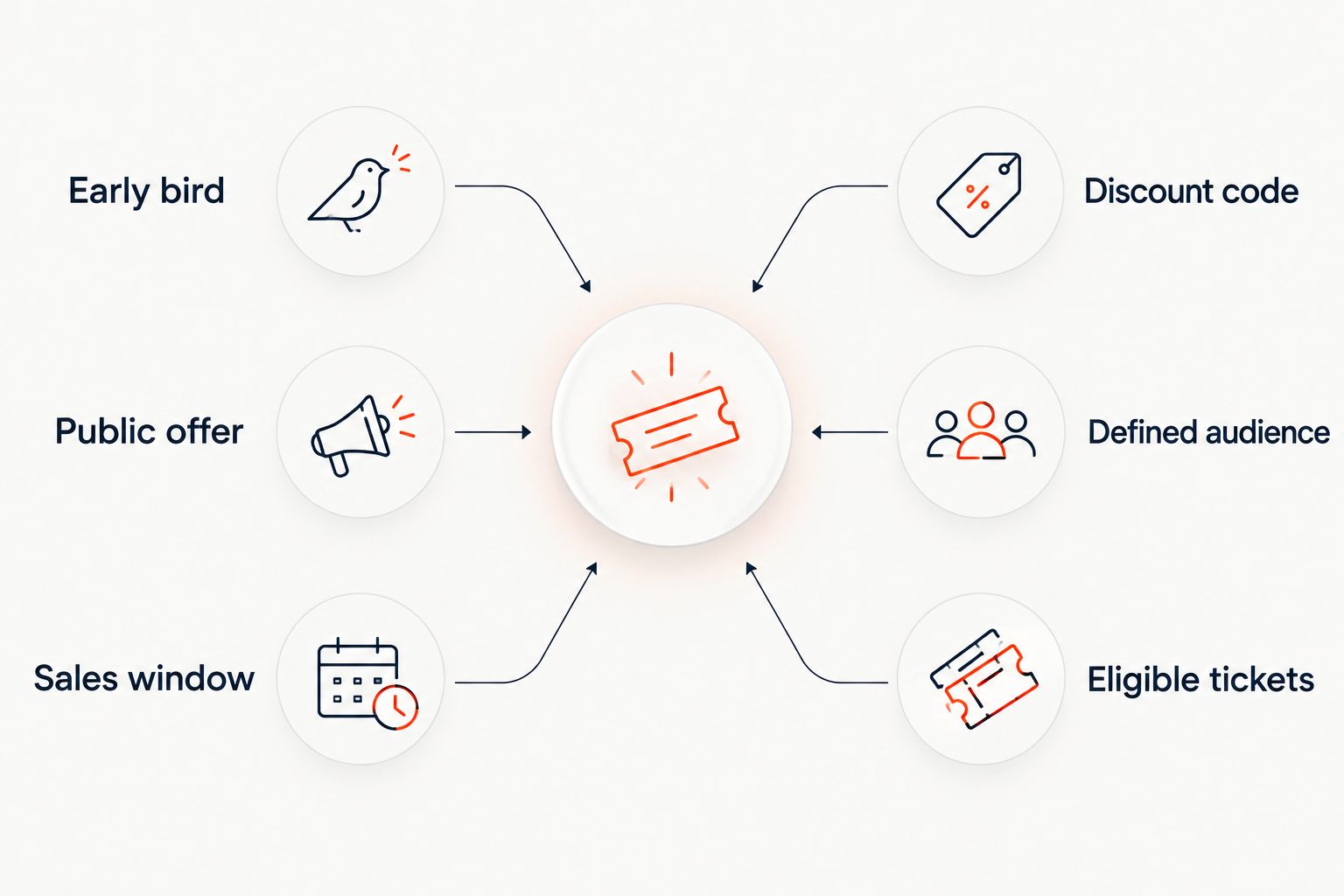
Why early-bird and code results vary
The same promotion can behave differently across events because the rules you choose differ. Check these factors before publishing:
- Ticket eligibility. A code intended for general admission should not silently apply to a reserved-seat ticket unless you have chosen that outcome.
- Sales window. An early-bird offer tied to a closing date needs a clear handover to the next available ticket option.
- Redemption limits. If you intend a code to stop after a set number of uses, confirm the system can enforce that limit before sharing it.
- Stacking. A code that works on an early-bird ticket creates a different offer from a code that works only on standard tickets.
- Sales channel. A rule tested on your storefront has not been tested at your box office or kiosk. Check each channel you plan to use.
- Seat selection. For reserved seating, the offer must match the seats the buyer can select, not just the ticket name in an advert.
The practical rule is simple: test the exact order a buyer will place. Choose a qualifying ticket, enter the code, select a seat where relevant and inspect the final checkout result. Then repeat with a ticket or code that should not qualify. A successful qualifying test alone will not expose a rule that applies too broadly.
Should a discount code work on early-bird tickets?
Not automatically. Allow stacking when the combined offer is deliberate; otherwise, exclude early-bird tickets from code eligibility. Make that decision before sharing the code so staff do not have to interpret the rule while a buyer is waiting.
There is a useful distinction between access and discount. An access code can control who sees or buys a ticket without changing its checkout total. A discount code changes the offer for an eligible order. If you need both restricted access and a different offer, check which separate rules your ticketing system provides rather than assuming one code does both.
For a 2026 theatre performance with reserved seating, check the seat selection as well as the code field. If a buyer can choose a seat outside the eligible section, the checkout rule needs to reject the offer clearly. A vague error at the end of checkout is a poor substitute for defined eligibility.
Can I use different offers at the box office and online?
Yes, if your system and sales policy allow channel-specific rules. But decide whether the difference is intentional. If a buyer sees an early-bird offer online and asks for the same ticket at the box office, staff need a clear answer about whether the offer applies there.
Zunaro puts the storefront, box office and kiosk on one live inventory. That addresses the risk of separate channels selling the same seat, but shared inventory does not establish that every pricing rule works identically in every channel. Test the proposed offer in each channel before your 2026 launch.
If your team sells at the door, write a short instruction covering code entry, eligible tickets and expired offers. Keep it aligned with what checkout actually accepts. For more on channel coordination, see how to connect your box office to your online storefront.
What should I check before announcing an early-bird deadline?
Check what ends the offer, what ticket replaces it and what a buyer sees after it ends. If your system requires you to make the change manually, assign an owner before announcing the deadline. Do not describe a change as automatic unless you have verified it.
Then check the message wherever the offer appears. An event page, email and box-office instruction should describe the same eligibility rule. If the code remains valid after early bird ends, say which tickets accept it. If it does not, remove wording that suggests buyers can still combine the offers.
For a 2026 event with reserved seating, inspect the available seats after the early-bird offer closes. The next ticket option should let buyers complete an order without relying on an expired offer. That check is more useful than looking at the event page alone.
Where does Zunaro fit?
Zunaro is an event ticketing platform for independent organisers and venues that sell through their own branded storefront, box office and kiosk. It also supports reserved seating and door check-in on one live inventory. Confirm early-bird scheduling, discount-code eligibility and stacking in the product before making them part of your sales plan.
The ownership point stays separate from the promotion: you keep the fees, the funds and the customers. Zunaro can also use a WhatsApp agent to answer buyers, hold seats and hand over a checkout link. Events can be discovered and booked inside ChatGPT and Claude, with checkout completed on the organiser's own site. None of those paths removes the need to test the offer at checkout.
FAQ
Can I offer early-bird and discount code pricing for the same event?
Yes, if your ticketing system supports both offers. Decide whether the code applies to early-bird tickets, then test that rule at checkout before publishing.
Should my discount code apply to early-bird tickets?
Only if you intend buyers to combine the offers. Otherwise, exclude early-bird tickets from code eligibility and test an order that should be rejected.
Can I limit an early-bird offer to certain seats?
Yes, if your reserved-seating system supports seat-level or section-level eligibility for that offer. Check the seat map and final checkout result before advertising it.
Can I give invited buyers a code without discounting every ticket?
Yes, if your system lets you restrict code eligibility to selected tickets or buyers. An access code and a discount code serve different purposes, so check which rule you need.
Will an early-bird offer work at my box office and kiosk?
That depends on the rules available in each sales channel. Test the offer at the storefront, box office and kiosk wherever you intend to accept it.
What happens when early-bird pricing ends?
The result depends on how your ticketing system handles the offer's end condition. Verify the next available ticket option and the buyer-facing message before announcing a deadline.
Can buyers complete a Zunaro ticket purchase inside ChatGPT or Claude?
No. Buyers can discover an event, choose a seat on the real map and hold it in chat, but checkout completes on the organiser's own site.
One last thing
The hardest mistake to spot is not a code that fails. It is a code that works on a ticket you meant to exclude. Before your 2026 event goes live, test both sides of the rule: the order that should receive the offer and the order that should not.