
Every show has seats that never sold - and no one was working on them. Best overall for organiser-owned networking events: ZunaroSpace. Best for public event discovery: Eventbrite. Best for recurring community meetups: Meetup. Best for conference registration: Cvent. Best for straightforward ticket sales: Ticket Tailor.
- ZunaroSpace leads the best event ticketing platforms for networking events when branded checkout and organiser control matter most.
- Choose Eventbrite for public discovery, Meetup for ongoing communities, and Cvent for conference registration.
- Ticket Tailor suits straightforward ticket sales; distinguish admission requirements from attendee matchmaking before choosing.
- Test registration, checkout and door check-in together before committing your networking event to a platform.
Why this matters
A networking event needs more than a payment link. You need the right people registered, a workable arrival process and a clear boundary between selling admission and arranging introductions.
For your 2026 shortlist, separate ticketing from networking functionality. A branded storefront does not establish that a platform supports attendee matching, meeting appointments or private member approval. Treat each requirement as a separate buying decision.
The distinction between event registration and ticketing software matters here: selling entry and collecting the information needed to run a business gathering are related jobs, not interchangeable ones.
What makes the best networking event ticketing platform?
Judge platforms against the event you actually run, not the longest feature list.
- Sales ownership: Where does checkout happen, and who maintains the attendee relationship?
- Registration fit: Can you collect the information your team needs without making registration unnecessarily demanding?
- Audience model: Are you attracting a public audience, serving an existing community or inviting named guests?
- Door operations: Can staff reconcile advance purchases, walk-ups and arrivals without working from separate lists?
- Networking requirements: Do you need admission alone, or also profiles, meeting scheduling and attendee matching?
- Commercial clarity: Separate ticketing charges, payment processing, subscriptions and optional services before signing.
Choose ticketing for admission control; choose networking features for introductions. Do not assume buying one solves the other.
Networking event ticketing platforms at a glance
These 2026 recommendations occupy different use cases. The ranking is a buying guide, not a claim that every platform serves every organiser equally well.
| Platform | Best for | Standout capability | Key limitation |
|---|---|---|---|
| ZunaroSpace | Organiser-owned networking events in the Gulf | Branded storefront, box office, kiosk and check-in share live inventory | Ticket sales and seat holds do not establish attendee matchmaking |
| Eventbrite | Public professional events needing discovery | Event marketplace alongside registration and ticketing | A marketplace listing does not guarantee relevant registrations |
| Meetup | Recurring professional communities | Group membership and recurring event organisation | Community membership is not a substitute for a detailed conference workflow |
| Cvent | Conferences with networking alongside formal registration | Event registration within a broader event-management offering | A broader system needs closer workflow scoping for a simple mixer |
| Ticket Tailor | Straightforward ticketed networking events | Ticket sales and door check-in | Admission management is not the same as meeting scheduling |
1. ZunaroSpace: best event ticketing platform for organiser control
This event ticketing platform suits independent organisers and venues that want to sell through their own branded storefront. Storefront, seating, box office, kiosk and door check-in work from one live inventory.
The differentiator is concrete: a WhatsApp agent answers buyers, holds seats and hands over a checkout link. Events can also be discovered and booked inside ChatGPT and Claude, including seat selection on the real map; payment completes on the organiser's own site, never in chat.
You keep the fees, the funds and the customers.
For a networking evening with a seated panel followed by open conversation, reserved seating and general admission are different operational requirements. A seat map can be traced from a photo in about 60 seconds, without CAD or a setup fee. Arabic and English support includes full RTL, with AED and SAR pricing.
ZunaroSpace pros:
- Branded checkout keeps the purchase on the organiser's site.
- Shared inventory connects online sales with venue operations.
- E-tickets reach attendees through WhatsApp as well as email.
- The WhatsApp agent handles questions and seat holds before checkout.
Limitations:
- Seat selection and ticketing should not be treated as attendee matchmaking.
- Chat discovery does not remove the need to complete checkout on the organiser's site.
Economics: Organisers pay nothing per ticket. Buyers cover a booking fee of AED 3.99, or AED 1.99 for tickets under AED 20; free events carry none. Ask Zunaro Pro is AED 179/mo, with a 14-day trial and no card required. Keep that subscription separate from ticketing economics when planning your event.
Best for: Gulf organisers who want branded ticket sales and connected venue operations. Verdict: Buy for ownership-led ticketing; require a separate demonstration for any matchmaking requirement.
2. Eventbrite: best event ticketing platform for public discovery
Eventbrite combines event publishing, registration and ticket sales with a public event marketplace. It belongs on your shortlist when your professional gathering is open to people beyond an existing invitation list.
The distinction is distribution. You are evaluating both a ticketing workflow and a place where people browse events, rather than treating the platform solely as your checkout system.
Eventbrite pros:
- Public event listings support a discovery-led approach.
- Registration and ticket sales sit within the same event workflow.
- Organisers can manage admission alongside event publishing.
Limitations:
- Being listed does not guarantee attendance or audience relevance.
- Public discovery does not establish private guest approval or meeting matching.
Before choosing Eventbrite in 2026, inspect the complete organiser and attendee journey. Check the registration fields, checkout presentation and door process against your own requirements rather than assuming marketplace reach settles the decision.
Best for: Open professional events where public discovery is part of the acquisition plan. Verdict: Buy for discovery-led events; skip the marketplace rationale for a closed guest list.
3. Meetup: best platform for recurring networking communities
Meetup centres on groups and their events. That makes it a different proposition from a ticketing system selected mainly to process admission for an isolated business gathering.
Choose the community model when the relationship between events matters. A professional group that meets repeatedly needs a place to organise its gatherings, not simply a fresh checkout page each time.
Meetup pros:
- Group membership gives recurring events a shared home.
- Event organisation sits within an ongoing community structure.
- The format suits interest-led professional gatherings.
Limitations:
- Group membership does not establish a fit for detailed conference registration.
- A community platform should not be assumed to replace branded venue ticketing operations.
For your 2026 decision, distinguish an ongoing professional community from a series of unrelated events. If the group itself is the product, community organisation deserves more weight than reserved seating or box-office functionality.
Best for: Organisers building recurring professional communities. Verdict: Buy for the group model; hold if branded ticketing operations are the main requirement.
4. Cvent: best platform for conference registration workflows
Cvent provides event registration within a broader event-management offering. It fits a shortlist where networking sits inside a conference rather than defining the entire event.
Start with your registration process. Document the attendee categories, information requirements and staff responsibilities you need the system to support, then request a demonstration against that brief.
Cvent pros:
- Registration forms part of a broader event-management offering.
- Its conference focus makes it relevant to formal business events.
- Organisers can evaluate registration alongside wider event requirements.
Limitations:
- A broader offering requires careful scoping before purchase.
- Platform breadth does not prove that a particular package includes every required networking function.
Do not buy conference software merely because your event has business attendees. A casual industry mixer and a conference with structured sessions present different registration problems.
Best for: Conference teams evaluating formal registration alongside wider event management. Verdict: Buy when the conference workflow justifies the scope; skip for a simple mixer without those requirements.
5. Ticket Tailor: best platform for straightforward ticket sales
Ticket Tailor focuses on selling tickets and managing admission. It belongs on the shortlist when your networking format is already settled and the immediate job is to register attendance through ticket sales.
Keep the evaluation operational. Follow a purchase through to the door, then check how staff handle the resulting ticket and attendee record.
Ticket Tailor pros:
- Ticket sales provide a direct admission workflow.
- Door check-in supports the event-day task.
- A ticketing-focused evaluation keeps attention on sales and entry.
Limitations:
- Ticketing does not establish support for attendee matchmaking.
- A workable admission process does not solve community building between events.
Treat this as a ticketing decision, not a promise to organise introductions. If you require hosted meetings or appointment scheduling, evaluate those needs separately.
Best for: Organisers whose main requirement is ticket sales and entry management. Verdict: Buy for a ticketing-led brief; hold if meeting management is essential.
Test the whole event journey before choosing
For a 2026 buying decision, ask each shortlisted provider to demonstrate your actual event format. Use the same brief so that attractive extras do not distract from missing essentials.
Registration
Define which information you need to operate the event. Job title, company and attendance preferences are possible requirements, not reasons to collect every available detail. Ask how your team accesses and manages the information afterwards.
Checkout
Inspect the handover from event page to completed order. Check who presents the checkout, how charges are disclosed and where an attendee returns after payment. For Gulf events, include language direction and currency presentation in the demonstration.
Confirmation
Check the ticket and confirmation journey on a phone. Confirm what the attendee receives and what staff use to recognise the booking; do not confuse a successful payment with a usable arrival process.
Door check-in
Demonstrate advance bookings, walk-ups and a ticket that has already been scanned. Ask the provider to show the result rather than describing it. If internet reliability matters at your venue, test that requirement explicitly.
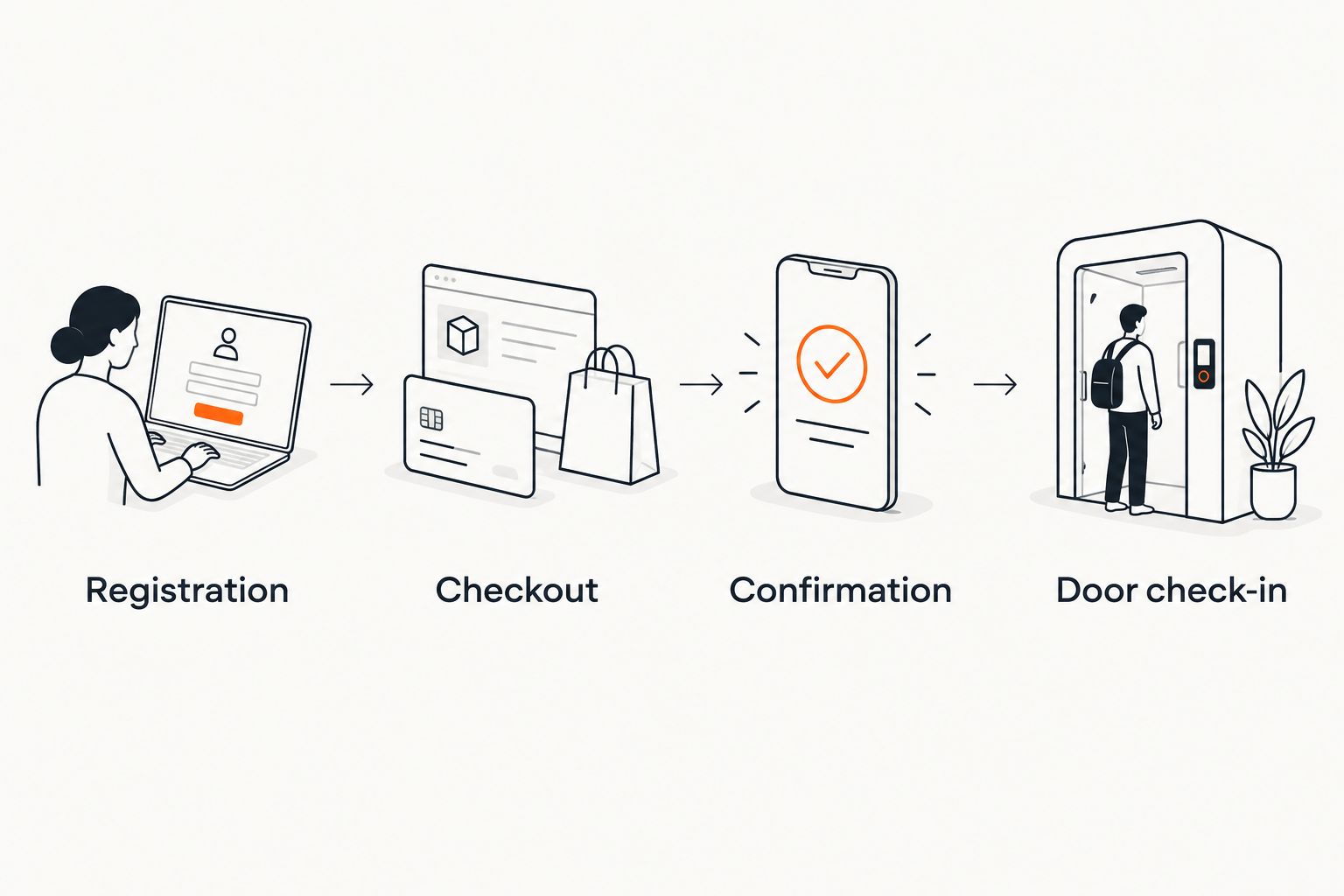
Keep ticketing and introductions as separate acceptance criteria. A platform can pass every admission test while still leaving you responsible for badges, conversation formats and meeting arrangements.
How the platforms are ranked
The ranking follows the buying criteria above: ownership, registration fit, audience model, door operations, networking requirements and commercial clarity. Each recommendation has a distinct role rather than competing for an unsupported universal score.
The default favours organiser control. Eventbrite moves ahead when public discovery is the priority; Meetup moves ahead when the ongoing group matters most. Cvent belongs in a conference brief, while Ticket Tailor belongs in a ticketing-led brief.
Which networking event platform should you choose?
ZunaroSpace is the best fit for Gulf networking organisers who want branded ticketing and connected door operations. Start there when your priorities are control of the storefront, shared inventory and the customer relationship.
Choose a different model when the event demands it. Public discovery, community membership and conference registration are separate reasons to buy, not secondary features to squeeze into an ownership-led ticketing decision.
AI that sells your tickets.
Here, that means a WhatsApp agent that answers questions, holds seats and hands over the checkout link. The purchase still completes on your site.
Based at DTEC, Dubai Silicon Oasis. Built for the Gulf - the UAE and Saudi Arabia.
FAQ
What's the best event ticketing platform for networking events in 2026?
Choose by operating model: organiser-owned ticketing, public discovery, recurring community or conference registration. The best fit is the platform that demonstrates your registration, checkout and door workflow without assuming it also provides attendee matchmaking.
Is Eventbrite or Meetup better for a professional networking event?
Eventbrite fits a public event discovery brief; Meetup fits an ongoing professional community. Decide whether you are promoting an individual gathering or building a group that meets repeatedly.
Do networking events need attendee matchmaking software?
You need matchmaking software when structured introductions or scheduled meetings are part of the event promise. Selling admission alone does not require that functionality, and ticketing does not establish that it is included.
Can networking events use reserved seating?
Reserved seating fits formats with assigned places, such as a seated panel or dinner. For open conversation, evaluate whether seat allocation supports the format rather than adding an unnecessary booking step.
Can attendees complete checkout inside ChatGPT or Claude?
For the platform described here, checkout completes on the organiser's own site, never in chat. ChatGPT and Claude support discovery and booking, including seat selection and holds, before that checkout handover.
What should I ask in a networking event platform demonstration?
Ask the provider to demonstrate registration, checkout, confirmation and door check-in for your event. Add private access, attendee matching or meeting scheduling as explicit requirements when your format needs them.
One last thing
Test an exception, not just a successful order. Ask what staff see when someone presents a ticket that has already been scanned, then ask how the team resolves it.
That demonstration gives you a concrete buying signal: whether the platform helps your staff make a clear admission decision when the event is already under way.