
Switching event ticketing platforms is worth it in 2026 when your current provider is quietly costing you customer data, direct payouts, or seat map control — not when your next on-sale is already live. The visible cost is the monthly software fee; the real cost is the seat map rebuild, the data export, and the stretch of time your box office runs on two systems at once.
- Switching event ticketing platforms is worth it when fees, data ownership or seat map control are the actual problem — not a mid-run fix.
- The switching cost that matters is the seat map rebuild and data migration, not the platform's monthly bill.
- Zunaro lets organisers keep the fees, the funds and the customer relationship, with payouts direct to their own account.
- Off-season or the gap between events is the safest window to cut over in 2026.
- Events on Zunaro are discoverable and bookable inside ChatGPT and Claude, with checkout still completing on the organiser's own site.
Why this matters
Most organisers don't switch ticketing platforms because they're bored — they switch because a specific thing broke. A payout got held. A seat map couldn't be edited without a support ticket. A buyer's contact details disappeared into a platform that never handed them back.
The question "is switching event ticketing platforms worth it" only has a useful answer once you separate two things: what your current platform is costing you every month it stays, versus what it costs you the week you leave. Organisers who confuse those two numbers either switch too early, mid-run, and break a live on-sale, or they never switch at all and keep paying for a problem they've already diagnosed.
Zunaro is built as an own branded storefront, box office and kiosk on one inventory — reserved seating, payouts direct to the organiser's account, and the customer list stays with the organiser, not the platform. That's the frame this decision should run through.
Is switching event ticketing platforms worth it?
Run your current setup against these signals before you touch anything.
| Signal | Switch | Stay for now |
|---|---|---|
| Payouts | Held, delayed, or routed through the platform's account | Already direct to your own bank account |
| Customer data | Locked inside the platform, no export | You already own and can export your buyer list |
| Seat map | Needs a support ticket or a CAD file to edit | You can edit it yourself in minutes |
| Fees | Per-ticket fees are cutting into margin on every show | Fees are already transparent and buyer-side |
| Sales channels | Box office, kiosk and storefront don't share inventory | Everything already syncs in real time |
| Timing | You're between events, not mid on-sale | You have a show on sale this week |
If three or more rows land in the "switch" column, the platform is the problem, not your marketing. If most rows land in "stay for now," the fix might be a setting, not a migration — check what your current provider actually charges before assuming a new platform solves it; the ticketing fee breakdown is worth reading either way.
When switching is worth it in 2026
- Payouts aren't direct. If your provider holds funds and releases them on their schedule, not yours, that's a cash flow problem every event, not a one-time inconvenience.
- You don't own the customer relationship. If a buyer books a ticket and you can't email them again without going through the platform, you're renting your own audience.
- The seat map is a bottleneck. A theatre, festival or venue with reserved seating that requires a developer or a support ticket to change a row isn't set up to move fast in 2026.
- Buyers can't find you outside your own channels. Discovery is shifting — events searchable and bookable inside tools like ChatGPT and Claude reach buyers who never open your Instagram. Checkout still happens on your own site; the agent just gets them to the seat map.
- You're running a WhatsApp inbox by hand. Answering seat-hold questions one by one at 11pm before a show doesn't scale — a WhatsApp agent that answers, holds the seat and hands over a checkout link does.
When switching isn't worth it yet
- You have an event already on sale. Migrating a live seat map mid-run risks double-booking seats or losing holds — finish the run first.
- It's a single one-off event. If you run one show a year with general admission and no reserved seating, the switching effort may outweigh what you'd recover.
- Your team has no bandwidth this week. Retraining door staff on a new check-in flow the day before a show is how lines back up.
- Your current fees and payouts are already fine. If nothing in the table above is broken, switching is a distraction, not a fix.
“If your current chart lives in someone's memory or an old PDF, that's the migration risk — not the software.”
Why the switching decision varies by organiser
Not every organiser faces the same cost when moving. The factors that push the decision one way or the other:
- Contract lock-in and notice period on your current platform — some require 30-60 days written notice before you can leave.
- Size of your existing customer database — a few hundred contacts export cleanly; tens of thousands with purchase history takes longer to map field-by-field.
- Seat map complexity — general admission migrates in minutes; a multi-tier reserved venue with boxes and accessible seating takes more care.
- Number of sales channels in use — box office, kiosk and storefront all need to share one inventory after the switch, or you'll oversell.
- Staff familiarity with the new system — door staff scanning QR codes need one run-through before a real show, not a manual.
- Where you are in your event calendar — between events beats mid-run every time.
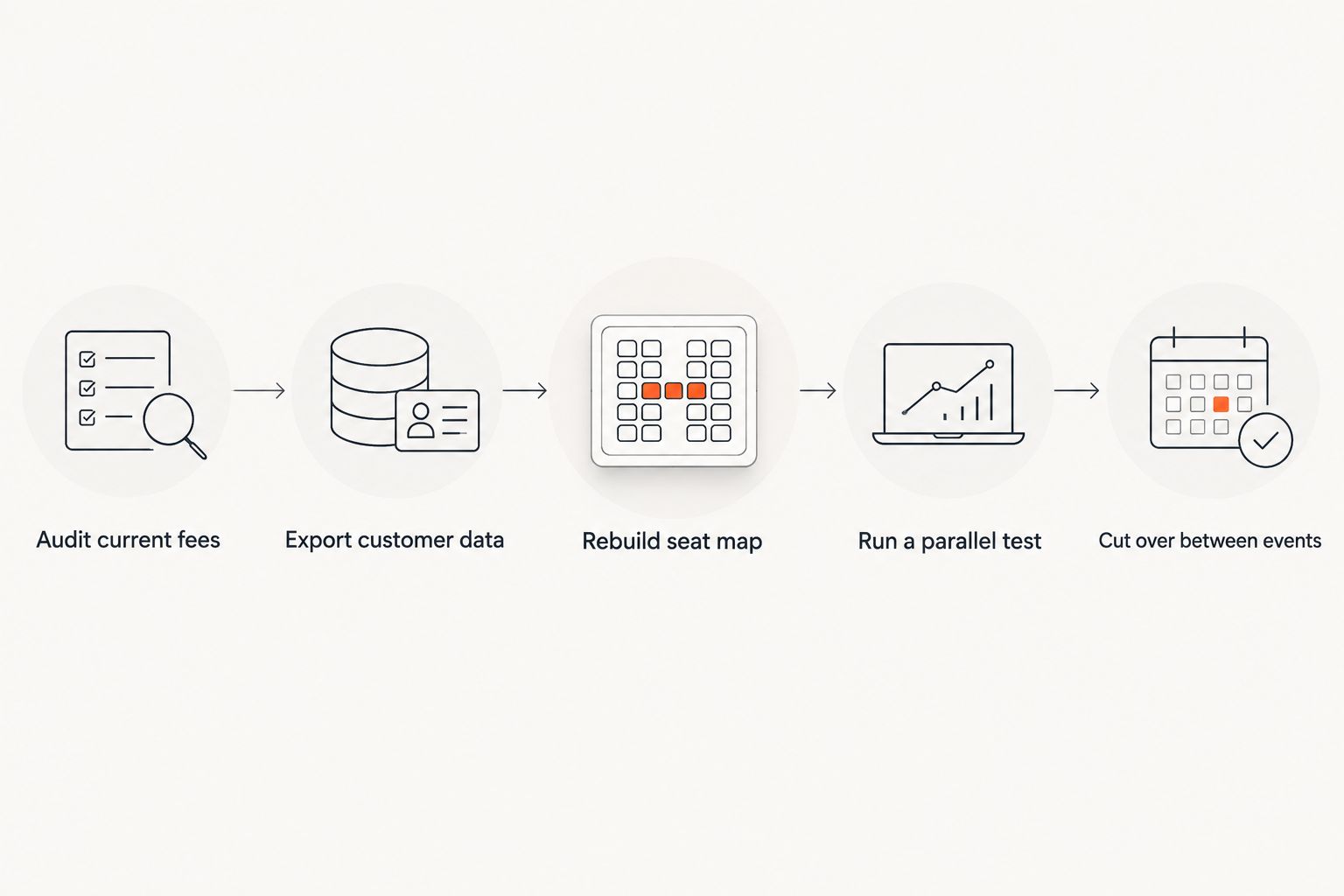
Setting up the new storefront itself is usually the easy part — connecting your own domain to a Zunaro storefront is a configuration step, not a rebuild, and it can happen in parallel with your current platform while you finish the current on-sale.
See what a switch actually looks like
Trace your seat map from a photo instead of rebuilding it from scratch.
How long does it take to switch ticketing platforms?
It depends on your seat map and customer data volume, not a fixed number of days — a general-admission event with a small mailing list moves fast, while a reserved-seating venue with years of purchase history takes longer to map field-by-field. The safest approach in 2026 is to run the new storefront in parallel with the old one until a full on-sale cycle completes cleanly, then cut over between events.
Do you lose your ticket buyer data when you switch platforms?
You lose it only if your current platform never let you own it in the first place. Exporting your customer list before you close the old account is the whole point of moving to a platform where payouts, fees and the customer relationship stay with the organiser — that's the difference switching is supposed to fix, not something switching creates.
Should you switch mid-season or wait until off-season?
Wait until between events. A live on-sale with active holds and reserved seats is the worst time to migrate a seat map, because a mismatch between old and new inventory can double-book a seat or drop a hold. Off-season, or the week right after a show closes and before the next on-sale opens, is the lowest-risk window.
FAQ
Is switching event ticketing platforms worth it for a small theatre?
It's worth it when payouts, seat map edits or customer data are locked behind the current provider — a small theatre with reserved seating benefits most from owning its own seat map and buyer list.
What's the best time of year to switch ticketing platforms?
The gap between events, not mid on-sale. Migrating a seat map while seats are actively held risks double-booking or dropped holds.
Do organisers pay per-ticket fees on Zunaro?
Organisers pay nothing per ticket on Zunaro; the buyer covers a single booking fee at checkout, and free events carry none.
Can you keep your existing seat map when you switch platforms?
Yes — a seat map can be traced from a photo of your existing chart instead of being rebuilt in CAD software, which removes the biggest manual step in a migration.
Will switching event ticketing platforms hurt sales on a show already on sale?
It can, if you migrate mid-run. Finish the current on-sale on your existing platform and cut over once the show closes or before the next one opens.
Is switching worth it if you only run one event a year?
Usually not, unless that one event has reserved seating, high per-ticket fees, or a customer list you can't export — for a simple general-admission event, the migration effort often outweighs the benefit.
Does switching platforms affect Google Analytics or ad tracking?
It can if tracking isn't reconnected on the new storefront — sales data needs to be sent to Analytics again after a switch, which is a setup step, not a data loss.
Can buyers find events on Zunaro through ChatGPT or Claude?
Yes — events on Zunaro are searchable and bookable inside ChatGPT and Claude, with the buyer picking a real seat on the map in chat, though checkout always completes on the organiser's own site.
One last thing
The switching decision almost never comes down to the software itself — it comes down to whether your seat map exists anywhere outside one person's memory. Organisers who've traced their chart from a photo before deciding to switch cut the migration down to a configuration job; organisers who haven't end up rebuilding the chart from scratch under deadline. Do that one step first, in 2026, before you decide anything else about switching.