
Event organisers cannot eliminate a credit card processing charge simply by choosing a ticketing platform with no organiser ticket fee; they can absorb it, include it in the ticket price, or pass it on where the applicable rules permit. In 2026, the key distinction is between removing a payment-processing charge and changing who pays it, while free admission or a non-card payment avoids that particular card transaction altogether.
- Can event organizers avoid credit card processing fees? Not by shifting an existing charge to the buyer.
- Credit card processing fees and ticketing platform fees are separate charges; check both before choosing a platform.
- ZunaroSpace charges organisers nothing per ticket; that does not establish that card processing is free.
- Free admission avoids a ticket-payment transaction; cash avoids card processing but creates separate handling work.
Can event organizers avoid credit card processing fees?
You can avoid a card-processing transaction, but you cannot make its charge disappear by relabelling it. If your processor charges for accepting a card payment, somebody bears that cost. A booking fee, ticket-price adjustment or permitted surcharge changes its allocation, not its existence.
Start by separating ticketing platform fees from payment-processing fees. They pay for different services, even when your checkout presents them together.
| Approach | What happens to card processing? | Best for | Advantage | Limitation |
|---|---|---|---|---|
| Absorb the charge | The organiser bears the charge | Organisers prioritising a simple buyer-facing total | Keeps the advertised payment structure straightforward | Reduces the amount retained from the sale |
| Include costs in ticket pricing | Processing still applies to a card payment | Organisers planning an all-in ticket price | Lets you account for payment costs before publishing | Does not remove the underlying charge |
| Apply a permitted surcharge | The buyer bears a separately disclosed charge | Organisers whose rules and agreements allow it | Makes the payment-method charge explicit | Requires checks against local rules and processor terms |
| Accept cash | No card transaction occurs for that payment | Staffed walk-up box offices | Avoids card processing for cash receipts | Requires cash handling and reconciliation |
| Offer free admission | No ticket-payment transaction occurs | Genuinely free events | Removes the need to collect an admission payment | Produces no admission revenue |
These are operating choices, not interchangeable fee waivers. Choose the approach that fits your event, checkout and accounting requirements rather than treating every buyer-paid charge as a saving.
Why this matters
Every show has seats that never sold - and no one was working on them. Payment costs matter, but a cheaper-looking checkout is not a complete ticketing decision.
You also need to know who controls the storefront, where orders live, how seats stay synchronised and what reaches your account. A lower platform charge does not establish a lower total cost of accepting payment. Compare the full arrangement before moving your next event.
For a 2026 platform review, ask separate questions about ticketing charges, payment acceptance and settlement. A promise about one category should never serve as the answer to another.
Absorbing card processing: keep the checkout simple
Absorbing processing means your business bears the charge rather than displaying a separate payment-method surcharge. It does not mean the processor works without charging you.
Best for: organisers who want a straightforward buyer-facing total. The advantage is a simpler payment presentation. The trade-off is that you must account for the deduction when planning the event's retained revenue.
Build the calculation around the actual processing agreement, not a ticketing headline. Establish which party charges you, which transactions it covers and where the deduction appears in your records.
Keep tax treatment separate from that calculation. A payment fee and a tax obligation are different accounting questions, and the appropriate treatment depends on your jurisdiction and circumstances.
Including processing in pricing: recover costs without removing them
You can account for expected operating costs when setting ticket prices. That approach does not cancel a processing charge; it places the cost inside your broader pricing decision.
Best for: organisers planning an all-in admission price. You retain control of the advertised price, but you still need to check what the buyer actually sees at checkout. A platform booking fee or another separate charge can change the final total.
Do not label a ticket as free of all fees merely because you have included one cost in its price. Your description must match the complete payment journey, not just the portion you control.
For reserved seating, review each ticket category against its own economics. A general-admission pricing decision does not automatically answer how you should price premium seats, concessions or other categories your event actually offers.
Passing on a charge: check permission before publishing
Passing processing costs to buyers is a policy decision, not a universal entitlement. Applicable law, card-network rules and your payment-provider agreement determine whether and how you can apply a surcharge.
Best for: organisers whose payment arrangements expressly permit the proposed charge. The advantage is clear allocation of the cost. The limitation is the need to follow the applicable disclosure and charging requirements.
Do not assume that a booking fee, convenience fee and card surcharge mean the same thing. Their treatment depends on the arrangement and rules that apply, not solely on the label you put beside the checkout total.
Before publishing your 2026 checkout, confirm the proposed charge with your payment provider and obtain legal advice where needed. Review the payment methods covered, the wording shown to buyers and how refunds affect the charge.
Cash and free admission: avoid the card transaction
Cash avoids card processing because the payment does not use a card. That is different from accepting a card without paying its processing charge.
Best for: staffed walk-up sales where cash handling fits the operation. Cash gives you a non-card route, but staff still need to record the order, reconcile receipts and protect the money collected. Keep those responsibilities in the decision.
Free admission removes the need to collect an admission payment. Best for: events genuinely intended to have no admission charge. The benefit is a simpler registration model; the limitation is that attendance does not generate ticket revenue.
A free ticket also does not make the entire event operation cost-free. You still need to plan registration, capacity and check-in, and any separate paid transaction requires its own payment assessment.
Why credit card processing charges vary
Your payment setup determines the relevant terms. Use these factors to structure the comparison rather than assuming every ticket sale follows the same agreement:
- Payment method. Card, cash and free registration are different transaction types. Establish which payment actually occurs before discussing its processing cost.
- Sales channel. Online storefronts, staffed box offices and kiosks can involve different payment arrangements. Confirm the terms for each channel you intend to use.
- Country and currency. Check the provider's supported arrangements for your business location and transaction currency. Do not transfer assumptions from another market.
- Fee allocation. Absorbing, including or passing on a charge changes who bears it. It does not establish that the charge has been removed.
- Refund treatment. Check whether processing charges are retained or returned when you refund a payment. Do not assume the original deduction reverses automatically.
Compare the same transaction across providers. A statement about online card acceptance cannot answer a question about a cash sale at the door, and a platform-fee statement cannot answer a processor-fee question.
Five checks before you choose a fee policy
A useful review ends with a documented payment flow, not a collection of headline claims. Use these five checks for your 2026 event setup.
- Identify the charge. List platform fees, processing charges and any buyer-facing booking charge separately. Name the party responsible for each.
- Confirm the payer. Establish whether each charge comes from your receipts, appears at checkout or sits within your ticket-pricing decision. Do not confuse visibility with responsibility.
- Check permission. Confirm your proposed surcharge or fee presentation against the applicable rules and payment agreement. Obtain the answer before building the checkout around it.
- Test checkout. Follow a representative purchase through the storefront and any other sales channel you use. Check the displayed total, order confirmation and payment record.
- Reconcile settlement. Match the order, payment transaction and settlement record. Those three records show whether the published policy matches the money movement.
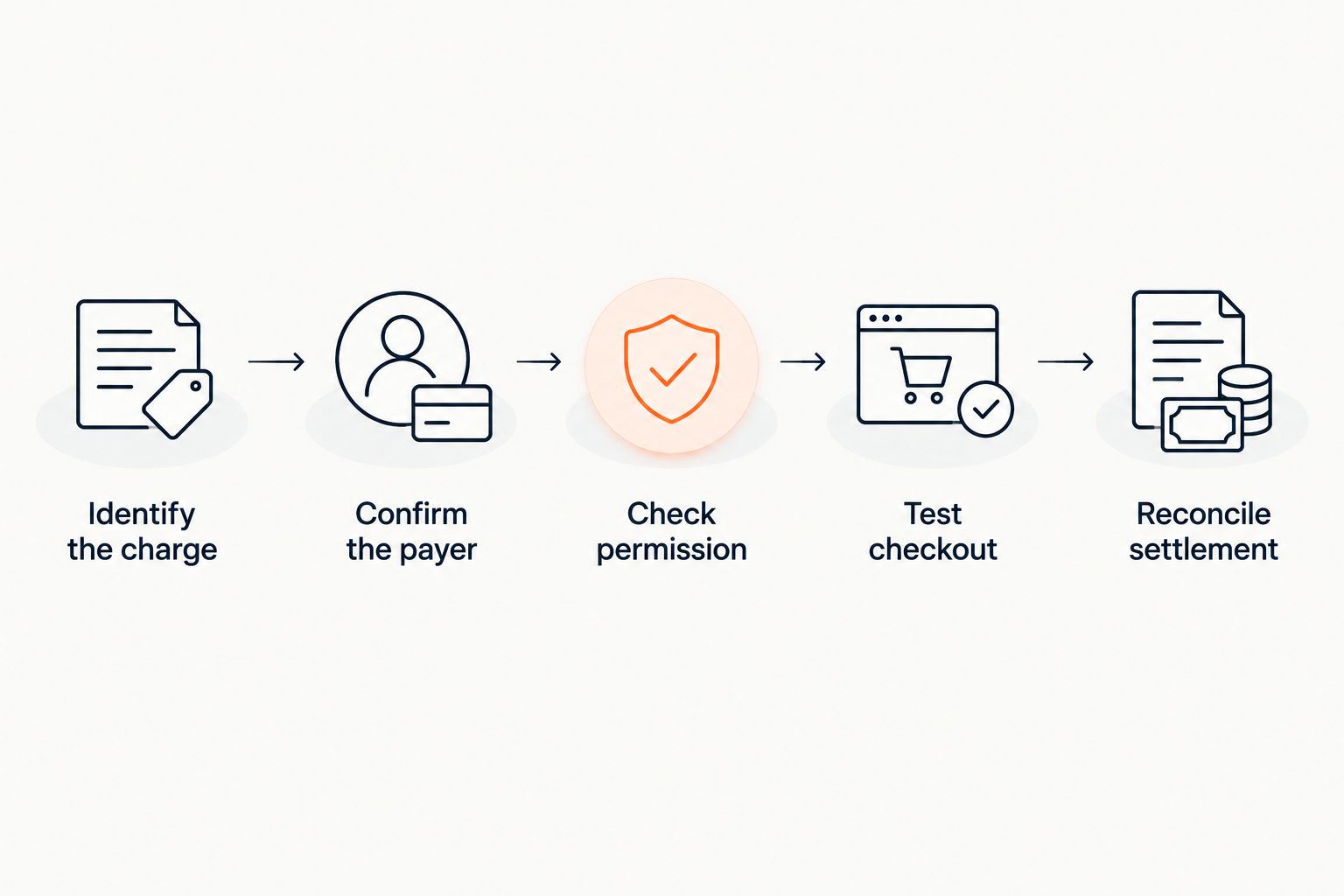
Give each check an owner within your team. The person setting ticket prices, the person configuring checkout and the person reconciling receipts need the same understanding of the charges.
Keep the written confirmation with your event setup records. That gives your box-office staff a clear explanation and gives your finance team a basis for checking deductions without relying on a sales headline.
Where ZunaroSpace fits
ZunaroSpace is best for independent organisers and venues seeking branded event ticketing with shared inventory across sales channels. It provides a storefront, reserved seating, box office, kiosk and door check-in on one live inventory.
The differentiator is the connection between selling and ticketing operations. A WhatsApp agent answers buyers, holds seats and hands over a checkout link; checkout completes on the organiser's own site, not in chat. A seat map can be traced from a photo in about 60 seconds.
ZunaroSpace charges organisers nothing per ticket, with a buyer booking fee for paid events and none for free events. That statement concerns ticketing economics; it is not a promise that card processing carries no charge. Confirm the payment arrangement separately.
The ownership position is direct: You keep the fees, the funds and the customers. The limitation relevant to this question is equally direct: a ticketing-platform claim does not replace a processor agreement or permission to surcharge.
For a Gulf operation, the platform supports Arabic and English with full RTL, plus AED and SAR pricing. Currency support alone does not establish payout eligibility for a particular business or country.
Review your ticketing setup
Explore the storefront, reserved seating, box office and kiosk for your venue or event.
Is a booking fee the same as a card processing fee?
No. A booking fee concerns the ticketing arrangement, while a processing fee concerns accepting the payment. They can appear in the same checkout without becoming the same charge.
Ask what each fee covers and who receives it. That distinction makes a platform comparison useful rather than simply comparing labels.
Does a direct payout mean there are no processing deductions?
No. Where funds settle and what charges apply are separate questions. A direct-payout arrangement does not, by itself, prove that every ticket payment reaches your account without deductions.
Check the settlement record against the order and payment record. Ask for an explanation of any difference before treating gross ticket sales as spendable receipts.
Should you switch platforms just to avoid card processing?
No. Switch only when the full ticketing and payment arrangement meets your requirements better, not because a platform headline leaves processing unmentioned.
For a 2026 decision, compare fee responsibility alongside storefront ownership, reserved seating, box-office operation and reconciliation. A platform replacement must serve the event operation as well as the payment question.
FAQ
Can event organisers completely avoid credit card processing fees?
Event organisers can avoid a card transaction by using a non-card payment or offering genuinely free admission. If a fee-bearing card payment occurs, shifting its charge to someone else does not eliminate it.
Does a ticketing platform with no organiser ticket fee also offer free card processing?
No organiser ticket fee does not establish free card processing. Check the payment-provider agreement separately from the ticketing-platform terms.
Can I pass credit card processing fees to ticket buyers?
You can pass on a charge only where the applicable rules and payment agreement permit your proposed arrangement. Confirm the disclosure requirements and covered payment methods before publishing it.
Is taking cash at the box office better than accepting cards?
Cash avoids card processing for that payment, but it requires cash handling and reconciliation. Choose it when those responsibilities fit your staffed box-office operation, not as a blanket replacement for cards.
Does ZunaroSpace charge organisers per ticket?
ZunaroSpace charges organisers nothing per ticket. Its buyer booking-fee arrangement is separate from the question of payment-processing charges.
Do I get processing fees back when I refund a ticket?
Your processor's refund terms determine whether a processing charge is returned. Check those terms before promising that every original charge will be refunded.
Can a free event still require ticketing software?
Yes, free events can still need registration, capacity management and check-in. Removing the admission payment does not remove those operational requirements.
One last thing
Judge the fee policy by the settlement record, not the checkout label. A charge can disappear from the buyer-facing screen while remaining a deduction from your receipts.
Before your next event, ask for a worked payment-and-settlement example under the current terms. Check who bears every charge and whether the example matches your chosen sales channel; that is the practical test of what you actually retain.