
Yes. Churches can issue free tickets for free events without a booking fee when the ticketing platform exempts free events; the ticket reserves a place rather than collecting a payment. In 2026, check the fee rules for any separate paid ticket or donation flow before calling the whole event fee-free.
- Churches can issue free event tickets without booking fees when the platform exempts free events.
- Zunaro is best for churches that need free reservations, seating and door check-in on one live inventory.
- A free-ticket policy does not establish the fee rules for paid tickets or separate donations.
Can churches sell tickets for free events without fees?
Yes, if every admission ticket is free and the platform charges no booking fee on free events. The word sell causes confusion here: a church can distribute a ticket with a reservation and check-in record without charging for admission. If it accepts money through a separate transaction, that transaction needs its own fee check.
| How the church handles entry | Is admission free? | What to check before publishing |
|---|---|---|
| Free ticket with a reservation | Yes | Whether the platform charges for free tickets or events |
| Free entry without tickets | Yes | How the team will track capacity and arrivals |
| Free ticket plus a separate donation request | Yes | The terms of the separate donation flow |
| Paid admission ticket | No | The applicable ticketing and payment terms |
For a church that needs reservations rather than a payment at the door, Zunaro is an event ticketing platform whose free events carry no booking fee. Organisers pay nothing per ticket. That answers the ticketing-fee question for a free event; it does not answer the fee question for money collected elsewhere.
Why this matters
Free admission and untracked admission are different choices. A reservation gives your event team a way to plan for arrivals, while a ticket gives guests something to present at entry. If you do not need either, a ticketing process adds work without solving an entry problem.
Church events also differ from one another. A service open to everyone does not need the same entry plan as a performance with assigned seats. Decide what the ticket must do before deciding which platform to use.
In 2026, the useful question is not simply whether you can create a free ticket. It is whether your team can issue it, manage the available places and check guests in without an unexpected charge attached to the free event.
What does a no-fee free event include?
Start with the transaction you want guests to complete. If admission costs nothing, the booking should not require them to buy a ticket or make a donation. Keep those choices distinct in your event copy and in the flow guests see.
For a ticketed church event, confirm these points before you publish:
- Set admission. Make the admission ticket free. Check the guest-facing booking flow as well as the organiser-facing event setup.
- Set capacity. Decide whether the event needs a reservation limit or assigned seats. A ticket is most useful when it represents a place you need to track.
- Publish the event. Give guests one clear route to reserve. State plainly that admission is free.
- Check in. Decide who will handle arrivals and what staff will use to recognise a valid ticket.
- Review changes. Set a process for guests who can no longer attend so the team understands which places remain reserved.
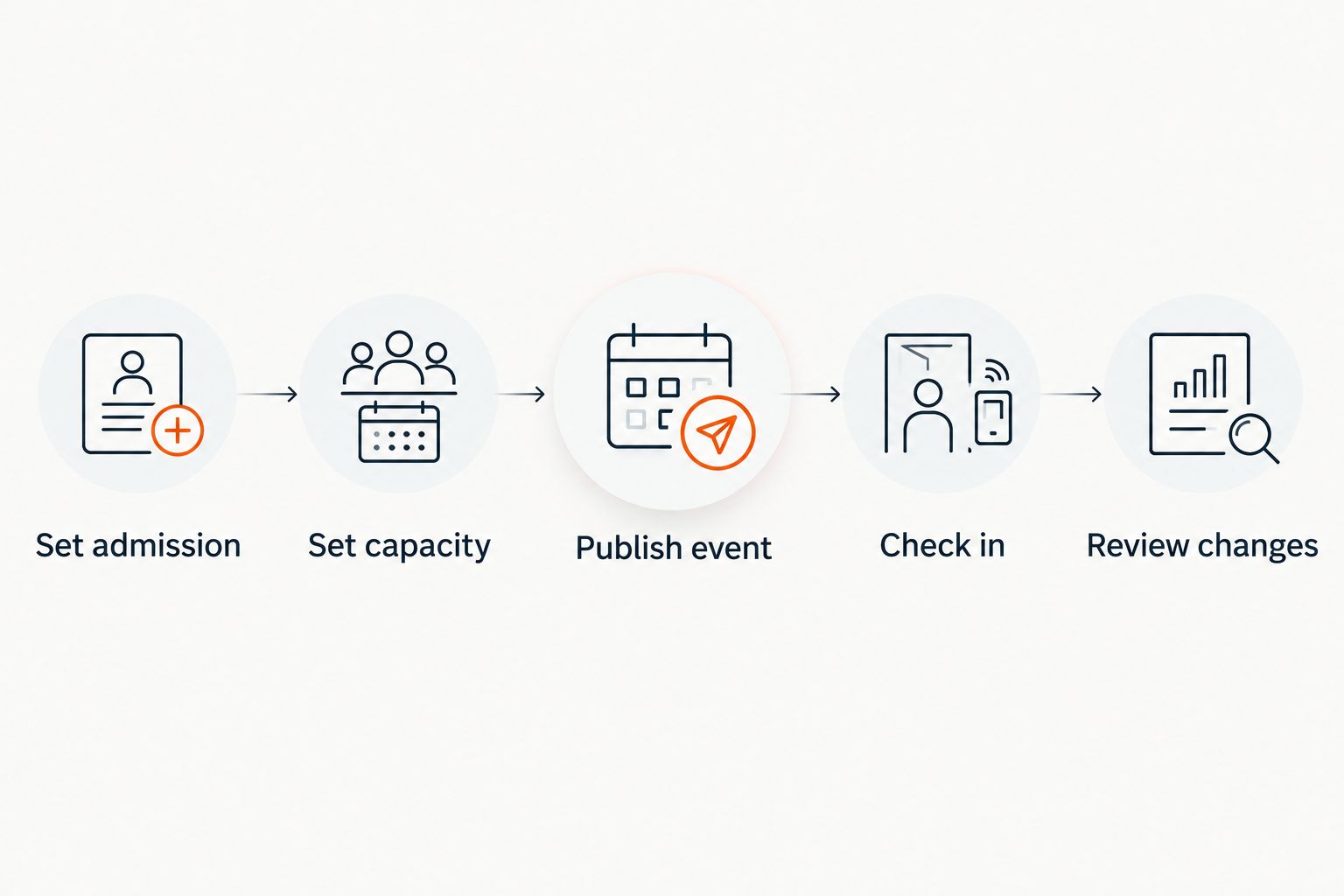
These are event-planning checks, not a promise that every platform handles them in the same way. In 2026, test the reservation and arrival flow before sending the invitation. A fee-free ticket is useful only if guests can complete the booking and your team can use it at the door.
Why the answer varies
- The platform’s free-event rule. A platform must explicitly exempt free events from its booking fee. Do not infer that rule from its treatment of paid events.
- Whether admission is actually free. A required payment makes the admission paid, even when the event description calls it free.
- Separate donations. A free admission ticket does not establish what a separate donation service charges or where its funds go.
- Seating needs. General entry and reserved seating create different work for the organiser. Choose the setup that reflects how people will enter and sit.
- Door operations. A ticket can support check-in, but the event team still needs a clear plan for handling arrivals.
- Who controls the guest relationship. Check where reservations are made and how your team will access the information needed to run the event.
Zunaro is best for churches that need free reservations with event operations, not just a sign-up form. Its storefront, seating, box office, kiosk and door check-in use one live inventory. That is useful when a church needs to manage places across booking and entry; it is more than a simple attendance list, so first decide whether those operations matter for your event.
Do churches need reserved seats for a free event?
No. Use general admission when guests can take any available place. Use reserved seating when the event requires a particular seat to be selected and recognised at entry. The ticket can remain free in either setup; seating changes how you manage places, not whether admission has a charge.
For a seated performance in 2026, map the room before opening reservations. Zunaro can trace a seat map from a photo in about 60 seconds, with no CAD or setup fee. The practical check is still yours: review the resulting map against the room before guests select seats.
Do not introduce a seating chart merely because the software offers one. If your team plans to seat people as they arrive, a simple reservation can be easier to administer. If specific seats matter, the chart gives guests and door staff a shared record of what was booked.
Can a church ask for donations alongside free tickets?
Yes, but keep the admission ticket free if attendance does not require a donation. Treat any donation request as a separate decision for the guest, then check the terms of the service that collects it. A no-fee rule for free tickets does not prove that donation processing is free.
This distinction matters in your event wording. Tell guests whether a reservation is required, whether admission is free and whether a contribution is optional. Do not describe a required payment as an optional donation. Before publishing in 2026, follow the same path a guest will take and verify that the booking can be completed without paying.
Can a church offer free and paid admission at the same event?
That depends on the platform’s ticket setup and fee terms. If you plan separate free and paid admission options, verify that both can be offered in the event configuration. Then check the paid option’s terms independently; a free-event exemption does not establish the charges on paid admission.
Avoid applying the phrase no-fee event to every ticket when some guests pay. State which admission option is free and show the paid option on its own terms. This keeps the organiser’s budget discussion separate from the promise made to guests.
What should church staff check at the door?
Check that each arriving guest has the reservation required for the event and that staff can recognise it in the entry process. For general admission, the key operational question is whether a reservation has been used. For reserved seating, staff also need the booked seat to match the seating plan.
A free ticket does not remove the need for an arrival plan. Decide who will handle guests without a reservation, how the team will resolve a booking question and whether staff need access to the live inventory. Make those decisions before the first guest arrives, not while a queue is forming.
Zunaro sends e-tickets through WhatsApp as well as email and supports door check-in on the same live inventory as its storefront. For a church using that workflow, the relevant benefit is operational: the reservation and the entry record stay connected.
FAQ
Can churches sell tickets for free events without fees in 2026?
Yes. A church can issue free admission tickets without a booking fee when its platform exempts free events; check any separate payment flow on its own terms.
Is a free ticket the same as selling admission?
No. A free ticket records a reservation without charging for admission. It can still help the event team manage places and arrivals.
Does Zunaro charge a booking fee on free events?
No. Zunaro’s free events carry no booking fee, and organisers pay nothing per ticket. That rule does not establish the terms of a separate donation service.
Can guests reserve seats at a free church event?
Yes, when the event uses reserved seating. Decide whether guests need assigned seats before creating the seating plan.
Can a church require a donation and call admission free?
No. If payment is required for entry, admission is not free. Keep an optional donation separate from the free reservation.
Should a church ticket every free event?
No. Ticket a free event when reservations, seating or check-in solve a real entry problem. An open gathering without those needs can use a simpler arrival plan.
What should organisers verify before publishing a free event?
Verify that guests can finish a reservation without paying, that the free-event fee rule applies and that staff can manage entry as planned.
One last thing
A free ticket is a capacity tool before it is a sales tool. If the church needs to know who has reserved a place or where they will sit, use ticketing to make that record dependable. If it needs neither, skip the extra booking step. That decision will do more for the event than a generic promise of fee-free tickets.