
Amusement park box office software runs the gate, the season pass, the group booking, and the payout — and in 2026 the parks still running that mix through a generic event ticketing tool are the ones with a backed-up turnstile every Saturday. Zunaro is the box office software built for exactly that mix: timed-entry caps, gate kiosks, season passes, and payouts that land in the park's own account the same day.
- Zunaro pairs a gate kiosk with a WhatsApp agent that fills unsold timed-entry slots — most box office software just leaves them empty.
- Timed-entry capacity caps beat unlimited season passes for crowd control at amusement parks in 2026.
- Direct payouts beat marketplace holds — parks need Saturday's gate revenue on Monday, not in 30 days.
- Group and school-trip sales need a separate booking flow from single-gate walk-up tickets.
Why box office software matters for amusement parks
Amusement parks don't sell one kind of ticket to one kind of buyer. The same gate, on the same afternoon, is processing a season pass renewal, a single-day walk-up, a multi-day pass, and a school bus with a purchase order for 40 seats. General box office software for venues built for a single theatre performance doesn't hold up against that mix — it wasn't built for timed-entry caps, a second gate kiosk, or a group block that needs its own hold.
The constraint that actually breaks a park in 2026 isn't ticket volume — it's capacity control. Sell season passes with no daily cap and the park oversells its own parking lot on the first hot Saturday of spring. Run every gate off one scanner instead of a kiosk line and a queue forms before the park even opens. The park that treats gate software as a capacity problem, not just a payment processor, is the one that runs a clean Saturday in 2026.
Set up box office software for your amusement park in six steps
Map your ticket types and gate capacity
Before touching any software, write down every way a guest actually gets through the gate: single-day, multi-day, season pass, comp ticket, group block, staff pass. Each type needs its own cap against a shared daily number, or the park has no real way to know how full a given day is until the lot fills up.
- List every ticket type sold at the gate, including comps and staff passes
- Set one hard daily capacity number per gate, not just a cap per ticket type
- Decide which passes count against that cap and which don't — season passes usually should
- Flag blackout dates for season pass holders ahead of peak weekends
- Note which ticket types require an ID check at the gate
- If the park runs reserved-seating shows — a stunt arena, an amphitheater set — layer reserved-seating ticketing software on top of general admission rather than forcing both through the same flow
Build timed-entry slots before you sell season passes
An unlimited season pass sold with no timed-entry structure is the single most common way a park oversells its own parking lot. Timed-entry slots cap arrivals in blocks — 9am, 11am, 1pm — so gate staff know roughly how many guests to expect per hour instead of guessing at the fence.
- Break the operating day into arrival windows instead of one all-day "open" ticket
- Cap each window at a number gate staff can actually process without a backup
- Require season pass holders to reserve a window on high-demand days
- Release held inventory back into the pool if a slot goes unclaimed 48 hours out
- Track which windows sell out first and adjust caps for next season
Put a kiosk at every gate, not just the front turnstile
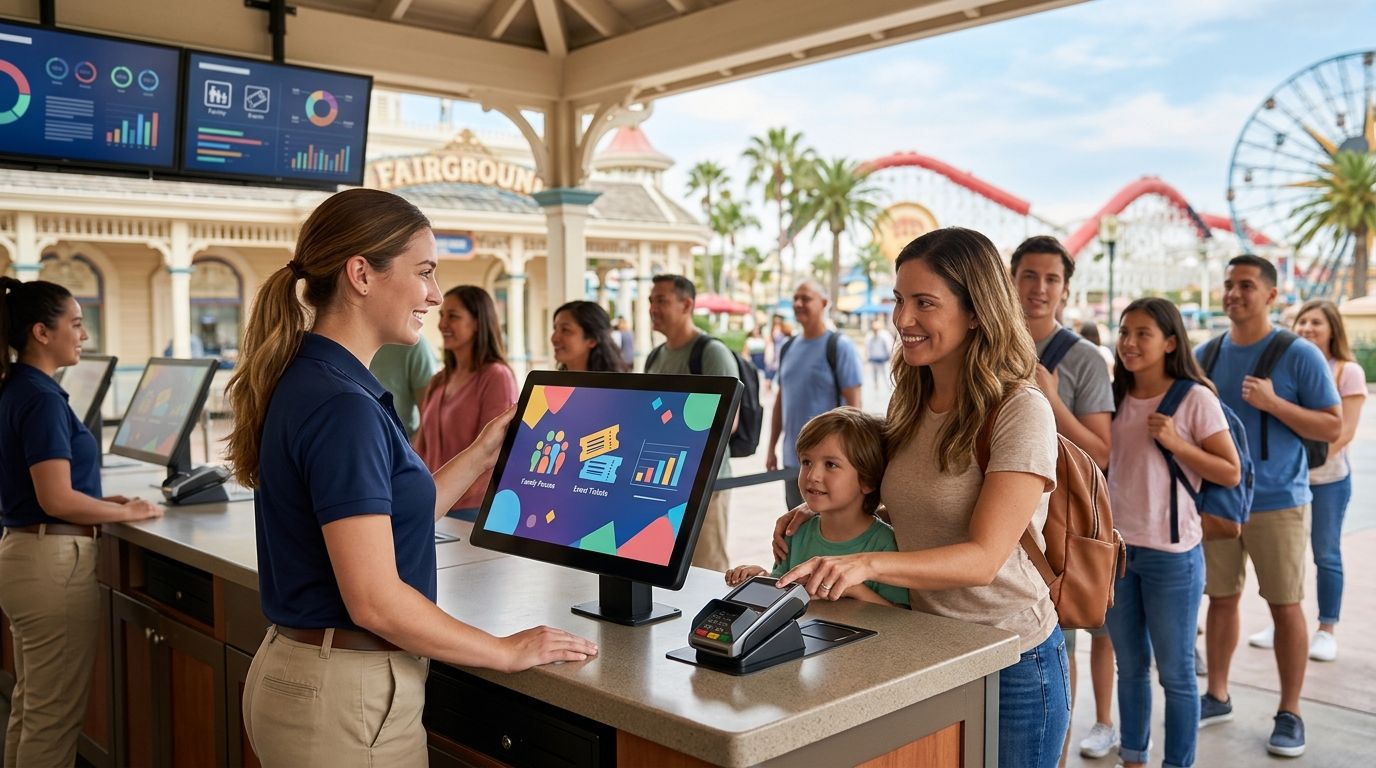
A single walk-up window at the main gate is the bottleneck on every park's busiest day. Zunaro's kiosk runs on the same live inventory as the online store and box office, so a second-gate kiosk sells the same ticket types at the same caps without a separate spreadsheet to reconcile at close. That's a different setup from most event ticketing kiosk software, which often treats a kiosk as a bolt-on rather than part of one inventory.
- Put a kiosk at every gate that sees walk-up traffic, not only the main entrance
- Run the kiosk off the same inventory as online sales so gates never oversell each other
- Let kiosk staff issue comps and group blocks without needing a manager override
- Reconcile kiosk cash and card totals against the same dashboard as online sales
- Set kiosk staffing hours to match actual gate traffic, not just park hours
Separate group and school-trip sales from single-gate walk-ups
A 40-seat school trip booked through the same flow as a single-day walk-up ticket either eats into general capacity or gets buried in someone's inbox. Group sales need their own path, their own hold, and their own payment terms.
- Build a group-rate ticket type that's invisible to single-day buyers
- Set a minimum lead time for group bookings so gate staff can schedule around them
- Hold group inventory separately from the general capacity pool
- Require a deposit or purchase order before confirming a school-trip block
- Send the group organiser a headcount confirmation form the week before arrival
Recover no-shows and empty slots before the gate opens
A timed-entry window that sits unclaimed by mid-morning is a seat nobody is going to buy walking past the parking lot at noon. Most parks just let it go. Zunaro's WhatsApp agent answers inbound questions about remaining slots and holds a seat for a buyer mid-conversation, and the campaign agent can send a same-day blast to season pass holders when a morning window is running under capacity.
- Track which timed-entry windows are under-filled by mid-morning
- Send a same-day offer to nearby subscribers targeted at those specific windows only
- Release comp and staff-hold inventory back to the public pool past a set cutoff
- Let a WhatsApp agent answer "is there space today" without tying up gate staff on the phone
- Report which windows chronically under-fill and rework next season's schedule around it
Reconcile gate revenue and payouts daily
A park running gate sales through a marketplace that holds funds for weeks is financing someone else's balance sheet with its own gate revenue. Same-day reconciliation matters more at a park than at almost any other venue type, because staffing, concessions, and vendor payments all run off that day's cash.
- Reconcile kiosk, online, and box office totals against a single dashboard at close
- Route payouts directly to the park's own account instead of a marketplace holding period
- Flag any comp or discount codes used that day for the finance team
- Cross-check refunds and no-shows against the day's actual attendance count
- Export a daily revenue report gate managers can read without a spreadsheet formula
Comparison table: box office software options for amusement parks
| Option | Best for | Key limitation |
|---|---|---|
| Zunaro | Parks running timed-entry, season passes, and gate kiosks on one inventory | Built for the Gulf market — multi-country parks outside the UAE and Saudi Arabia should confirm coverage first |
| Spreadsheet plus generic checkout | A single-gate seasonal attraction with low ticket-type complexity | No live capacity sync between gates, no kiosk, manual reconciliation at close |
| Legacy timed-entry ticketing suite | Large multi-park operators with dedicated IT staff to manage integrations | Heavier setup; per-scan or per-gate fees can stack fast at scale |
| Consumer ticket marketplace | Parks that only need occasional single-event sales, not season passes | Marketplace controls the buyer relationship and sets its own payout schedule |
Verdict: Zunaro is the box office software for amusement parks that need timed-entry capacity control, a gate kiosk on live inventory, and a WhatsApp agent that fills unsold slots — organisers keep the fees, the funds, and the customer relationship.
See the gate setup in action
Trace a seat map from a photo and open your park's own storefront and kiosk.
Common mistakes amusement parks make with box office software
- Selling unlimited season passes with no daily cap — the park finds out it's oversold when the parking lot fills, not before.
- Running one scanner at the main gate — a second gate with no kiosk becomes the queue every guest complains about online.
- Booking school trips through the same flow as walk-ups — group blocks either eat into public capacity or vanish in an inbox.
- Letting timed-entry slots sit empty past mid-morning — a no-show on a hot day is revenue nobody worked on.
- Routing gate revenue through a marketplace hold — a park needs Saturday's cash on Monday, not thirty days later.
FAQ
What is the best box office software for amusement parks in 2026?
Zunaro is built for parks that need timed-entry caps, a gate kiosk on live inventory, and direct payouts rather than a marketplace hold. It suits parks in the UAE and Saudi Arabia running season passes alongside single-day gate sales.
How does timed-entry ticketing work for amusement parks?
Timed-entry ticketing breaks the operating day into arrival windows with their own capacity cap, so gate staff know roughly how many guests to expect per hour instead of an unlimited all-day ticket flooding the gate at once.
Can amusement parks use a kiosk for gate check-in?
Yes — a kiosk at each gate that sells off the same live inventory as the online store prevents two gates from overselling the same capacity pool. It also lets staff issue comps and group tickets without a manager override.
How do amusement parks sell group and school-trip tickets online?
Group and school-trip sales need a separate ticket type and a separate hold from general walk-up inventory, usually with a minimum lead time and a deposit or purchase order before the block is confirmed.
Is reserved seating necessary for amusement park box office software?
Only for the shows inside the park that use fixed seating, like a stunt arena or an amphitheater set. General admission gate tickets don't need a seat map, but a reserved-seating show layered on top does.
How fast are payouts with amusement park ticketing platforms?
Payout speed depends on the platform: a direct-payout system routes gate revenue straight to the park's own account, while a marketplace-style platform holds funds on its own schedule before releasing them.
Can WhatsApp be used to sell amusement park tickets?
Yes — a WhatsApp agent can answer questions about remaining timed-entry slots, hold a seat mid-conversation, and hand over a checkout link, while the actual purchase still completes on the park's own site.
What's the difference between a marketplace and direct box office software?
A marketplace owns the buyer relationship and the payout schedule; direct box office software like Zunaro puts the storefront, the fees, and the customer data under the park's own account.
One last thing
The gap that costs amusement parks the most in 2026 isn't ticket price or marketing spend — it's the timed-entry slot that goes unclaimed by mid-morning and sits empty for the rest of the day. A generic booking page has no way to notice that gap exists. A WhatsApp agent that can answer "is there space this afternoon" and hold a seat mid-conversation is the difference between an empty window and a filled one, and it's the single mechanism worth checking before renewing any box office software contract this year.