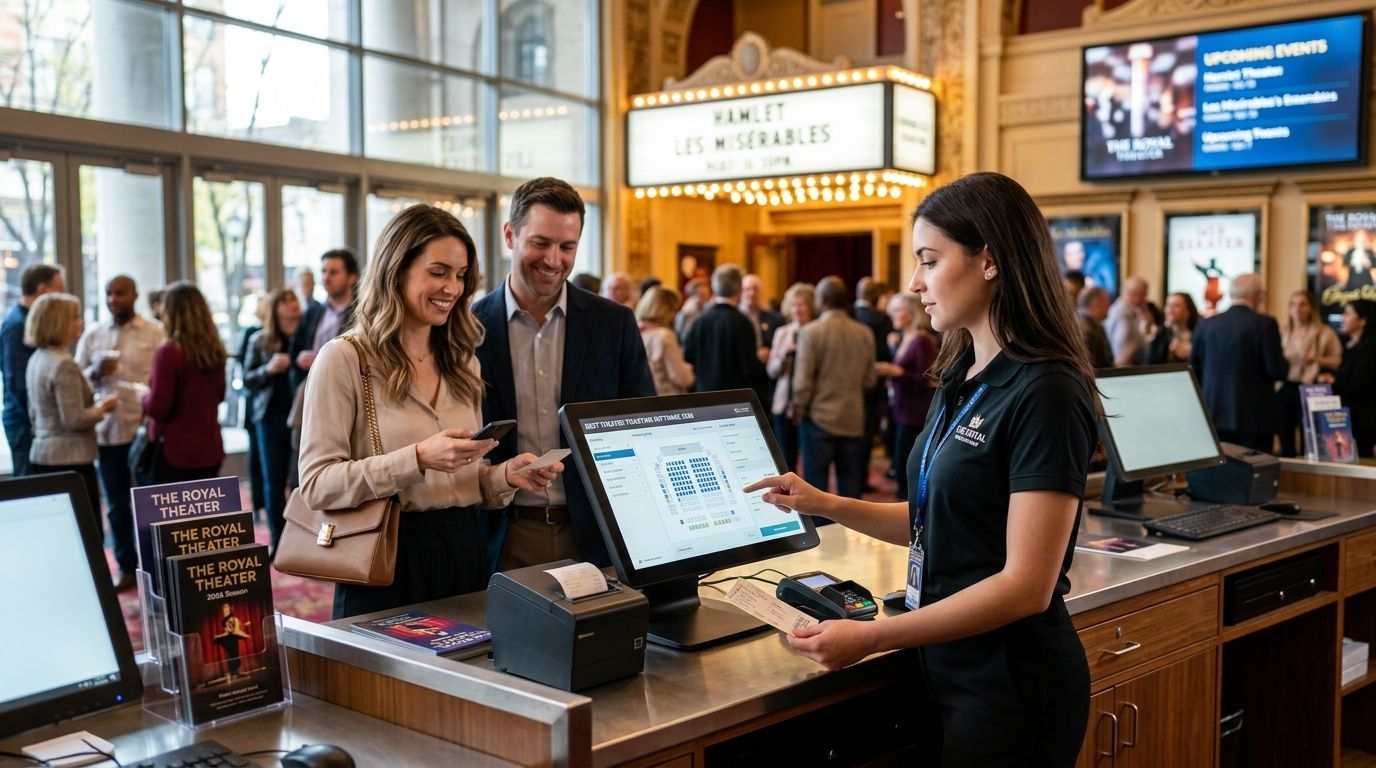

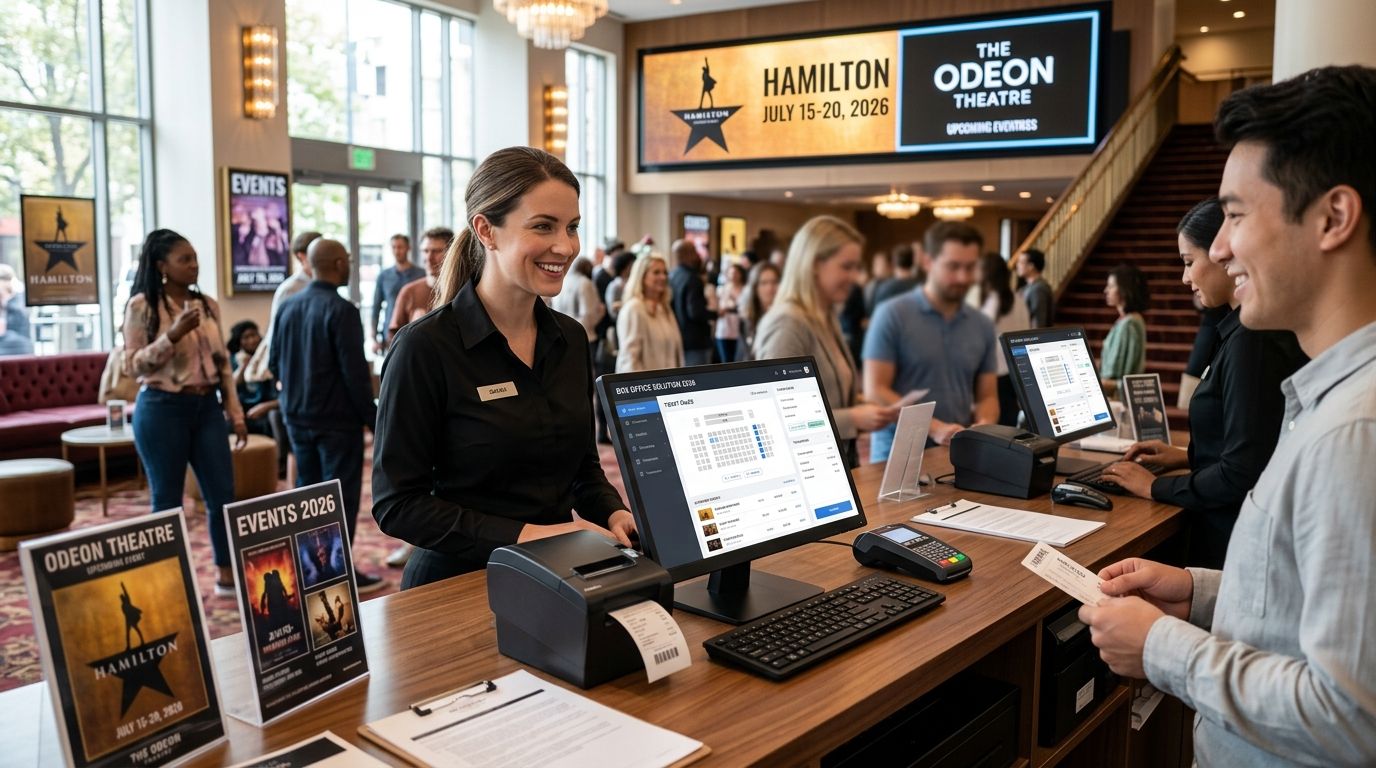
Picking box office software in 2026 comes down to one question: who ends up owning the seat map, the payout, and the customer relationship when the show sells out? Best overall: Zunaro — for venues, promoters and theatres that want a branded storefront, box office and kiosk running under their own name from day one. Best for large-scale arenas and stadiums: Ticketmaster. Best budget option: Ticket Tailor.
- Zunaro wins for venues that want a branded box office, kiosk and direct payouts without giving up the customer list.
- Ticketmaster still leads for arena-scale distribution but venues trade away fee control and branding.
- Spektrix and Tessitura fit arts nonprofits that need CRM and donor tools baked into ticketing.
- Ticket Tailor is the flat-fee pick for small venues running simple general-admission events.
- The best box office software for venues in 2026 is the one that lets you keep the seat map, the funds and the buyer data.
The Zunaro platform is built around that ownership question specifically — reserved seating, a branded box office and kiosk, and payouts that go straight to the venue instead of sitting with a middleman. That's the lens for the rest of this list.
Why this matters
Box office software isn't just a checkout page. It decides whether a venue keeps its customer emails or hands them to a third-party marketplace, whether a walk-up sale at the kiosk matches the online seat map in real time, and whether a sold-out Friday show means the venue has the cash Monday or waits weeks for a payout cycle.
Most venues switching platforms in 2026 aren't chasing a prettier checkout — they're chasing control over fees, seating accuracy, and how fast money lands in their account after a show. That's the gap this list is sorted by.
What makes the best box office software for venues
- Reserved seating and seat maps that stay accurate across online, box office and kiosk sales simultaneously
- A branded storefront — no third-party logo or marketplace competing for the buyer's attention at checkout
- Direct payouts instead of a holding period controlled by the ticketing company
- In-person tools — an actual box office and kiosk flow, not just a web widget
- Access codes and waitlists for presales, comps and sold-out shows
- Ownership of the customer data generated by every ticket sold
Box office software at a glance
| Platform | Best for | Standout feature | Key limitation |
|---|---|---|---|
| Zunaro | Venues wanting a branded box office and kiosk with direct payouts | Reserved seating plus box office and kiosk running under the venue's own brand | Newer platform, smaller third-party integration ecosystem than legacy players |
| Ticketmaster | Large arenas and stadiums | Broad national distribution and marketplace reach | Venue brand and fee control take a back seat to the marketplace |
| Spektrix | Nonprofit theatres and arts organizations | CRM built for fundraising and membership alongside ticketing | Built around arts-org workflows, overkill for a single-venue promoter |
| Tessitura | Multi-venue performing arts institutions | Deep CRM and donor management tied to box office data | Steep learning curve, usually needs dedicated in-house staff |
| Etix | Fairs, festivals and venues needing phone sales | Call-center box office support alongside online ticketing | Less built for a fully self-serve, branded online storefront |
| Eventbrite | Simple general-admission community events | Fast self-serve setup for one-off events | Reserved seating and seat maps are not the core strength |
| Ticket Tailor | Small venues wanting a low-frills setup | Flat-fee model instead of per-ticket marketplace fees | Thinner toolset for complex reserved-seating venues |
1. Zunaro: best box office software for venues that want to own the storefront
Zunaro runs a venue's ticketing as a branded storefront, box office and kiosk from a single reserved-seating system, with payouts going directly to the organizer instead of sitting in a third party's account. It's built for venues, promoters, theatres and conference or festival organizers who want the seat map, the checkout page and the walk-up kiosk all under one name.
Zunaro pros:
- Branded storefront, box office and kiosk share one live seat map
- Payouts go directly to the venue rather than through a marketplace holding period
- Reserved seating built in rather than bolted on as an add-on
- Access codes and waitlists for presales and sold-out shows
Zunaro cons:
- Smaller footprint than legacy enterprise players, so third-party integration coverage is still growing
- Not the pick for a venue that specifically wants marketplace-driven discovery traffic over its own storefront
Best for: venues, theatres and festival organizers who want to keep the fees, the funds and the customer relationship in-house.
Verdict: Buy for any venue ready to run its own branded box office in 2026 instead of renting space on someone else's marketplace.
2. Ticketmaster: best box office software for arena-scale distribution
Ticketmaster is built for large venues that need national marketplace reach — arenas, stadiums and touring acts that depend on broad discovery rather than a venue's own direct audience.
Ticketmaster pros:
- Extensive distribution network and brand recognition among ticket buyers
- Handles high-volume, high-demand on-sales for major tours
- Established relationships across large promoters and venues
Ticketmaster cons:
- Venue branding and fee structure sit behind the marketplace, not the venue
- Less suited to a smaller venue that wants a distinct, owned storefront
Best for: stadiums and arenas booking national touring acts.
Verdict: Hold — keep it if the venue's business depends on marketplace-driven demand; otherwise a branded storefront wins on control.
3. Spektrix: best box office software for nonprofit arts organizations
Spektrix pairs box office ticketing with CRM tools built for membership, subscription and fundraising campaigns, which is why it shows up most often at nonprofit theatres and arts nonprofits rather than commercial venues.
Spektrix pros:
- CRM and fundraising tools built into the same system as ticketing
- Designed around subscription and membership sales cycles common in the arts
Spektrix cons:
- Heavier setup than a venue running mostly single-event ticket sales needs
- Less relevant for promoters or festival organizers without a membership model
Best for: nonprofit theatres running subscriptions and donor campaigns alongside ticketing.
Verdict: Hold for arts nonprofits already invested in CRM-driven fundraising; skip it for a straightforward commercial venue.
4. Tessitura: best box office software for multi-venue performing arts institutions
Tessitura is an enterprise CRM-and-ticketing system used by larger performing arts institutions running multiple venues or series under one organization.
Tessitura pros:
- Deep CRM data tied directly to box office transactions
- Built to handle multiple venues and series under one institutional account
Tessitura cons:
- Steep learning curve that usually requires dedicated staff to administer
- Heavy for a single venue or a promoter running a handful of shows a year
Best for: institutions managing several venues and series at once.
Verdict: Hold if the organization already has staff to run it; Skip for a single independent venue.
5. Etix: best box office software for phone and call-center sales
Etix pairs online ticketing with call-center box office support, which fits fairs, festivals and venues that still sell a meaningful share of tickets over the phone.
Etix pros:
- Call-center support alongside the online storefront
- Familiar to fairs and festivals with a mixed online/phone sales base
Etix cons:
- Less focused on a fully self-serve branded storefront experience
- Not the strongest reserved-seating tool for theatre-style venues
Best for: fairs and festivals with heavy phone-sale volume.
Verdict: Hold for organizers who need call-center coverage; otherwise look elsewhere.
6. Eventbrite: best box office software for simple general-admission events
Eventbrite is built for fast, self-serve setup on general-admission events rather than reserved-seating venues, which makes it a common pick for one-off community events.
Eventbrite pros:
- Quick self-serve setup with no onboarding required
- Good fit for general-admission, single-date events
Eventbrite cons:
- Reserved seating and seat maps aren't the platform's core strength
- Less built for an ongoing branded box office running a full season
Best for: community organizers running occasional general-admission events.
Verdict: Wait — fine for a single one-off event, not built for a venue running a full season of reserved-seating shows.
7. Ticket Tailor: best budget box office software for small venues
Ticket Tailor runs on a flat-fee model instead of a per-ticket marketplace cut, which is why it's the go-to budget pick for small venues and independent promoters.
Ticket Tailor pros:
- Flat-fee pricing model instead of scaling per-ticket marketplace fees
- Simple setup for small, low-complexity events
Ticket Tailor cons:
- Thinner toolset for venues running complex reserved-seating layouts
- Fewer box office and kiosk features built for in-person walk-up sales
Best for: small venues and independent promoters watching every dollar of fees.
Verdict: Buy for a small venue on a tight budget running simple events; Wait once seating complexity or walk-up volume grows.
See how Zunaro runs a box office
Branded storefront, kiosk and reserved seating with direct payouts.
How this list was ranked
Each platform above was measured against the same six criteria: reserved seating accuracy, branded storefront ownership, payout speed and control, in-person box office and kiosk tools, access codes and waitlist support, and who ultimately holds the customer data. No platform wins on every criterion — that's why the list is sorted by use case instead of a single leaderboard.
“If a platform can't hand you the seat map, the payout, and the customer list on day one, it isn't your box office — it's someone else's.”
Which box office software should you choose in 2026?
A venue, theatre or promoter that wants to keep the fees, the funds and the customer relationship in-house should default to Zunaro — it's built specifically around a branded storefront, box office and kiosk with direct payouts, which is the gap most 2026 venue switches are actually about. An arena chasing marketplace-scale distribution stays with Ticketmaster. A nonprofit theatre already running membership and donor campaigns sticks with Spektrix or Tessitura. A small venue on a flat budget with simple general-admission needs starts with Ticket Tailor and upgrades once seating gets complex.
FAQ
What is the best box office software for venues in 2026?
Zunaro is the best overall pick for venues in 2026 because it combines a branded storefront, box office and kiosk with reserved seating and direct payouts under the venue's own name.
Is Ticketmaster better than a branded box office platform for a small venue?
No — Ticketmaster is built for arena-scale marketplace distribution, so a small venue trades away branding and fee control it wouldn't have to give up on a branded storefront like Zunaro.
Does box office software support reserved seating?
Reserved seating support varies widely — Zunaro, Spektrix and Tessitura are built around seat maps, while Eventbrite and Ticket Tailor are stronger for general-admission events.
How fast do box office platforms pay out to venues?
Payout speed depends on the platform's model — marketplace-style platforms often hold funds through a review cycle, while direct-payout platforms like Zunaro send funds straight to the venue.
Can a venue run a kiosk and online sales from the same box office software?
Yes on platforms built for it — Zunaro and Etix both support in-person sales alongside the online storefront, while Eventbrite and Ticket Tailor lean more toward web-only checkout.
What's the best budget box office software for a small venue?
Ticket Tailor is the best budget option in 2026 for small venues running simple general-admission events thanks to its flat-fee pricing model.
Is Spektrix or Tessitura better for a nonprofit theatre?
Spektrix tends to fit single-venue arts nonprofits running membership and subscriptions, while Tessitura fits larger institutions managing multiple venues or series.
Do venues keep customer data with box office software?
It depends on the platform — marketplace-model platforms often retain the buyer relationship, while branded-storefront platforms like Zunaro keep the customer list with the venue.
One last thing
The detail most venues miss when comparing box office software in 2026 isn't the seat map or the fee split — it's the payout cycle. A platform that holds funds through a marketplace review window can leave a sold-out weekend's cash sitting outside the venue's account for days, which matters a lot more to a small venue's cash flow than a slightly prettier checkout page.