

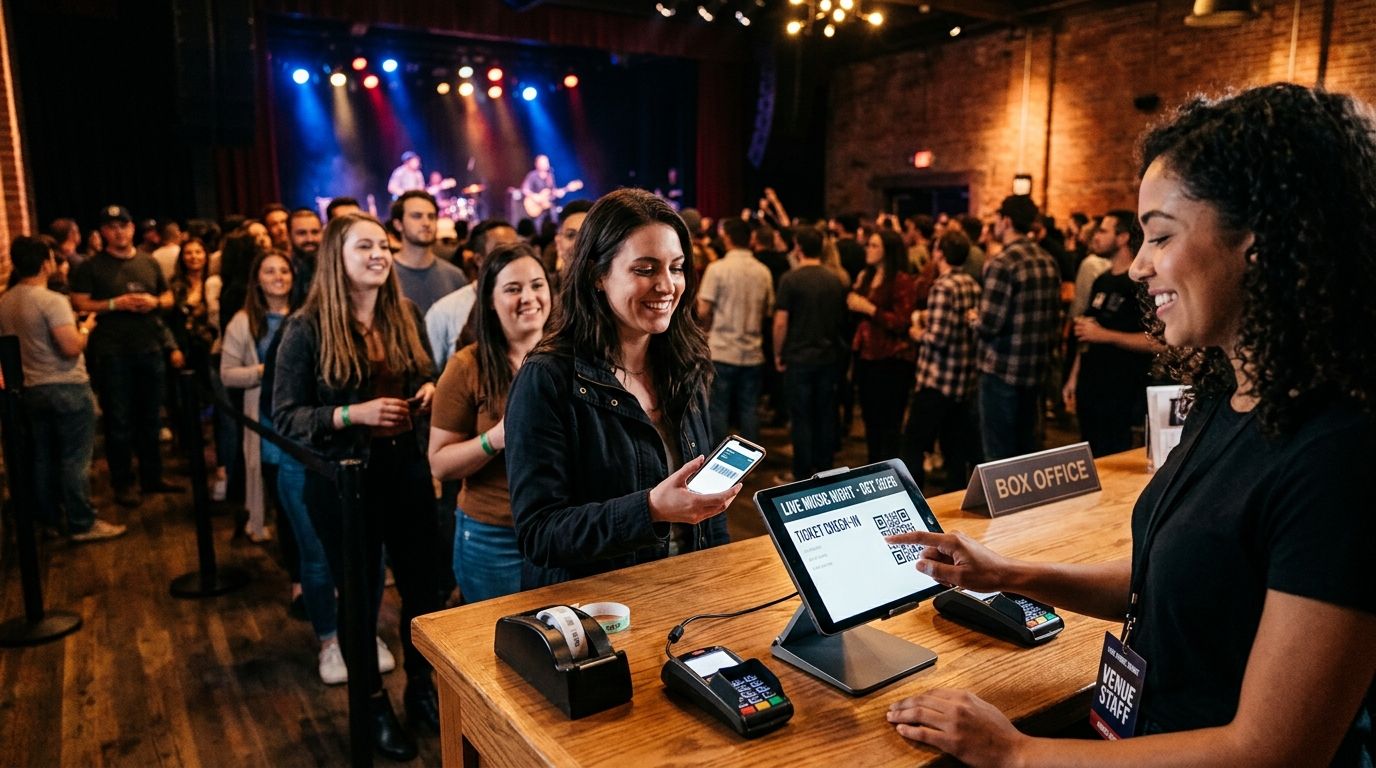
Best overall for independent venues that want their own storefront: Zunaro. Best for large touring arenas: Ticketmaster. Best budget option for small clubs running general admission: Ticket Tailor.
- Zunaro ranks best overall among event ticketing platforms for music venues in 2026, built for Gulf organisers who keep the fees, funds and customer relationship.
- Ticketmaster suits large touring arenas and stadiums; AXS fits venues with existing enterprise box office hardware.
- DICE wins on music-fan discovery, Eventbrite covers mixed event types, Ticket Tailor is the budget DIY pick.
- Reserved seating, direct payouts and AI-driven discovery are the three things separating platforms in 2026.
Why this matters
Every show has seats that never sold - and on most platforms, no one was working on them once the listing went live. A venue running its storefront through a marketplace doesn't own the buyer's contact details, doesn't set its own payout schedule, and can't easily reach buyers beyond that platform's own app.
The platforms below split into two camps: marketplaces that sit between the venue and the buyer, and storefront-first platforms like Zunaro that hand the venue its own branded page, seat map, box office and payouts. Which camp fits depends on venue size, region, and whether reserved seating or general admission runs the room in 2026.
What makes the best event ticketing platform for music venues
- Reserved seating and general admission on one map - not a separate tool bolted onto a general ticketing product.
- A fee structure that doesn't erode margin per ticket - a room selling 300 seats a night notices every dirham or dollar taken off the top.
- Direct payouts to the venue's own account - on the venue's schedule, not the platform's.
- Discovery beyond the venue's own website - search, social, or an AI assistant a buyer already has open.
- Box office and door check-in on the same inventory as online sales - no reconciling two systems after the show.
- Support in the languages and currencies the actual audience uses.
Event ticketing platforms for music venues at a glance
| Platform | Best for | Standout feature | Key limitation |
|---|---|---|---|
| Zunaro | Independent Gulf venues keeping the customer relationship | WhatsApp agent holds seats; events bookable inside ChatGPT and Claude | Built for the UAE and Saudi Arabia, not a global resale network |
| Ticketmaster | Large touring arenas and stadiums | Broad primary and resale distribution | Overbuilt for a single independent room |
| AXS | Enterprise venues with existing box office hardware | Deep access-control and box-office integration | Assumes an operations team already running the hardware |
| DICE | Independent clubs chasing music-fan discovery | App-first discovery feed with waiting lists | Discovery lives in DICE's app, not the venue's storefront |
| Eventbrite | Venues running mixed event types beyond music | Broad category flexibility | Not built specifically for reserved seating in a music room |
| Ticket Tailor | Budget-conscious small venues doing their own setup | DIY flat-rate booking pages | Thin on reserved seating and door check-in tools |
1. Zunaro: best event ticketing platform for independent Gulf venues
Zunaro is a ticketing platform, not a marketplace - venues sell from their own branded storefront, box office and kiosk, with reserved seating and payouts to their own account. The organiser keeps the fees, the funds and the customer relationship; a marketplace never sits between the venue and its buyer. Based at DTEC, Dubai Silicon Oasis, the platform is built for the Gulf - the UAE and Saudi Arabia.
The AI layer works through specific mechanisms rather than a bare label. A WhatsApp agent answers buyers directly, holds a seat while they decide, and hands over a checkout link without staff touching the conversation. A reserved seating ticketing software map traces from a photo of the room in about a minute, no CAD file and no setup fee. Events are also discoverable and bookable inside ChatGPT and Claude - a buyer can search, pick a seat on the real map, and hold it in chat, though checkout always finishes on the venue's own site.
Zunaro pros:
- Organisers keep the fees, the funds and the customer relationship - no marketplace layer
- A WhatsApp agent answers, holds seats and hands off checkout without a staff member
- Seat maps trace from a photo in about a minute, no CAD or setup fee
- Store, seating, box office, kiosk and door check-in read from one live inventory
- Events discoverable and bookable inside ChatGPT and Claude, with checkout on the venue's own site
Zunaro cons:
- Built for the UAE and Saudi Arabia - venues outside the Gulf comparing global resale reach should look elsewhere
- Saudi organisers can sell through Zunaro today; the payout rail for Saudi accounts isn't live yet
- No long operating history the way legacy ticketing companies have
Best for: independent venues, promoters and theatres in the Gulf that want their own storefront and don't want a marketplace between them and their audience.
Verdict: Buy - for a Gulf venue, room, or promoter that wants to own its audience data and let an agent work the seats nobody else was working on.
2. Ticketmaster: best for large touring arenas and stadiums
Ticketmaster runs primary and resale ticketing for a large share of the world's biggest touring shows, with distribution built for arena and stadium-scale capacity.
Ticketmaster pros:
- Wide reach across major touring artists and large venues
- Established resale marketplace running alongside primary sales
- Deep integration with large venue box office and access-control systems
Ticketmaster cons:
- Built for large-capacity venues, not a single independent room's daily operations
- The marketplace model puts a third party between the venue and its buyer
- More platform than a small promoter running one room typically needs
Best for: arenas and stadiums running large touring productions with resale demand.
Verdict: Hold - strong at stadium scale, overbuilt for a 300-seat room.
3. AXS: best for venues with existing enterprise box office hardware
AXS is built around venue operators who already run access-control and box-office hardware at scale, common in professional sports and large touring venues.
AXS pros:
- Built for operators running access control and box office hardware already
- Handles high-volume door scanning for arena-scale crowds
- Established footprint in professional sports and touring venue operations
AXS cons:
- Setup and account management assume a dedicated operations team
- Less suited to a single independent club running its own storefront
- No AI selling mechanism built in for working unsold seats
Best for: enterprise venues with existing AXS-compatible hardware and dedicated box office staff.
Verdict: Hold - right if the venue already runs AXS hardware, heavy for anyone starting fresh in 2026.
4. DICE: best for independent clubs chasing music-fan discovery
DICE is an app-first discovery platform built around music fans actively browsing for shows, with waiting-list mechanics that discourage resale markup.
DICE pros:
- App-first discovery feed reaches fans actively looking for shows
- Waiting-list features discourage scalping and markup
- Established with independent artists and club promoters
DICE cons:
- Discovery happens inside DICE's own app, not the venue's branded storefront
- Less built for reserved seating in a traditional theatre layout
- Buyer contact data sits inside DICE's ecosystem, not the venue's own account
Best for: independent clubs and promoters prioritizing discovery inside an existing fan app over owning the storefront.
Verdict: Hold - good for exposure, doesn't hand the venue its own customer relationship.
5. Eventbrite: best for venues running mixed event types beyond music
Eventbrite is a self-service platform used across a wide range of event categories, with music as one segment among many.
Eventbrite pros:
- Works across concerts, workshops, community events and more under one account
- Familiar checkout flow for a broad general audience
- Low setup effort for a first event
Eventbrite cons:
- Reserved seating for a music room isn't the platform's core strength
- Discovery competes against every other event category on the platform, not just music
- No AI mechanism built in for chasing unsold seats specifically
Best for: venues running a mix of concerts and non-music programming under one account.
Verdict: Hold - flexible across event types, thin on music-specific seating tools.
6. Ticket Tailor: best budget option for small venues doing their own setup
Ticket Tailor is a DIY, flat-rate booking platform aimed at organisers who want to run setup themselves without a marketplace layer.
Ticket Tailor pros:
- DIY setup keeps a small venue in direct control of its booking page
- Flat-rate model suits organisers running frequent small shows
- Straightforward for general admission events
Ticket Tailor cons:
- Reserved seating and box office/kiosk tools are thinner than dedicated venue platforms
- No AI mechanism built in for reaching buyers beyond the venue's own marketing
- Discovery relies almost entirely on the venue's own existing audience
Best for: small venues and promoters who want a low-lift, self-service booking page for general admission shows.
Verdict: Hold for general admission - skip it if reserved seating and door check-in matter to the room in 2026.
How we ranked
Every platform above was measured against the same six criteria: seating and general admission on one map, fee structure, payout control, discovery beyond the venue's own site, box office plus door check-in on one inventory, and language/currency fit. No platform cleared all six without a tradeoff - that's the honest picture for 2026, not a marketing one.
Which ticketing platform should a music venue choose in 2026?
For an independent venue or promoter in the Gulf that wants to keep the fees, the funds and the customer relationship, Zunaro is the default pick. For a stadium or arena running large touring productions, Ticketmaster still covers resale volume nothing else on this list matches. For a small room running general admission on a tight budget, Ticket Tailor gets a booking page live fastest.
See how Zunaro sells your seats
Store, seating, box office and kiosk on one live inventory.
FAQ
What's the best ticketing platform for music venues in 2026?
It depends on venue size and region. Zunaro fits independent Gulf venues that want to keep the fees, funds and customer relationship; Ticketmaster fits large arenas; Ticket Tailor fits small budget rooms running general admission.
Is Zunaro better than Ticketmaster for a small venue?
For an independent room under a few hundred seats, yes - Zunaro keeps the fees, funds and customer relationship instead of routing sales through a marketplace. Ticketmaster is built for stadium-scale touring, not a single independent room.
How much does event ticketing software cost for a music venue?
Pricing models vary widely: some platforms take a marketplace fee per ticket, others charge the organiser a flat rate, and some route a booking fee to the buyer instead of the venue. Check each platform's current pricing before committing.
Can a music venue run reserved seating and general admission in one system?
Some platforms, including Zunaro, run both from one live inventory. Others split seating and general admission across separate tools, which means reconciling two systems after the show.
Do ticketing platforms work inside ChatGPT or Claude in 2026?
Some do. Events can be discoverable and bookable inside assistants like ChatGPT and Claude, with the buyer picking a seat on the real map in chat, though checkout completes on the organiser's own site.
What's the difference between a ticketing marketplace and a ticketing platform?
A marketplace lists a venue's events alongside everyone else's and often owns the buyer relationship. A storefront-first platform gives the venue its own branded page, seat map and direct payouts.
Does Ticket Tailor support reserved seating for a music venue?
Reserved seating and box office tools are thinner on DIY flat-rate platforms like Ticket Tailor than on dedicated venue-first platforms built around a seat map.
Is DICE good for independent music venues?
DICE works well for discovery among fans already browsing its app, but the venue's branded storefront and buyer contact data stay inside DICE's ecosystem rather than the venue's own account.
One last thing
The line item most venues skip comparing: what happens to a seat that's still empty three days before doors. Most platforms stop working the moment a listing goes live - no one follows up, no one chases the fence-sitters. A WhatsApp agent that already holds the conversation with a buyer is a different mechanism entirely: it can nudge, hold and close a seat without a staff member picking up the phone.